
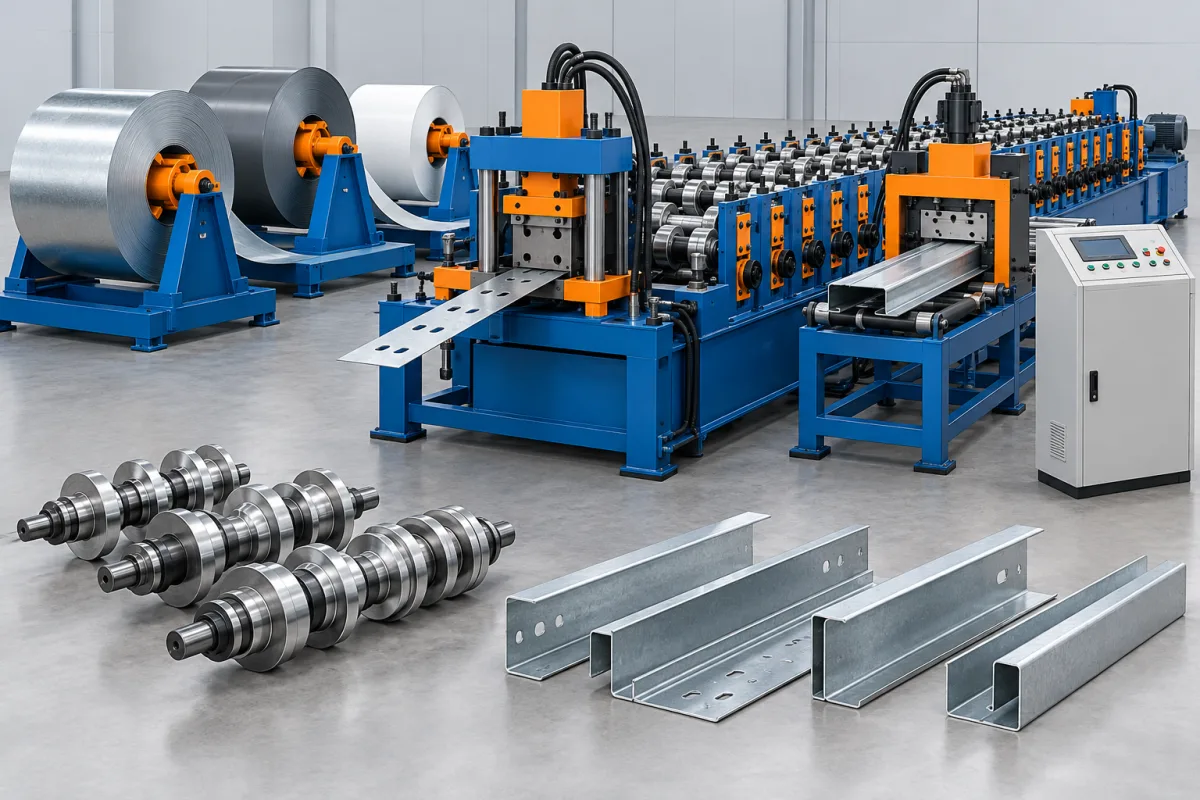
Purlin roll forming equipment cost depends on the sections, material envelope, connection features and changeovers included in the project. A basic channel former and a line producing identified, punched building members are not equivalent purchases. The cost comparison should begin with the complete member catalog and end at accepted bundles.
Define the component package being priced
List the required C, Z and other sections with their web, flange, lip, length and feature drawings. Pair them with material combinations. Independent maximum dimensions can create misleading quotations because not every maximum necessarily occurs in the same member.
State whether the line delivers finished purlins or profiles awaiting punching, marking or another operation. Those additional steps consume equipment, labor and floor space even if they are excluded from the principal machine's price.
Changeover automation has a workload-dependent value
Identify which movements are automated and what remains manual. C-to-Z conversion, size adjustment, material setup, punch positions and cutting components can have different transition requirements. Compare the complete recovery of an accepted member.
A stable long-run catalog may use flexibility less often than a shop making many small building packages. Price the extra automation against measured or demonstrated transitions in your schedule rather than assuming every reduction in tool movement becomes a proportional production gain.
Punching scope can materially change the package
Provide representative hole, slot and notch patterns with their final-member datums. Ask which operations are included, which need extra tooling and which remain offline. Feature reach and orientation matter as well as nominal hole size.
Include punch tooling, scrap handling, inspection and replacement references in the comparison. An offer with limited feature capability can appear inexpensive until the missing work is costed in a separate fabrication station.
Cutting and handling need the actual member range
Review short and long parts, section-specific cutting components and end-condition requirements. A machine-only quote may omit the supports or stacking needed to preserve straightness and remove finished members efficiently.
Consider order identification with the handling package. A building order can contain similar sections with different holes. Marking and bundle control help prevent a correct component from becoming unusable through an identification error.
Normalize installation and support responsibilities
Separate transport, site preparation, utilities, installation, training and trial material. Identify who supplies each item and how acceptance is conducted. A quotation gap is a project cost or risk to resolve, not evidence of a cheaper equivalent solution.
- Approved member and material combinations.
- Forming, punch and cutoff tools.
- Required change parts and setup references.
- Coil loading, discharge and bundle handling.
- Order-data and identification functions where included.
- Commissioning, inspection, training and spare-part documentation.
Calculate the value of faster complete changes
Assume a hypothetical schedule with 12 meaningful changes each week. If a proposed arrangement saves 18 minutes per complete transition, it releases 216 minutes, or 3.6 hours, weekly. Across an assumed 45 production weeks, that is 162 hours. These inputs illustrate the method and are not equipment claims.
Determine what those hours are worth in your operation. They may reduce overtime, free capacity or have little financial value if demand is limited. Do not automatically multiply them by a theoretical maximum output and treat the result as guaranteed additional sales.
Use a transparent automation payback example
Suppose the extra automation costs 40,000 budget units and the demonstrated annual benefit is 10,000 units after additional maintenance and operating expenses. Simple recovery is four years before financing and tax effects. If the realistic benefit is only 5,000 units, recovery becomes eight years.
The useful lesson is sensitivity to utilization and complete savings, not the assumed numbers. Use actual quotations and measured transition data. Keep reduced scrap, labor and additional contribution separate so the same improvement is not counted twice.
Compare cost per accepted member family
One average cost per metre can hide a dense hole pattern or frequent short parts. Group members by meaningful work content and track material, feature operations, setup and accepted yield. This gives a clearer basis for pricing customer orders and evaluating equipment.
For example, two equal-length purlins may occupy different production time if one has many connection features and the other is plain. Their material cost may be similar while conversion cost differs. A line comparison should preserve that distinction.
Budget for quality and data errors explicitly
Separate the cost of a reusable offcut from the cost of a fully punched but incorrectly identified member. The latter may contain more processing work and create downstream sorting or site delay. Assigning every reject only a scrap-metal value understates that difference. Use the actual disposition and recovery route when building a quality-loss allowance, and avoid assuming all nonconforming components can be repurposed without engineering review.
Rejected geometry, misplaced holes and incorrect part marks have different consequences. Record them separately in operating studies. A high gross throughput is not valuable when members require rework or cannot be assigned confidently to the building package.
Include representative data and marking checks in acceptance where those functions are supplied. Automation does not make an incorrect drawing revision or unit convention harmless. The project should define how approved order information is verified before production.
Frequently asked purlin cost questions
Why can two CZ quotations differ so much?
They may cover different materials, size combinations, punching, changeovers and handling. Normalize the complete member catalog and inclusion schedule before comparing price.
Is the largest capacity envelope always worth buying?
Only if it serves credible demand or a justified future requirement. Additional capability can add cost without improving the current order mix. Document the commercial reason for each boundary product.
Should offline punching be ignored when comparing formers?
No. If it is required to finish the member, its equipment, labor, handling and inspection belong in the complete route. A cheaper former may shift cost downstream.
What is the best evidence for an automation premium?
A timed transition and representative production basket demonstrating accepted members, with the same inspection boundary as the alternative. Use that evidence in a transparent cost model rather than relying on a generic speed claim.
Continue your research
- Purlin Roll Forming Machines
- C Purlin Roll Forming Machine
- Z Purlin Roll Forming Machine
- 80-300mm CZ Purlin Roll Forming Machine
- 100-400mm CZ Purlin Roll Forming Machine
- Automatic Size Change CZ Purlin Machine
- How Purlin roll forming machine Works
- How To Choose a Purlin roll forming machine
- Materials and Thickness for Purlin roll forming machine