
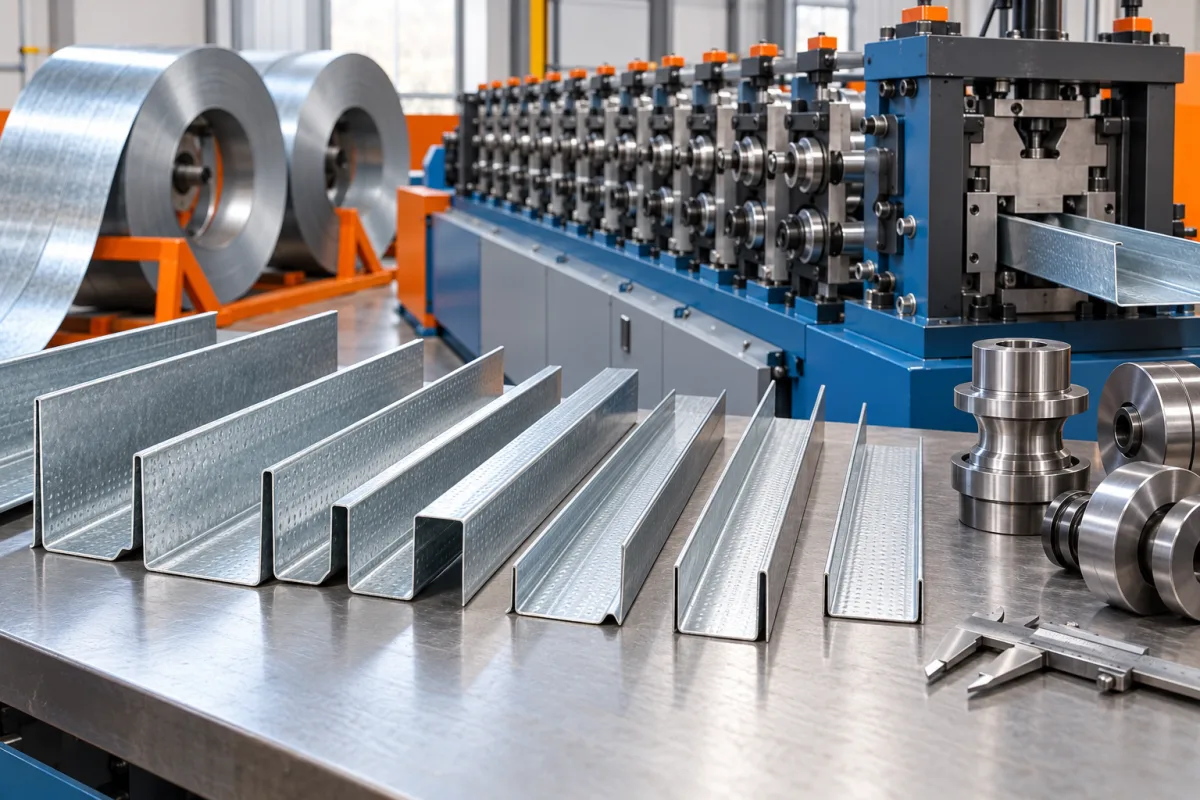
Choosing a stud and track roll forming machine requires a matched product catalog and a realistic packing plan. The sections must fit their framing system, and the complete route must deliver the quantities and bundle formats the business sells. Advertised speed or a long list of adjustable widths cannot replace that definition.
Separate the framing markets you intend to serve
Identify whether the initial products are drywall framing, structural members or more extensively fabricated frame components. Their material and feature requirements can differ. Begin with controlled drawings rather than assuming all light steel framing belongs to one interchangeable category.
Prioritize confirmed demand. A small number of common stud and track pairs may justify a different equipment arrangement from a broad catalog of short custom orders. The selection should explain how each required product contributes to the business.
Specify studs and tracks as mating products
Provide both section drawings, including actual web, flange and lip dimensions. Identify the intended receiving fit and assembly method. Nominal trade size alone can obscure the dimensional relationship between the pair.
Ask suppliers to demonstrate the matching products together. Independent samples that each look like channels do not prove compatibility. Include the cut ends and representative lengths in the assembly review.
Build a material and geometry matrix
Pair each product with grade, thickness convention, coating and developed strip width. Do not present unrelated extremes as one universal capability range. Ask the equipment supplier to confirm the combinations it proposes to support.
Where future structural products are contemplated, identify their actual drawings and material requirements rather than assuming a drywall line can expand automatically. Obtain a defined engineering boundary for future additions.
List service and fixing features explicitly
Specify holes, slots, notches or embossing required by the product. Include dimensions and final-member datums. Ask which are produced inline and which need additional work.
Feature capability affects both scope and output. A trial of unpunched material may omit the operation that controls production. Use representative patterns in the comparison, and keep product-design approval separate from the machine's ability to make a hole.
Compare dedicated and flexible arrangements
A dedicated high-volume route can concentrate on stable products. A flexible line serves a wider mix but requires configuration recovery and scheduling. The useful comparison depends on how often the actual orders change.
Request complete transition demonstrations, including stud-to-track changes and the important size adjustments. Identify manual parts, controls and first-off checks. Time recovery through an accepted mating pair, not merely the motion of the main forming assemblies.
Match cutting to the length distribution
Collect the lengths customers order and distinguish repeated stock lengths from project-specific pieces. More short pieces mean more cuts and handling events for the same linear quantity. Long pieces place different demands on support and packaging.
Require the proposed route to demonstrate acceptable ends and length control across representative cases. A fast run at one middle length does not establish the practical range or the condition of the ends used during assembly.
Make bundling part of the initial layout
Define how sections are collected, nested where appropriate, counted, strapped and identified. Ask whether the proposed downstream equipment handles both studs and tracks and the complete size range. A packaging arrangement that suits one section may need changes for another.
Draw coil loading and finished-bundle removal into the floor plan. The forming mill's footprint alone does not establish operational space. Safe access, inspection and material staging must be included from the beginning.
Use a sales-order trial with measurable outcomes
Choose a basket representing the business: a common stud, its matching track, an important boundary product and a relevant change. Include specified features and normal packing. Count accepted pieces and record the elapsed-time boundary.
- Dimensional conformity of each section.
- Fit of the required stud and track pair.
- Feature positions and condition.
- Cut length and usable ends.
- Accepted quantity after collection and packing.
- Correct bundle count and identification.
Evaluate support using a recovery scenario
Use an inclusion worksheet that gives each supplier the same packaging boundary. If one offer includes a complete counted and strapped bundle while another ends at a receiving table, request the missing handling cost and labor assumptions. Also identify utilities, coil loading, inspection equipment and commissioning material. Mark unresolved entries instead of treating them as included. This exercise often explains apparent price differences more clearly than a list of motor sizes. The final comparison should show how each route completes the same customer order with the required matched products, features, counts and identification, and what the buyer must provide outside the quoted package.
Ask how staff recover an approved size after maintenance, identify a replacement feature tool and verify the first-off pair. The answer should refer to the supplied documentation and actual configurations, not only a general promise of training.
For a practical selection scenario, imagine the business spends most days on one stock stud but changes to matching track several times weekly. Compare the full change and packing sequence, not only the stud's maximum rate. A slightly slower former with reliable recovery may better serve the order pattern than a faster route whose downstream transitions are poorly defined.
Frequently asked selection questions
Should bundle automation be added only after buying the former?
Evaluate it at the same time, even if purchase is staged. It affects layout and practical output. Define how the initial route works and what a future upgrade requires.
Can a nominal web-size range define the machine completely?
No. Flanges, lips, material combinations and features also matter. Supply the matched product catalog and requested transitions.
Is the fastest stud demonstration the best evidence?
Only for the narrow condition demonstrated. A useful comparison includes matching track, features, changes and packing on a representative sales-order basket.
What should be resolved before ordering?
The product and material matrix, feature scope, mating criteria, changeover method, handling layout and acceptance plan. Clear boundaries prevent later disagreement over what the line was expected to produce.
Continue your research
- Stud & Track Roll Forming Machines
- Drywall Stud Roll Forming Machine
- Drywall Track Roll Forming Machine
- C89 Light Gauge Steel Framing Machine
- C140 Light Gauge Steel Framing Machine
- Top Hat Light Steel Framing Machine
- How Stud and track roll forming machine Works
- Stud and track roll forming machine Price: What Affects the Cost?
- Materials and Thickness for Stud and track roll forming machine