
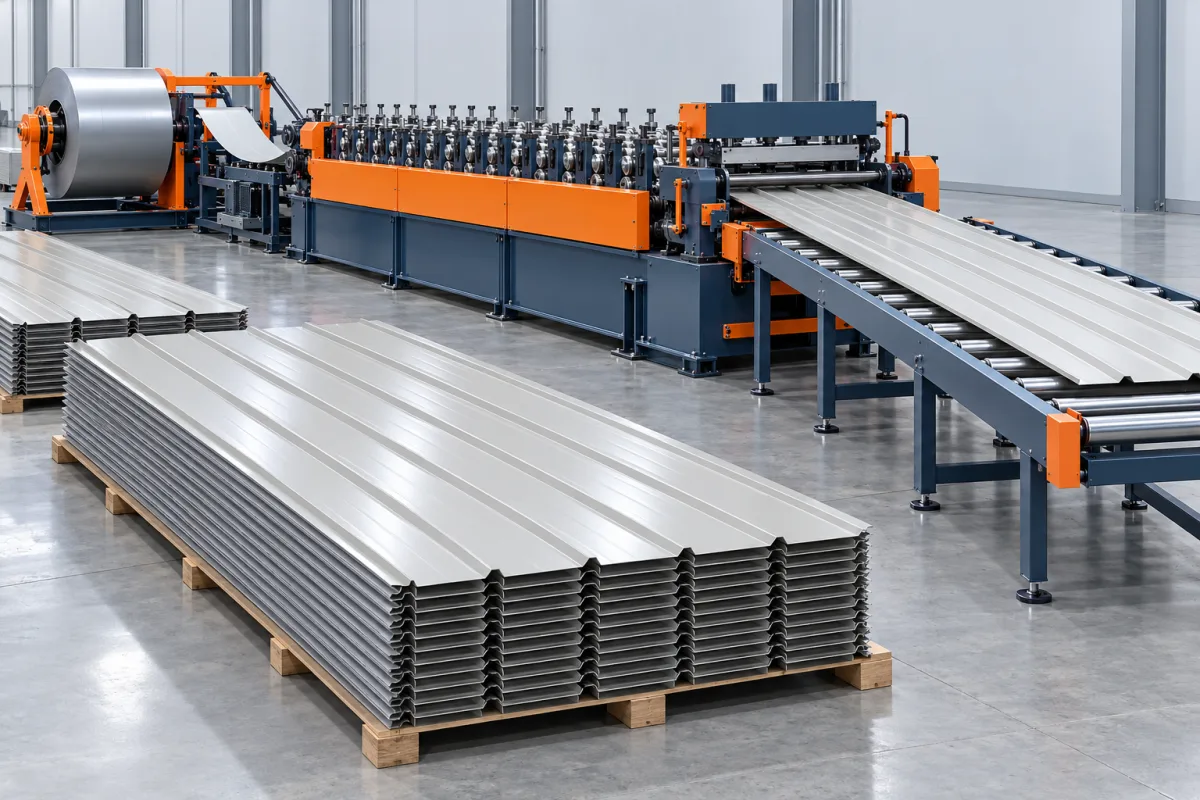
Wall cladding productivity is the rate at which a factory delivers accepted, identified panels with the required face and joint. The forming mill's strip speed is only one contributor. Appearance inspection, length changes, end fabrication and protective packing can determine the real output of a facade order.
Measure the product that can actually be shipped
Define accepted output after the operations included in your production boundary. A panel awaiting necessary end fabrication is not equivalent to one ready for installation. Likewise, a panel with an unacceptable scratch should not remain in the saleable count just because its dimensions are correct.
Report both quantity and effective coverage where useful. Cladding panels with different reveals or covers can have identical cut lengths but deliver different facade area. Preserve the product identity in the report so a change in mix does not look like a change in machine efficiency.
Separate long runs from project-order work
A repeated industrial wall sheet and a mixed architectural facade schedule create different production patterns. The latter can involve varied lengths, finishes and special pieces. Time spent preparing and identifying each order may be significant even if the actual forming operation is brief.
Create separate trial baskets when these patterns are commercially important. One long run can measure sustained performance, while a mixed basket reveals change and handling losses. Neither should be presented as the sole prediction for every future order.
Map the route beyond the roll exit
Follow a panel through cutting, any required fabrication, inspection, protection and bundle release. Record queues as well as working time. A fast former may simply create work in progress in front of a slower finishing station.
- Coil and finish preparation.
- Profile setup and first assembly approval.
- Forming and length cutting.
- Holes, notches or end operations outside the line.
- Appearance inspection and protective packing.
- Bundle identification and release.
Use accepted area and elapsed time together
For a hypothetical order, assume 180 accepted panels at 3.5 metres long with 0.3 metre effective cover. Accepted nominal area is 180 × 3.5 × 0.3 = 189 square metres. If the agreed route takes 210 elapsed minutes, average output is 54 square metres per hour across that boundary.
These values are illustrative arithmetic, not equipment capacity. If a separate finishing operation remains, label the result as intermediate output instead of finished cladding. Use actual cover rather than visible face width when the product definition distinguishes them.
Appearance handling can be the limiting operation
Finish-sensitive panels may require separation and supported movement that take longer than simply pushing material through the mill. Observe where the route waits and where damage appears. Raising forming speed without changing that constraint can increase congestion or rejected panels.
Evaluate improvements under the intended protective arrangements. Removing inspection or bypassing safe handling to obtain a better demonstration rate does not create sustainable productivity. The correct target is repeatable saleable output with the required finish.
Changeover ends at an accepted joint
For a line serving different cladding sections, record the interval from the last accepted panel of one setup to the first accepted panel and mating assembly of the next. Include guides, cutoff parts, settings and inspection where they are required.
A width-adjustment time alone can omit substantial recovery work. This matters for short facade orders, where several minutes of first-off checking may exceed the forming time. Use the complete transition when comparing flexible and dedicated equipment arrangements.
Length mix changes cutting and handling work
Short panels increase the number of individual pieces and cuts for the same linear output. Long panels need more extensive support and may complicate packing. The production study should therefore record the length distribution, not simply average length.
For example, an order containing many short infill panels can consume more identification and handling effort than the same area in long repeated sections. A single square-metre rate may hide that difference. Add pieces per order and handling time to the report when they explain the result.
Keep yield losses visible
Record rejected starts, joint mismatch, visible damage and packing losses separately. They require different actions. A line can maintain a high gross metre count while delivering disappointing accepted coverage if appearance losses occur late in the route.
Compare improvements on similar work. If a protective handling change reduces scratches, verify the result with the same finish and representative lengths. A lower rejection count on an easier product mix does not by itself establish that the change solved the original problem.
Plan capacity using the bottleneck and order mix
Keep subcontracted operations visible too. If special end fabrication leaves the factory, its turnaround and accepted return quantity affect delivery capacity even though it does not occupy the forming mill. Include that boundary in customer lead-time planning.
Use measured times for recurring activities and realistic order quantities. Include the required availability of inspection, fabrication and packing resources. A capacity plan based solely on the mill's nominal speed can promise more facade work than the complete shop can release.
Test a downside case with more short orders or configuration changes. This reveals whether delivery commitments depend on an unusually favorable schedule. When considering new equipment, invest where the study shows a persistent constraint rather than automatically choosing the fastest former.
Frequently asked cladding productivity questions
Why is the wall-panel line waiting when the former is fast?
The constraint may be discharge, inspection, end fabrication or packing. Log the actual waits and follow the material route. A forming-speed adjustment cannot solve every downstream queue.
Can appearance inspection be removed from a capacity estimate?
Only from a clearly labeled machine-only study. The business still needs the inspection required to release its product, so operational capacity must include it or show its separate resource requirement.
Should all facade orders use one output rate?
No. Different lengths, finishes, joints and special operations create different workloads. Group similar order types and retain the assumptions behind each planning rate.
What should a supplier output demonstration include?
The specified material and joint, representative lengths, required changeover and normal handling through the agreed acceptance boundary. Count accepted panels and document stops so the result can be used in a real production plan.
Continue your research
- Wall Cladding Roll Forming Machines
- Wall Panel Roll Forming Machine
- Metal Siding Roll Forming Machine
- Box Profile Wall Panel Roll Forming Machine
- Corrugated Wall Cladding Roll Forming Machine
- Trapezoidal Wall Cladding Roll Forming Machine
- How Wall cladding roll forming machine Works
- How To Choose a Wall cladding roll forming machine
- Wall cladding roll forming machine Price: What Affects the Cost?