
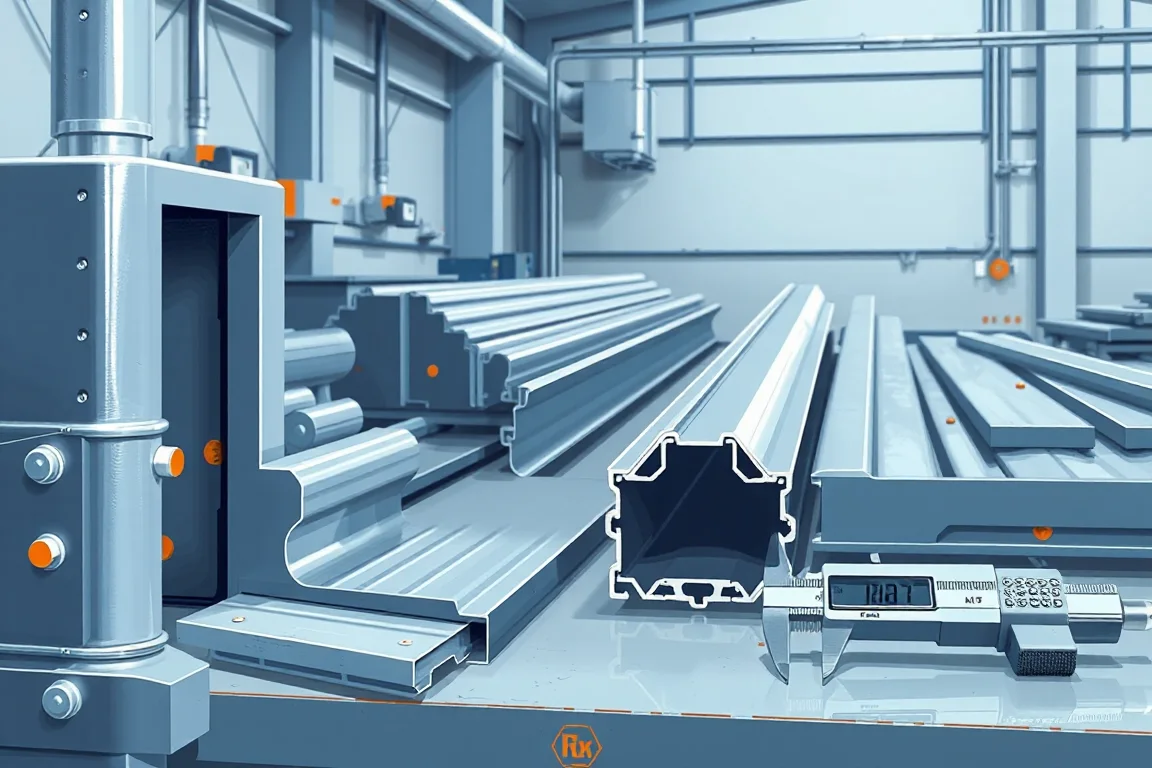
The question of material thickness for a greenhouse roll forming machine is not answered by a single number. Thickness is a selection requirement you state, together with the metal grade and the protective coating, and it applies to a specific profile produced on a specific line. A gutter line, a film-lock channel line and a structural post line may all be called greenhouse roll forming machines, yet each may form different sections from different coil inputs. Treating one thickness value as universal across those duties is a common source of misunderstanding.
This guide explains what thickness does inside the forming process, why it must be declared separately from coating and grade, how to match it to each greenhouse component, and how to verify that a quoted machine can actually produce your accepted output.
Why thickness is a buyer requirement, not a specification label
In roll forming, thickness controls how the strip behaves as it passes through successive roller stations. A thicker strip resists bending more, so it requires more forming force and may need larger bend radii to avoid cracking or excessive springback. A thinner strip can buckle or oil-can if the stations are set for heavier material. As thickness increases, the neutral axis shifts and the developed width of the flat strip changes, which affects where holes and cut lengths land after forming.
Because of these interactions, no responsible line can be described as handling all thicknesses of all metals. What a line can do depends on the profile geometry, the roller design, the number of stations, the drive capacity, the material grade and its temper. That is why thickness belongs in your request as a specified base-metal value with a permitted variation, not as a range copied from a marketing sheet.
Separate base-metal thickness from coating and surface treatment
Base-metal thickness is the thickness of the steel or aluminium before any coating. Coating adds to the overall measured thickness but does not add forming strength in the same way. A galvanized or pre-painted strip has a zinc or paint layer whose adhesion and ductility matter during bending: a brittle or poorly adhered coating can crack and flake at tight bends even when the base metal forms correctly.
When you specify, state the grade, the nominal base-metal thickness and the permitted thickness variation as one set, and state the coating type and coating mass or film build separately. If you combine them into a single vague figure, the supplier cannot tell which variable drives the forming behaviour. A change in grade from a softer drawing-quality steel to a higher-strength structural steel at the same thickness can alter springback and hole position enough to affect assembly.
Match thickness to the greenhouse component function
Greenhouse structures use several unrelated profile functions, and each one justifies a different thickness decision. Drainage gutters carry water and condensate, so they need a section that sheds and joints reliably; their thickness affects stiffness over spans and the quality of any folded or riveted joint. Film-lock channels retain covering film, so their thickness influences how the channel lips deflect when the retaining element is inserted. Structural posts and rafters carry loads, so their thickness is usually set by structural calculation rather than by forming convenience. Crop support wires and growing channels are a separate case: many nutrient-film and hydroponic channels are plastic extrusions, and a metal roll forming line is not a substitute for a plastic extrusion process.
A practical approach is to list each component, its function, its expected environment and its structural role, then assign a thickness to each. The line that forms a thin film-lock channel may not be the line that forms a thick structural member, and the tooling for one should not be assumed to produce the other.
How thickness moves through the forming sequence
A greenhouse profile line generally begins with coil preparation, where the strip is uncoiled, straightened and sometimes cleaned. Connection punching follows: holes for fasteners, brackets and film-retaining hardware are usually punched before forming, because punching a formed section is harder to locate. The strip then passes through a series of roller stations that progressively bend the section. After forming, a cutoff separates the finished length. Some profiles need secondary operations such as notching, embossing or end forming.
Thickness interfaces at every step. The uncoiler and straightener must handle the coil weight and the strip stiffness. The punch tooling must be sized for the thickness so holes are clean rather than torn. The roller stations must be designed for the bend radii and springback of that grade and thickness. The cutoff must sever the section cleanly without distorting it. When any of these interfaces is specified for a different thickness than the one you intend to run, the symptoms appear as hole distortion, edge wave, twist, or inconsistent cut lengths rather than as an obvious thickness error.
What the operating range really means
Suppliers may state an operating thickness range for a line. That range is a claim about the machine's capability under defined conditions, and it should be verified for your exact profile, grade and coating. A range that covers a thin film-lock channel and a thick structural section in one sentence does not prove that the same tooling produces both to your acceptance criteria. Ask for written confirmation of the supported combinations: which grade at which thickness with which profile and which coating. A list of unrelated maximum values does not demonstrate capability.
Similarly, a mill that processes one grade at a given thickness has not thereby demonstrated the same result for a harder or softer material. Harder material resists bending and increases springback; softer material may mark or deform more easily. Each material change should be treated as a new forming question until evidence shows otherwise.
How to state thickness and grade in a purchase enquiry
Give the supplier a clear picture. State the profile drawing or section with dimensions. State the metal grade and its standard designation if one applies, rather than an ambiguous gauge number. State the nominal base-metal thickness and the permitted variation. State the coating or surface finish and which face is exposed. State the coil width and any known coil condition. State the hole positions, cut lengths and any secondary operations. State the required accepted output per shift, measured in finished good parts, not in line speed alone.
This lets the supplier assess tooling, drive capacity and cutoff design against a defined job. It also gives you a basis for acceptance: you can compare the supplied sample parts against the drawing and against your own trial assembly.
Alternatives: different processes for different greenhouse components
Roll forming is not the only way to make a greenhouse section. Press braking can form short lengths from sheet, and it offers flexibility but lower repetition consistency and more handling. Extrusion is common for plastic growing channels and some aluminium profiles; it produces a continuous section but uses a different material behaviour and tooling cost structure. Tube mills and roll forming lines differ in how they close a section, and a welded tube is not the same product as an open roll-formed channel. The right choice depends on the component function, the material, the length required, the hole pattern and the volume. Selecting roll forming for a drainage gutter or a film-lock channel is a different decision from selecting it for a structural post.
Cost and quote scope
Cost discussions for a greenhouse roll forming machine are often confused because the quote scope varies. A quote may cover only the forming line, or it may include uncoiler, straightener, punch, cutoff, hydraulics, controls and tooling. It may or may not include commissioning, training, spare rollers or acceptance testing. Without a stated scope, two quotes cannot be compared.
For a useful cost comparison, ask for the accepted-output cost rather than a headline price. That means the number of good finished parts per shift that the line can produce from your specified material and profile, and the scope of supply needed to achieve it. Thickness affects this indirectly: a heavier gauge may require slower forming or different tooling, which changes the output and therefore the effective cost per part. Because no verified prices are supplied here, the practical step is to require a scope list and a defined output basis in every quote.
Troubleshooting thickness-related symptoms
When parts do not meet the drawing, thickness is one possible cause among several. Symptoms such as edge cracking, poor hole quality, twist, bow, inconsistent cut length, or film-retaining hardware that does not fit can each have multiple origins. The diagnostic evidence you need is dimensional: measure the base-metal thickness of the coil actually used, measure the formed profile against the drawing, record hole positions before and after forming, and check the cut length. Compare the grade and coating with the specification. If the material has changed, the forming setup may need review by the supplier. Do not attempt to adjust forming stations or moving machinery without the supplier's guidance and a safe isolation procedure.
Acceptance checks for thickness-sensitive features
Acceptance should be tied to the greenhouse drawing. Check film-retaining hardware fit in the channel. Check drainage joints for alignment and sealing behaviour. Check connection holes against the mating part. For growing systems, evaluate the suitability of the material and coating for the actual nutrient and cleaning environment, because a channel called hydroponic is not automatically suitable for contact with nutrient solution. Material and coating suitability need specialist confirmation beyond the forming question.
Checklist for specifying material thickness
- List each greenhouse component separately by function.
- State the metal grade and standard designation, not a gauge number.
- State nominal base-metal thickness and permitted variation.
- State coating type, coating mass or film build, and the exposed face.
- Provide the profile drawing with dimensions and bend radii.
- State hole positions, cut lengths and secondary operations.
- Provide representative coil samples from the intended supplier.
- Ask for written confirmation of supported grade-thickness-profile combinations.
- Define accepted output per shift using the actual profile and material.
- Agree on acceptance checks against the greenhouse drawing.
FAQ
Can one greenhouse roll forming machine run all greenhouse thicknesses?
No line should be assumed to run every thickness of every greenhouse profile. Capability depends on profile geometry, roller design, drive capacity, grade and coating. A line set for a thin film-lock channel may not form a thick structural post to the same tolerance. Ask for supported combinations rather than a general range.
What thickness variation is acceptable in the coil?
Permitted thickness variation is a coil property that you should specify with the nominal thickness. It affects hole position, bend angle and springback. The acceptable variation depends on your profile tolerance and assembly requirements. Do not rely on an assumed value; state it in the enquiry and compare incoming coil measurements against it.
Does coating thickness count toward forming thickness?
Coating adds to overall measured thickness but behaves differently from base metal during bending. A thick or brittle coating can crack at tight bends even when the base metal forms correctly. Specify base-metal thickness and coating separately, and consider how the coating will tolerate the bend radii in your profile.
Why do holes shift after forming when thickness changes?
Forming redistributes material along the section. A change in thickness changes the developed length and the neutral axis, so punched holes can end up in a different position after bending. Punching before forming is common, but the punch pattern must be designed for the intended thickness and grade.
Is a metal gutter profile suitable for hydroponic nutrient channels?
Not automatically. Many hydroponic and nutrient-film channels are plastic extrusions made by a different process. A metal gutter line forms metal sections and should not be assumed to substitute for a plastic extrusion system. For growing systems, material and coating suitability for the nutrient and cleaning environment need specialist confirmation.
How do I compare quotes that mention different thickness ranges?
Compare on scope and accepted output, not on the thickness range alone. A quote that includes uncoiler, punch, cutoff, tooling and commissioning is not comparable to one that covers only the forming stands. Ask each supplier to define the supported grade-thickness-profile combination and the good parts per shift from your material.
Making the decision
Material thickness for a greenhouse roll forming machine is a decision you make part by part, with grade and coating stated alongside it, and with the forming, punching, cutoff and assembly interfaces understood. Declare the base-metal thickness and its permitted variation clearly, distinguish that from coating, match each profile to its greenhouse function, and verify capability with written combinations and sample parts. That approach reduces the risk of buying a line whose actual accepted output does not match the drawings your greenhouse is built from.
Continue your research
- Greenhouse Profile Roll Forming Machines
- Greenhouse Gutter Roll Forming Machine
- Greenhouse Channel Roll Forming Machine
- Greenhouse Film Locking Channel Machine
- Greenhouse Crop Support Channel Machine
- Greenhouse Purlin Roll Forming Machine
- How Greenhouse roll forming machine Works
- How To Choose a Greenhouse roll forming machine
- Greenhouse roll forming machine Price: What Affects the Cost?