
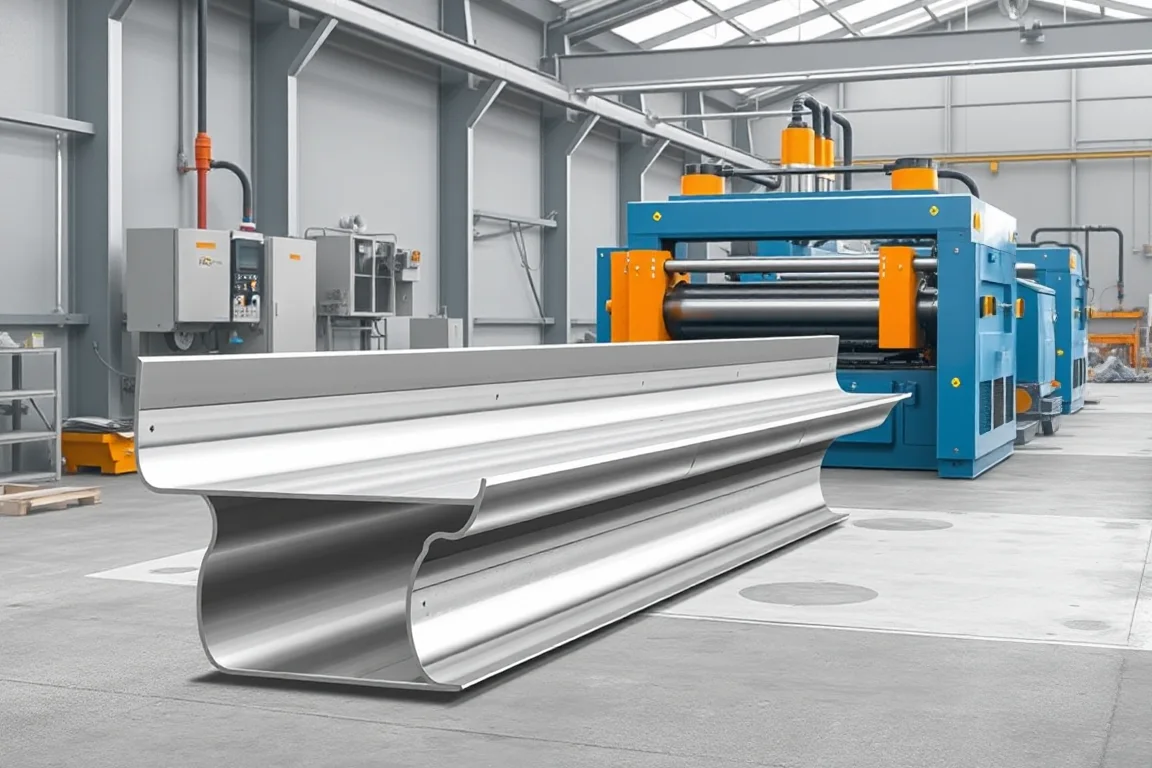
A greenhouse gutter roll forming machine produces a linear metal profile that does more than collect water. In a greenhouse structure, the same member often serves as a drainage channel, a support rail, and a mounting interface for film-lock or glazing retention. The tooling and line configuration therefore have to be selected from the complete connection and joint detail, not from a drainage cross-section alone. This article explains what the finished profile includes, how its interfaces constrain the production route, and how to evaluate tooling, changeovers, inspection and accepted output for a specific greenhouse design.
What the finished greenhouse gutter profile actually contains
A gutter profile produced on a roll forming line is usually a sequence of functional zones along one continuous section. The drainage zone forms the channel that carries condensate and rainwater toward a downpipe or collection point. The film-lock zone forms a slot or channel that accepts a retaining spring, wire or extruded insert, and its geometry must match the retention hardware chosen for the covering. A support zone provides the bearing surface or fixing flange where the gutter meets a post, truss or rafter. Connection holes are punched at defined positions for bolted joints, brackets or end plates.
These zones are not independent. The position of the film-lock channel relative to the drainage lip affects how the film sits and how water sheds away from the covering. The depth and width of the drainage zone affect stiffness, which in turn affects how far apart supports can be placed. The connection-hole pattern must align with the structural member it attaches to. A line that forms an attractive channel but ignores the attachment and retention detail produces a part that cannot be assembled without field modification.
Why the greenhouse interface defines tooling selection
The most common misunderstanding is that a gutter is a simple open channel. In practice, the greenhouse interface is the controlling feature. If the gutter receives a film-lock spring, the slot width, lip form and surface condition must suit that spring. If the gutter carries glazing bars or panels, the bearing surfaces and any gasket recess must be formed consistently. If the gutter connects to a post, the fixing flange and hole positions must match the post section and the intended fastener.
Because these interfaces differ by greenhouse family, two gutters with similar drainage appearance can require completely different roll tooling. A drainage-only profile may need a relatively simple progression. A combined drainage and film-lock profile may need additional forming stations, more careful material support, and a punching station positioned before or within the forming sequence. The joint detail, including how two gutter lengths meet and how the joint is sealed or overlapped, should be part of the drawing review because it may require an end treatment, a notch or a specific cut quality.
Production route from coil to greenhouse-ready member
A practical production route for this component family follows a sequence that keeps punching and forming in a logical order. Coil preparation establishes the strip width, edge condition and feeding consistency. Connection punching creates the holes, slots or notches that the greenhouse assembly needs; doing this before final forming can be easier when the strip is flat, but it requires the punch positions to remain correct after the material deforms. Section forming then builds the drainage, film-lock and support zones through a series of stations. Cutoff separates the finished length. Greenhouse-interface checks confirm that the formed and punched part fits the intended joint and retention hardware.
The order of punching relative to forming is a genuine engineering decision. Punching flat strip allows simpler tooling and easier slug removal, but forming can shift hole position if the material stretches unevenly around the profile. Punching after forming can hold position more accurately in some profiles but requires access to the formed section and may be limited by the channel geometry. The choice should be made with the specific profile and material, not as a universal rule.
Coil preparation and material condition
Coil preparation is not just loading. Strip width, camber, edge burr and surface protection all influence the formed profile. A protected metal section, such as a coated or painted strip, can be damaged by poorly adjusted guides or by forming stations that mark the visible surface. The coating also affects friction and springback, so the same tooling may behave differently on a protected strip than on an uncoated one.
The material grade and base-metal thickness are buyer inputs. They should be stated in the enquiry rather than assumed from a generic description. A gutter that is structurally adequate in one thickness may be too flexible in another, and the film-lock slot may not retain hardware correctly if the material deforms differently. The line's operating range for thickness and grade requires supplier verification against the actual profile and material, because a nominal range without a specific section and grade is not a meaningful promise.
Connection punching and hole strategy
Connection holes are functional features, not cosmetic details. Their diameter, position and edge distance determine whether the gutter can be bolted without tearing or loosening. A punched hole close to a formed bend can distort during forming or can crack in service if the material is stressed. The drawing should show hole positions relative to the drainage zone, the support flange and the film-lock channel so that the punch tooling can be designed with adequate clearance.
Where a joint uses slotted holes for site tolerance, the slot direction matters. A slot that allows length adjustment along the gutter may conflict with a slot intended for lateral alignment. The production line can punch a range of hole shapes, but the tooling is specific. The acceptance check should confirm that holes align with the mating part, not merely that they exist.
Forming stations, support and the film-lock channel
Roll forming a combined gutter is a balance between forming the drainage shape and preserving the film-lock detail. The film-lock channel often has a narrow slot or re-entrant lip that needs controlled material flow. If the forming sequence bends the strip too aggressively, the slot can close, distort or develop a localized thinning. Support rolls and guide rolls help control the strip through these stations, and their adjustment affects the final section.
The number and arrangement of forming stations follow from the profile complexity and the material. A drainage-only section may need fewer stations than a section with a film-lock channel, a support flange and a return lip. Adding stations can improve formability but also increases line length, setup complexity and the number of adjustments that must be recorded for changeover. The correct configuration is the one that produces the agreed profile within the agreed tolerance at the agreed material, not the one with the most or fewest stations.
Cutoff requirements and end quality
Cutoff is a separate operation with its own tooling and quality consequences. The cut must be supported by the profile so that the section does not collapse or twist as the blade passes. Cut length accuracy matters for joint alignment and for handling long members. End quality matters where the gutter end is exposed, where it joins another length, or where a seal or end cap is fitted.
Some greenhouse designs require secondary operations after cutoff, such as notching for a joint, drilling for a bracket, or bending for a curved run. These operations should be identified in the quotation scope because they may be outside the forming line's standard capability. A line that forms and cuts accurately may still leave the part incomplete for assembly if notching or bending is assumed but not included.
Tooling alternatives and what changes between them
Tooling alternatives for a greenhouse gutter usually differ in three ways: the number and design of forming stations, the punching arrangement, and the cutoff method. A dedicated set of rolls is designed for one profile family and offers repeatable output with limited adjustment. A convertible or modular arrangement may allow some profile variation by changing selected stations or spacers, but it often trades setup time and adjustment sensitivity for flexibility. A line intended for multiple gutters may need quick-change features, recorded settings and a disciplined changeover procedure.
The comparison is not simply dedicated versus flexible. A dedicated line can be appropriate when the greenhouse range is stable and volume justifies it. A flexible line can be appropriate when several gutter variants share a common drainage base but differ in film-lock or support detail. The decision should be based on how many variants are genuinely required, how often they change, and how much setup scrap and adjustment time the changeover consumes. The equipment scope should state which variants are covered and what is required to move between them.
Changeovers, setup scrap and handling
Changeover is a production event, not a minor adjustment. It includes coil change, strip threading, roll station adjustment, punch tool change, cutoff length change and first-off verification. Each step consumes time and may produce setup scrap until the profile stabilizes. Recording the settings for each variant reduces the time and scrap on subsequent runs, but the record must be based on the actual material and profile rather than on a nominal starting point.
Long members and variable cut lengths need an organized handling plan. A gutter that is formed and cut accurately can still be damaged during unloading if it is dropped, stacked without support or dragged across a surface. The handling plan should cover how parts are removed from the line, how they are bundled, and how they are stored before transport to the greenhouse site.
Inspection and accepted output
Inspection should begin with the first-off piece and continue with a representative steady-production sample. The agreed gauges and drawing define what is checked: the drainage zone shape, the film-lock channel, the support flange, the connection-hole positions and the overall length. The first-off check confirms that the line is set correctly; the steady-production check confirms that it stays correct as the coil runs and as temperature or material condition varies.
Acceptance is not only dimensional. The intended gutter joint and the relevant structural interface should be assembled using the specified components. Fit and dimensional requirements are compared against the approved drawing. This assembly check reveals problems that a profile gauge alone may miss, such as a film-lock slot that grips the hardware unevenly or a connection hole that aligns in one direction but not another. For growing systems, suitability for the actual nutrient and cleaning environment should be evaluated separately from the forming line's dimensional acceptance, because corrosion and chemical exposure are in-service questions rather than roll forming questions.
Separating forming from assembly, certification and service
The roll forming line produces a formed and cut metal member. It does not certify the greenhouse, install the gutter, or guarantee the drainage design. Assembly may involve brackets, sealants, end caps and fasteners that are outside the forming scope. Certification, structural verification and in-service performance depend on the complete greenhouse system, the support spacing, the loads and the environment. Keeping these responsibilities separate helps avoid the mistake of treating a forming-line acceptance check as a structural approval.
For growing systems, the material and coating choice should reflect the nutrient solution, cleaning agents and humidity the gutter will see. A protected metal section may be appropriate in one environment and unsuitable in another. That decision belongs to the greenhouse designer, not to the roll forming machine selection, although the material specified does affect forming behavior and tooling.
Practical checklist before approving a production line
- Confirm the complete gutter drawing, including drainage zone, film-lock channel, support section and connection holes.
- State the base-metal grade and thickness to be formed, and ask the supplier to verify the operating range for that specific profile and material.
- Confirm the intended retention hardware and joint components so the film-lock and joint details are represented in the tooling review.
- Run the agreed material and profile, not an easier demonstration substitute.
- Inspect first-off pieces and a representative steady-production sample with the agreed gauges.
- Assemble the intended gutter joint and relevant structural interface using specified components.
- Record changeover steps, setup scrap, punching time and unloading time.
- Compare the written equipment scope with all secondary operations needed for a finished part, including notching, bending, sealing or end treatment.
- Define accepted output per shift with the actual profile and material rather than a nominal figure.
- State the electrical supply voltage, frequency and phase; installed power requires a confirmed equipment schedule.
FAQ: greenhouse gutter roll forming machine decisions
Can one roll forming machine produce both a drainage gutter and a film-lock gutter?
Yes, if the tooling is designed for the combined profile. The film-lock channel adds stations and requires controlled material flow, so it is not simply a drainage gutter with an extra bend. The line should be reviewed against the complete section, and the film-lock slot should be checked for consistent grip with the intended retaining hardware.
Is a metal gutter roll forming line suitable for hydroponic growing channels?
Not as a substitute for a plastic extrusion system. Many hydroponic NFT channels are plastic extrusions with different cross-sections, jointing and food-contact considerations. A metal gutter line can produce a metal drainage or support member, but the suitability of that metal part for the nutrient and cleaning environment is a separate evaluation.
How should connection holes be positioned relative to the formed profile?
Hole positions should be defined against the mating part and the formed features, with adequate edge distance from bends and lips. Whether punching occurs before or after forming depends on the profile and material, because forming can shift hole position. The acceptance check should confirm alignment with the mating part, not only the presence of holes.
What determines the cutoff method for a greenhouse gutter line?
The cutoff method follows from the profile geometry and the required end quality. The cut must be supported so the section does not collapse or twist. Cut length accuracy matters for joint alignment and handling. If a joint or end treatment requires notching or a specific end form, that operation should be identified separately from the basic cutoff.
How can a buyer assess changeover time before purchase?
Ask for the changeover steps to be recorded and demonstrated on the agreed profiles and materials. Observe coil change, roll adjustment, punch tool change and first-off verification. Setup scrap and adjustment time are part of the real changeover cost and should be compared between tooling alternatives rather than assumed from a general description.
What should be included in acceptance testing for a gutter production line?
Acceptance should include first-off and steady-production dimensional checks against the agreed drawing and gauges, a fit check of the film-retention hardware, and an assembly check of the intended gutter joint and structural interface. For growing systems, evaluate the material's suitability for the actual nutrient and cleaning environment separately from the forming line's dimensional acceptance.

Continue your research
- Greenhouse Profile Roll Forming Machines
- Greenhouse Channel Roll Forming Machine
- Greenhouse Post Roll Forming Machine
- Greenhouse Film Locking Channel Machine
- Greenhouse Crop Support Channel Machine
- Greenhouse Purlin Roll Forming Machine
- How Greenhouse roll forming machine Works
- How To Choose a Greenhouse roll forming machine
- Greenhouse roll forming machine Price: What Affects the Cost?
Configuration & specification inputs
Match the configuration to your section drawing, material and production requirements.
| Parameter | Requirement / confirmation needed |
|---|---|
| Profile geometry | A greenhouse gutter can combine drainage with structural or glazing interfaces. Include the greenhouse connection and joint detail so tooling is not selected from a drainage cross-section alone. |
| Material | Specified protected metal sections; plastic growing channels use a different process |
| Thickness & grade | Buyer to specify base-metal thickness and grade; operating range requires supplier verification. |
| Process route | Coil preparation → connection punching → section forming → cutoff → greenhouse-interface checks |
| Cutting | Confirm profile-supported cutoff, cut lengths, end quality and any secondary operations. |
| Output | Define accepted output per shift with the actual profile and material. |
| Electrical supply | Buyer to state voltage / frequency / phase. Installed power requires a confirmed equipment schedule. |
| Acceptance | Assemble the intended gutter joint and relevant structural interface using the specified components. Compare fit and dimensional requirements against the approved drawing. Keep installation drainage design separate from the forming line's dimensional acceptance. |