
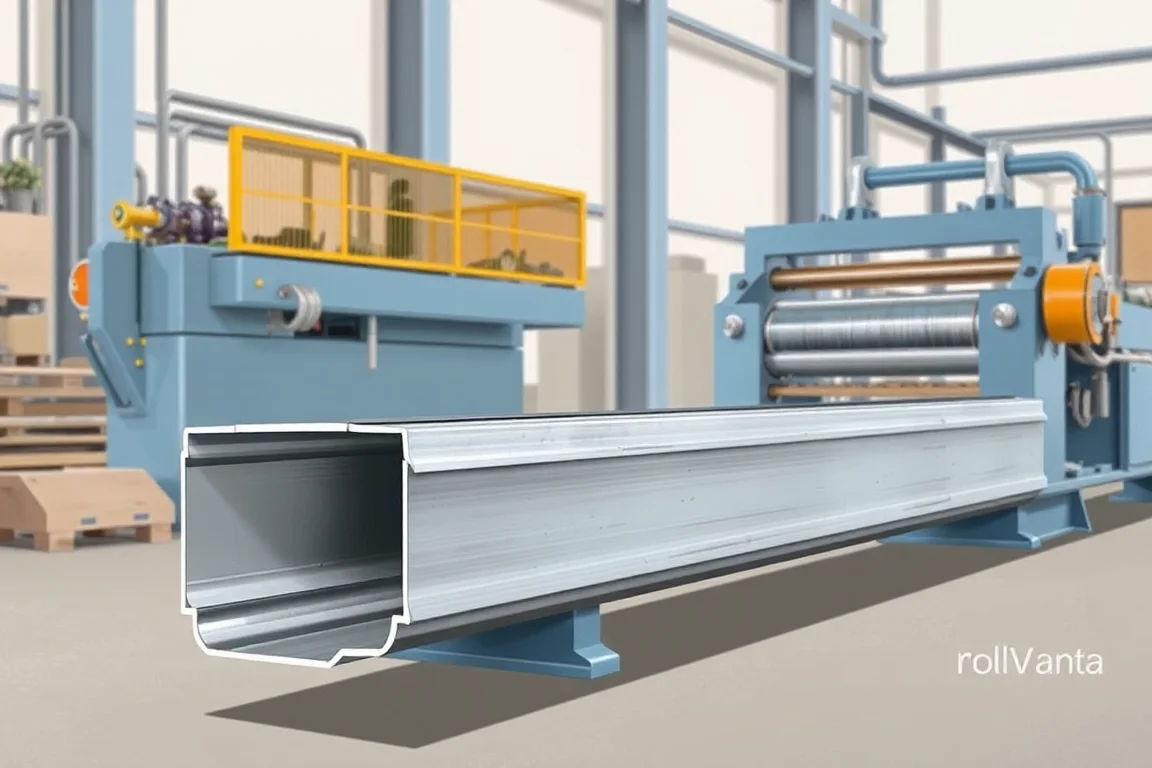
A greenhouse post roll forming machine turns coiled metal into open-section structural posts used in greenhouse frames. These posts carry vertical loads, resist bending from cladding and equipment, and provide connection points for trusses, rails, foundations and bracing. The machine is built around a specific post drawing: the web, flanges, lips and hole pattern determine the roll tooling, the punching stations and the cutoff. This article explains what a post roll forming line does, how it differs from equipment for tubular members, and how to specify and evaluate a line when the structural post is defined by an approved drawing. It does not cover roof gutters, crop channels or other greenhouse profiles that are not structural posts.
Greenhouse post functions and section families
Greenhouse posts are the vertical members that transfer roof and cladding loads to the foundation and brace the structure against lateral movement. This article concerns open-section posts, such as drawing-defined C, sigma, lipped-channel or custom profiles; greenhouse structures can also use tubular and other post constructions. Each family suits different connection methods and manufacturing routes. A C-section offers a flat web for simple bolted connections; a sigma adds stiffening returns that can improve bending behaviour for a given coil width; a Z-section allows overlapping at splices and can nest for transport. The choice belongs to the greenhouse designer, not the machine builder.
The post may be a single-skin open profile or a closed tubular member. Round, square and rectangular tubes are normally produced by tube mills or purchased as finished sections, not by the open-profile roll forming line described here. Some posts are made from two roll-formed halves that are later joined, but that is a different process route. Before requesting a roll forming quotation, confirm whether the post drawing is an open section. If the drawing shows a welded tube or a seamless pipe, the correct production route is elsewhere.
Post drawing: web, flanges, lips and connection datums
The post drawing defines the geometry the machine must reproduce. The web is the main flat face, often the surface that faces the greenhouse interior or exterior. Flanges turn from the web and provide stiffness and surfaces for cladding or rails. Lips return from the flange edges and can house seals, stiffen the section or provide an edge for fasteners. Each of these elements has a nominal dimension and a tolerance. The drawing should also show bend radii, which affect roll design and the minimum flange length the tooling can form.
Connection datums are the features that locate the post relative to other structure. They include hole positions for truss brackets, rail attachments and base plates; slot orientation; and any notches or cutouts. These datums are usually defined from a common edge or from the web centreline. In a roll forming line, holes are typically punched in the flat strip before forming, so every hole position must be expressed as a distance along the strip and across the strip width. If the drawing only shows the finished post, the machine supplier has to convert those positions into pre-form coordinates. Any error here shows up as holes in the wrong place after forming. The drawing should therefore include a developed strip layout or clearly dimensioned flat-pattern information.
Open roll-formed posts versus tubular members
The distinction between open roll-formed posts and tubular members is fundamental. Open sections are formed progressively from a flat strip by a series of contoured rolls. Each pass bends the strip a little more until the final section shape is reached. This route is efficient for long runs of a constant cross-section and allows punching or notching to be integrated into the line. Tubular members, by contrast, are usually made on tube mills that form a closed shape and weld the seam. They can be stronger in torsion for a given weight, but they require different tooling and a welding process that an open-profile line does not have.
Some greenhouse designs use open posts because they are easier to connect to with bolts through the web, and because they can nest for shipping. Others use tubes because they resist twisting and present a smooth surface. The machine selection must follow the structural decision. An open-profile line without seam-forming and welding equipment does not deliver a welded round tube; a tube-production proposal likewise should not be assumed to cover an open lipped post. When comparing quotations, confirm that each supplier is quoting the same construction type. A price for an open-section line is not comparable to a price for a tube line.
Material, coating and corrosion exposure as requirements
Greenhouse posts are exposed to moisture, condensation and sometimes fertiliser or soil contact. The material and coating are therefore performance requirements, not just commercial choices. Common substrates include hot-dip galvanised steel, zinc-aluminium coated steel and pre-painted steel. The coating type and thickness affect formability: harder coatings can crack at tight bend radii, while some paints are more flexible. The machine tooling must be compatible with the coating so that the formed post does not show coating damage that would reduce corrosion resistance.
The buyer should specify the base-metal thickness, grade and coating in the enquiry. The machine supplier needs this information to propose roll materials, surface finishes and drive power. A line set up for thin, soft strip may not run thicker or higher-strength material without changes to the rolls or the drive. Thickness range is a verification item: the supplier should confirm the operating window for the specific post drawing and material. Do not assume that a machine described as suitable for a general category will handle every thickness the greenhouse designer might choose.
Coil entry and progressive forming sequence
The line starts with a coil of strip, usually mounted on a mandrel uncoiler. The strip is fed through a straightener and sometimes a pre-punching station. The straightener removes coil set so that the strip enters the forming rolls flat and consistent. If the post requires holes, slots or notches, these are normally punched or cut in the flat strip while it is still easy to locate and support. The developed strip layout places these features at the correct longitudinal positions.
From the punching station, the strip enters the progressive forming section. This consists of a series of roll stands, each with upper and lower rolls that progressively bend the flanges and lips. The number of stands depends on the section complexity, the material thickness and the bend radii. A simple C-post may need fewer stands than a sigma with returns and stiffening ribs. The rolls are arranged so that the strip is guided and supported through each pass. Lubrication may be used to reduce friction and heat, but it must be compatible with the coating. After the final forming pass, the section is ready for cutoff.
Connection holes, base interfaces and end work
Connection holes are one of the most important quality features of a greenhouse post. They must align with truss brackets, rails, diagonal bracing and base plates. Because holes are usually punched before forming, the line must maintain the correct distance between the leading edge and each hole group, and between hole groups. A servo-controlled feed or a registration system can help maintain this accuracy. The punching station should be designed for the hole sizes and patterns on the drawing, including any slots or elongated holes that allow site adjustment.
Base interfaces may include holes for anchor bolts, tabs for embedding, or a cut end that fits into a foundation socket. Some posts require a notch or a swage at the bottom. These features may be produced in the line by a punch or a secondary operation. End work such as deburring, chamfering or sealing cut edges may also be required to protect the coating. The quotation should state which of these operations are inside the machine supply and which are manual or offline.
Size variants and complete changeover
A greenhouse project may use several post sizes: different web depths, flange widths or thicknesses. A roll forming line can be designed to produce a family of sections, but changeover between them is not always quick. Some lines use interchangeable roll sets or adjustable roll positions; others require removing and replacing entire stands. The buyer should ask for the changeover method and the typical time for each size change, because this affects productivity when multiple sizes are needed in one shift.
Tooling commonality matters. If the same rolls can be adjusted to cover a range of web depths, the number of spare roll sets is lower. If every size needs a dedicated set, storage and handling become a factor. The quotation should list what is included for each post size and what is optional. A complete changeover includes not only the forming rolls but also the punching tools, cutoff die and any guides. Partial quotes can hide significant extra cost.
Cutoff, straightness and long-member supports
After forming, the post is cut to length. The cutoff can be a stationary die that stops the line for each cut, or a flying die that moves with the strip. Flying cutoffs allow continuous production, while stationary cutoffs are simpler and may suit lower speeds. The cut quality matters: a rough cut can leave burrs that snag handling or reduce coating protection. The cutoff must also handle the section shape without deforming the flanges or lips.
Straightness is critical for a post that must stand vertical and align with connections. Long posts can twist or bow if the forming rolls are not aligned or if the material has residual stresses. Where required, the proposed route may include a reviewed post-forming straightening arrangement; verify the relaxed member against the agreed supports and measurement method. Support tables and run-out rollers prevent the cut post from sagging and bending as it leaves the line. The buyer should ask how straightness is measured and what tolerance the supplier expects to achieve on the specified post.
Configuration and equipment supply boundary
A greenhouse post roll forming machine is usually part of a larger supply. The boundary should be clearly defined in the quotation. Typical items inside the boundary include the uncoiler, straightener, feed unit, punch press, forming stands, cutoff, electrical controls and safety guards. Items often outside include the coil handling equipment, foundation works, compressed air supply, and any secondary operations such as welding brackets or painting. The buyer should also confirm who provides the first set of rolls, the commissioning and the training.
Electrical supply is a buyer-to-state requirement. Voltage, frequency and phase must be confirmed before the equipment schedule is finalised. Installed power depends on the number of forming stands, the drive type and the punching force, and should not be assumed from a general machine size. The quotation should include a complete equipment list with power requirements for each major component. Any item not listed should be treated as excluded until confirmed in writing.
Accepted output under a realistic post schedule
Production targets should be based on the actual post, material and shift pattern. Line speed is often expressed in metres per minute, but effective output also depends on cut length, hole pattern, changeover time and operator breaks. A realistic schedule might include several post lengths and a size change during the shift. The buyer should ask for a calculated output for their specific mix, not a single maximum speed figure.
Acceptance should define what a conforming post is. This includes dimensional checks on web, flange and lip, hole position, cut length and straightness, as well as visual checks for coating damage and burrs. The machine supplier and the greenhouse designer should agree on the check points and record them with the first sample. The machine supplier's section capability does not replace the greenhouse design or its foundation and installation requirements. Structural performance, load ratings and installation details remain the responsibility of the greenhouse designer and the project engineer.
Component inspection versus greenhouse structural design
Inspection of the roll-formed post is a manufacturing check. It confirms that the section matches the approved drawing within the specified tolerances. It does not confirm that the greenhouse will withstand wind, snow or other loads. Those calculations belong to the structural designer, who considers post spacing, bracing, foundations and connection strengths. The machine supplier cannot certify the structural adequacy of a post without a full design brief, and should not be asked to do so.
This separation is important when writing the acceptance criteria. The machine should be accepted on its ability to produce the specified geometry and hole pattern repeatably. The greenhouse should be accepted on the basis of structural calculations and site inspection. Mixing the two can lead to disputes. The buyer should ensure that the post drawing used for the machine is the same revision as the one used for structural design, and that any changes are communicated to both parties.
Quotation checklist and FAQs
Use this checklist to gather the information a machine supplier needs. It also helps compare quotations on a like-for-like basis.
- Profile / drawing: Provide the fully dimensioned post drawing, including flat pattern or developed strip layout with hole positions.
- Material: State base metal, grade and coating type and thickness.
- Thickness / grade: Give the minimum and maximum thickness to be run, and the yield or tensile strength range.
- Process route: Confirm whether holes are punched before forming, and list any notches or secondary operations.
- Cutoff requirements: Specify cut lengths, cut quality, and whether a flying or stationary cutoff is preferred.
- Production target: Define accepted output per shift for the actual mix of post sizes and lengths.
- Electrical supply: State voltage, frequency and phase available at the site.
- Acceptance checks: Agree on dimensional and visual checks, and record them with the first sample.
What is the difference between an open roll-formed post and a tubular post?
An open post is made from flat strip that is progressively bent into a C, sigma, Z or similar shape with an open cross-section. A tubular post is a closed shape, usually round, square or rectangular, made on a tube mill that forms and welds the seam. The two require different production equipment. A greenhouse post roll forming machine for open sections cannot produce welded tubes, and a tube mill cannot produce a lipped open section without major modification.
Can one machine produce several post sizes?
Yes, but the changeover method and time vary. Some lines use adjustable rolls or interchangeable roll sets to cover a family of sections. Others require replacing entire stands. The quotation should state which sizes are covered, what tooling is included for each, and the expected changeover time. If the project uses multiple sizes in one shift, changeover time directly affects output and should be part of the production calculation.
How should coating be specified for roll forming?
Specify the coating type, thickness and flexibility requirements. Hot-dip galvanised, zinc-aluminium and pre-painted steels behave differently in forming. Tight bend radii can cause coating cracks, especially on thicker or harder coatings. The machine supplier needs to know the coating to select roll materials and surface finishes that minimise damage. The buyer should also state any post-forming protection required, such as touch-up paint or edge sealing.
Where are connection holes made in the process?
Connection holes are normally punched or cut in the flat strip before forming. This allows accurate positioning and easy support of the strip. The developed strip layout must show each hole as a distance along the strip and across its width. If holes are made after forming, they may be drilled or punched in a secondary operation, which adds cost and can affect hole position accuracy. The process route should state clearly whether punching is in-line or offline.
What determines the number of forming stands?
The number of stands depends on the complexity of the section, the material thickness and strength, and the bend radii. More bends or tighter radii usually require more passes to avoid overstressing the material. A simple C-section may need fewer stands than a sigma with stiffening returns. The machine supplier should propose a stand count based on the specific post drawing, not a generic rule. The buyer should ask for the proposed sequence and the expected strip deformation.
How is output measured for a post roll forming line?
Output is best measured as accepted posts per shift or per hour, based on the actual mix of lengths and sizes, the hole pattern, and the changeover time. Line speed alone can be misleading because stops for cutting, punching or size changes reduce effective output. The buyer should request a calculation using their production schedule. Acceptance should then verify that the line can meet that calculated output while producing posts that conform to the drawing.

Continue your research
- Greenhouse Profile Roll Forming Machines
- Greenhouse Gutter Roll Forming Machine
- Greenhouse Channel Roll Forming Machine
- Greenhouse Film Locking Channel Machine
- Greenhouse Crop Support Channel Machine
- Greenhouse Purlin Roll Forming Machine
- How Greenhouse roll forming machine Works
- How To Choose a Greenhouse roll forming machine
- Greenhouse roll forming machine Price: What Affects the Cost?
Configuration & specification inputs
Match the configuration to your section drawing, material and production requirements.
| Parameter | Requirement / confirmation needed |
|---|---|
| Profile geometry | A greenhouse post must match the structural design and connection system. Confirm open-section versus tube construction before assuming that the required post belongs on a profile roll former. |
| Material | Specified protected metal sections; plastic growing channels use a different process |
| Thickness & grade | Buyer to specify base-metal thickness and grade; operating range requires supplier verification. |
| Process route | Coil preparation → connection punching → section forming → cutoff → greenhouse-interface checks |
| Cutting | Confirm profile-supported cutoff, cut lengths, end quality and any secondary operations. |
| Output | Define accepted output per shift with the actual profile and material. |
| Electrical supply | Buyer to state voltage / frequency / phase. Installed power requires a confirmed equipment schedule. |
| Acceptance | Use the approved structural component requirements as the manufacturing target. Record the material and connection-interface checks with the sample. The machine supplier's section capability does not replace the greenhouse design or its foundation and installation requirements. |