
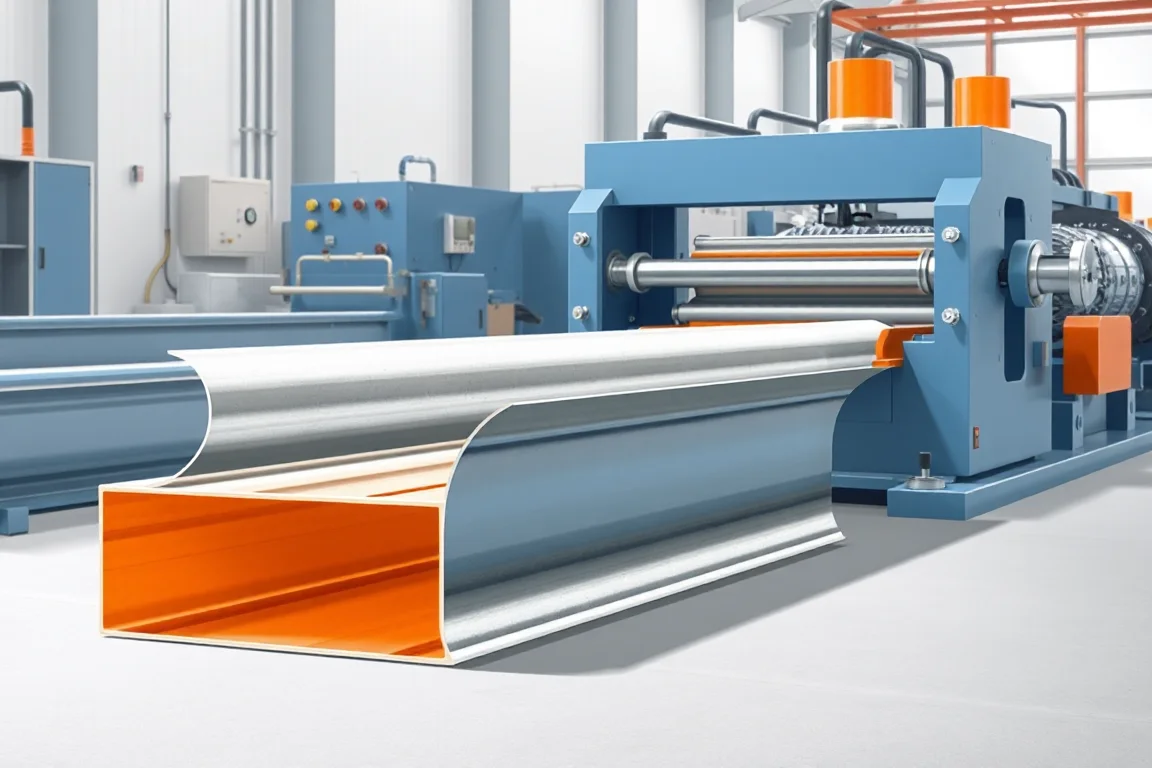
A hydroponic gutter roll forming machine produces long metal channels used to support plants and move water in controlled-environment growing systems. Unlike a roofing gutter line, the finished section is a crop-facing channel with a defined growing surface, edge treatment and drainage path. The machine forms strip into a continuous profile through successive roll stations, then cuts lengths that become part of a bench, rack or floor-mounted system.
This page is for buyers evaluating a forming line for metal hydroponic gutters rather than extruded plastic NFT channels. It explains what the equipment does, how the profile dictates tooling and downstream operations, and what to confirm before requesting a quotation. The practical questions are profile contour, material and coating route, hole and outlet positions, straightness over long lengths, and how the finished channel mates with covers, end caps and support brackets.
What a Hydroponic Gutter Line Actually Makes
The line converts flat metal coil into a shaped channel. A typical sequence uncoils the strip, feeds it through forming stations that bend the edges and base, punches or notches connection openings, and cuts finished lengths. The output is a rigid or semi-rigid metal trough that can carry a growing medium, a substrate mat or a bare-root crop support depending on the system design. The forming line does not mix nutrients, position plants or control irrigation; those functions belong to the wider installation.
What distinguishes a hydroponic gutter from ordinary rainwater goods is the internal geometry and the way the channel interacts with the crop zone. A rainwater gutter is usually judged on external shape, hanger fit and water capture from a roof. A growing channel is judged on the usable top opening, the internal depth available for roots or medium, the flatness of the base, the smoothness of the water path, and the way ends and outlets join to the rest of the system. These differences change both the roll tooling and the acceptance criteria.
The machine may form a single profile or be built for changeover between several channel widths and depths. Some lines produce a plain channel that is later drilled, slotted and fitted with separate end pieces. Others integrate punching and notching into the forming sequence so that connection holes appear in a known position relative to the profile datum. Each approach has consequences for cycle time, tooling cost and dimensional control.
Section Contour, Growing Surface and Drainage Interfaces
The contour determines how the channel behaves as a structural and hydraulic component. A common metallic growing channel has a broad open top, sloping side walls and a base that may be flat, slightly veed or formed with a shallow drainage channel. The base geometry affects how water moves toward an outlet and how stable a substrate block sits. Roll tooling must reproduce that geometry consistently, because small changes in bend angle alter the effective width and the fit of covers or clips.
A drainage outlet is usually created by punching or drilling after forming, or by a separate secondary operation. The position and diameter of that opening must be controlled relative to the channel base and end. If the outlet is punched in-line, the tooling must be timed to the cut length so that every channel receives the opening in the same place. If it is made off-line, the forming line only has to deliver a consistent channel, but the downstream operation still needs a repeatable datum.
Growing surface quality matters because the channel may hold a substrate or a root mat. A surface with waviness, twist or local dents can create uneven contact or water pooling. The forming line should therefore be assessed not only on profile dimensions but on flatness along the base and on the absence of marks transferred from dirty or damaged rolls.
Metal Forming Versus Plastic Extrusion
Extruded plastic NFT channels are produced by pushing molten polymer through a die. The cross-section is set by the die, the surface is normally smooth, and features such as fixing legs or internal ribs can be included in the extrusion. Setup for a new size means a new die and downstream calibration, but the process is well suited to constant-section, lightweight channels.
Roll forming is a cold metal process. Strip is bent progressively between rotating rolls, so the cross-section is created by tool geometry rather than a die orifice. Metal channels can be made in long lengths, can be coated before or after forming, and can be punched or notched in the same line. The trade-off is that sharp internal corners, deep returns and very complex undercuts are harder to form in metal than to extrude in plastic, and tooling is profile-specific.
For a grower or system builder, the choice between metal and plastic is not a simple quality ranking. Metal channels offer stiffness and the ability to span between supports, but they add weight and require a coating route that suits the installation environment. Plastic and metal channels need their own material, geometry and support assessment; neither material alone establishes an acceptable span or deflection. A metal gutter line makes sense when the project calls for a formed metal section that cannot be bought as a standard extrusion, or when local forming of long lengths reduces transport and joining.
Material and Coating Specification with Crop-System Review
The material and coating route must be agreed before tooling is designed. Base-metal thickness and grade affect springback, minimum bend radius and the force required at each station. A heavier strip may need more forming stations or larger roll shafts than a light strip of the same profile. The buyer should state the intended base metal and any protective coating, because the same profile formed in different materials will not behave identically.
Coating options for metal channels include pre-painted coil, metallic coatings and post-forming treatments. Pre-painted coil protects the visible surface but can crack or mark if bend radii are too tight or if rolls are not kept clean. Post-forming treatment can cover cut edges but adds a process step and its own handling requirements. The review should consider the whole crop system: how the channel is supported, whether it is covered, how it is cleaned between cycles, and what it contacts.
Review compatibility with the intended crop system using the actual alloy, coating formulation, water chemistry, cleaning method and operating environment. Obtain the relevant material evidence before approving that combination. The machine specification should record the material identity and the finishing route so that the formed channel can be assessed against the intended installation.
Coil Preparation, Surface Protection and Staged Forming
Good forming starts before the first roll station. Coil should be stored so that it is free from moisture, dirt and mechanical damage. The decoiler feeds strip at a controlled tension; too little tension can cause the strip to wander, while too much can stretch or mark the surface. A straightener or leveler may be used to remove coil set before forming, especially with thinner or pre-painted material.
Surface protection is a practical concern for visible and crop-facing surfaces. Rolls should be smooth, clean and free from rust or built-up debris. Guide devices should contact the strip at points that will not become visible in the finished channel where possible. If protective film is used, the line must handle it without wrinkling or trapping air.
Forming is staged across a number of stations. Each station makes a small bend, and the sum of those bends produces the final contour. The number of stations depends on profile complexity, material thickness and the allowable bend radius. A simple channel may need relatively few stations; a profile with returns, stiffening ribs and a shaped base needs more. Staging also affects setup: more stations mean more adjustment points but generally smoother material flow and less risk of surface damage.
Holes, Outlets, Ends and Separate Assembly Operations
Hydroponic channels usually need openings for drainage, connection or fixing. These can be round holes, slots or notches, and they can be made in-line or off-line. In-line punching is efficient but requires tooling synchronized with the forming and cut sequence. Off-line drilling or punching gives more flexibility for low volumes or varied hole patterns, but it adds handling and a separate datum.
End treatments are equally important. Some systems use a formed end that fits a connector or cap; others cut the channel square and rely on a separate molded or fabricated end piece. The forming line may include an end-forming station, or the cut length may simply be deburred and prepared for assembly. The acceptance check should include a trial assembly with the actual end caps, connectors and covers, because a channel that measures correctly in isolation can still fail to seat if the end geometry is wrong.
Secondary operations may include deburring, edge trimming, hole cleaning and the fitting of gaskets or seals. These are not always part of the roll forming machine, but they belong in the process route description. If they are excluded, the buyer should know who performs them and how the datum is maintained.
Long-Channel Straightness and Support
Hydroponic gutters are often long, and straightness matters because a curved channel is difficult to support and can create uneven water flow. Straightness is influenced by coil quality, strip tension, roll alignment, forming sequence and the way the cut length is handled after cutting. A channel that looks straight on the line may bow or twist when it is lifted or stacked.
Support spacing is a system design decision rather than a machine rating. The buyer should determine how the channel will be supported in the greenhouse or growing room and what deflection is acceptable. The forming line can be checked for consistent straightness by measuring a sample length on a flat surface and noting any bow, twist or camber. Recording these observations over several samples gives a more useful picture than a single measurement.
Profile Variants and Tooling Changes
Many projects need more than one channel size. A line can be designed for rapid tooling change or for dedicated production of a single profile. Quick-change systems use interchangeable roll sets, cassette stations or movable side frames. Dedicated lines focus on an approved profile, while changeable arrangements provide a defined transition method. Compare actual recovery time and accepted output rather than assuming either arrangement is always faster.
When evaluating a multi-profile line, ask how the datum is preserved after a changeover and how the punch and cut tooling are aligned to the new profile. The setup procedure should include a first-off sample check before full production. Tooling storage, lifting aids and alignment features all affect how quickly and repeatably a change can be made.
Cutting and Water-Management Interface Inspection
The cutoff is the last major operation in the line. It determines cut length accuracy, end squareness and burr condition. A flying shear or a stationary cut-off can be used depending on line speed and profile. The cut must not crush or distort the channel, and the end should be suitable for the intended connection method.
Inspection of the water-management interface should include the outlet position, the internal base profile near the outlet, and the fit of any end cap or connector. A practical check is to assemble a short sample with its outlet fitting and end pieces and confirm that the parts seat without forcing. This does not test hydraulic performance, but it does reveal dimensional mismatches that would cause problems during installation.
Output Including Handling and Finishing
Output should be defined as accepted length per shift for the actual profile, material and coating. Line speed alone is not a production rate, because changeover, coil changes, first-off inspection and secondary operations all consume time. The buyer and supplier should agree on a realistic figure for the specific project.
Handling and finishing are part of the output definition. Long channels need support during run-out and stacking to prevent bending. If the line includes automatic stacking or wrapping, that equipment affects the layout and the labor requirement. If finishing such as deburring or protective film removal is manual, it should be included in the production plan.
Practical Trial and Quotation Checklist
Use this checklist to compare proposals on a consistent basis. It is written for the buyer, and it does not replace a full technical specification.
- Profile drawing with dimensions, bend radii and datum points.
- Base metal, thickness, grade and coating route.
- Process route from coil to finished channel, including secondary operations.
- Punching and notching requirements, including hole positions and tolerances.
- Cutoff method, cut length range and end quality.
- Output target based on accepted lengths per shift for the real profile.
- Straightness requirement and the method used to check it.
- Tooling changeover procedure for any additional profiles.
- Handling, stacking and finishing arrangements.
- Acceptance checks: dimensions, trial assembly with covers and connectors, material identity and finishing route.
Request a first-off sample procedure that includes the normal handling and joining steps. A sample inspected only as it leaves the cutoff may not reveal problems that appear when the channel is lifted, stacked or assembled.
Frequently Asked Questions
Can one hydroponic gutter roll forming machine produce both metal channels and plastic NFT profiles?
No. Roll forming shapes metal strip by bending it between rolls, while plastic NFT channels are made by extrusion through a die. They are different processes with different equipment. A metal forming line can produce a range of metal profiles with the right tooling, but it does not produce extruded plastic sections.
How do I specify the drainage outlet position for quotation?
Provide a drawing that shows the outlet location relative to the cut end, the channel base and the profile datum. State whether the outlet is punched in-line or made off-line, and give the diameter or slot size. If the outlet must align with a fitting, include that fitting in the trial assembly requirement so the supplier can check the interface.
What material information should be fixed before tooling is designed?
The base metal, thickness, grade and coating route should be fixed. These affect springback, bend radii and roll pressure. If the material is likely to change later, say so during enquiry, because tooling designed for one strip may not form another to the same dimensions without adjustment.
Why is straightness treated as a separate acceptance point?
Long channels can bow or twist during forming, cutting or handling even when the cross-section is correct. Straightness affects support, water flow and assembly. It should be checked on a flat surface over a defined sample length, and the results should be recorded as part of the acceptance record.
Are end caps and covers part of the roll forming machine scope?
Usually not. The roll forming machine produces the channel; end caps, covers and connectors are often separate items. The scope should state which parts are included and which are supplied by others. The trial assembly should include the actual mating parts so that interface fit is verified.
How should I compare a metal channel proposal with an extruded plastic alternative?
Compare the full system, not just the channel. Consider span between supports, weight, coating route, connection method, cleaning access and local availability of lengths. Metal forming suits projects that need a specific metal section or long formed lengths; plastic extrusion suits projects that can use a standard constant-section profile. The right choice depends on the installation and the support design.

Continue your research
- Greenhouse Profile Roll Forming Machines
- Greenhouse Gutter Roll Forming Machine
- Greenhouse Channel Roll Forming Machine
- Greenhouse Film Locking Channel Machine
- Greenhouse Crop Support Channel Machine
- Greenhouse Purlin Roll Forming Machine
- How Greenhouse roll forming machine Works
- How To Choose a Greenhouse roll forming machine
- Greenhouse roll forming machine Price: What Affects the Cost?
Configuration & specification inputs
Match the configuration to your section drawing, material and production requirements.
| Parameter | Requirement / confirmation needed |
|---|---|
| Profile geometry | Hydroponic growing channels are often extruded plastics, not formed sheet metal. A metal-channel proposal needs an explicit material, coating and nutrient-contact review; this page compares process suitability rather than promising a universal hydroponic former. |
| Material | Specified protected metal sections; plastic growing channels use a different process |
| Thickness & grade | Buyer to specify base-metal thickness and grade; operating range requires supplier verification. |
| Process route | Coil preparation → connection punching → section forming → cutoff → greenhouse-interface checks |
| Cutting | Confirm profile-supported cutoff, cut lengths, end quality and any secondary operations. |
| Output | Define accepted output per shift with the actual profile and material. |
| Electrical supply | Buyer to state voltage / frequency / phase. Installed power requires a confirmed equipment schedule. |
| Acceptance | Compare the finished channel with its cover, connectors and other mating parts. Record material identity and the specified finishing route. Include normal handling and joining steps in the sample preparation so inspection reflects the delivered component. |