
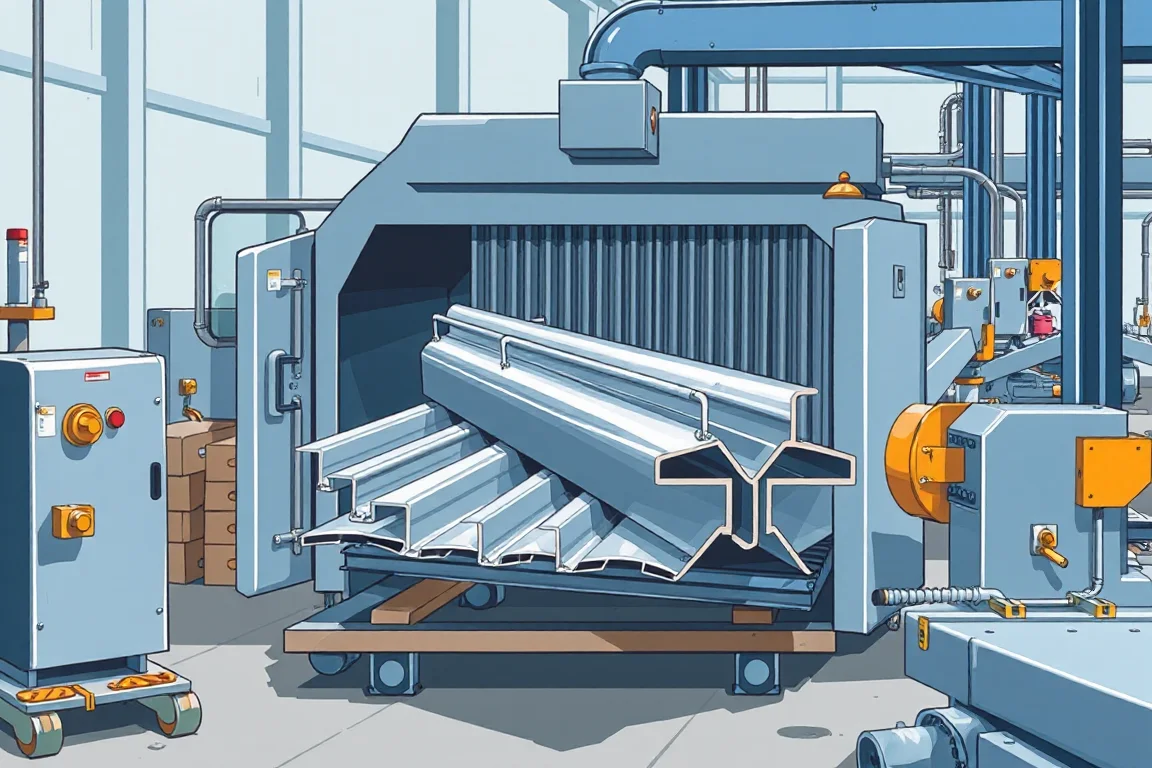
Production speed and output of a greenhouse roll forming machine is not a single number stamped on the equipment. It is the rate at which the line produces accepted lengths of the specified profile from the specified coil, with hole patterns, end cuts, and handling that match the greenhouse drawing. The practical question is how many usable meters or pieces leave the line per shift after setup, coil changes, punch cycles, cutoff, and quality checks. This guide explains the sequence, the interfaces that limit speed, and how to compare alternatives and quote scopes.
What “production speed” means for greenhouse profiles
In roll forming, line speed usually refers to the linear speed of the strip through the forming stations. That figure can be quoted for a machine, but it does not equal output. A greenhouse profile often includes a gutter drainage shape, a film-lock channel, a support section, and connection holes. The forming pass can run at one rate while the punch press, cutoff, and handling run at another. If the punch pattern requires multiple hits or the cutoff must produce a clean end on a shaped section, those operations may set the pace. Output is then the accepted length per shift, measured after rejects and rework are separated.
The production sequence and its interfaces
The typical sequence runs coil preparation, connection punching, section forming, cutoff, and greenhouse-interface checks. Coil preparation includes loading, uncoiling, and feeding the strip. Connection punching creates holes for fasteners, brackets, or film-retaining hardware. Section forming bends the strip through a series of rolls to produce the gutter, channel, or support shape. Cutoff separates the finished length. Interface checks confirm that the profile matches the drawing and that film-lock channels, drainage joints, and connection holes align.
Each step has an interface that can limit speed. The uncoiler must supply strip without dragging or slipping. The feeder must position the strip accurately for punching and forming. The punch press cycle time depends on hole count, pattern, and whether the holes are pierced in one stroke or several. The forming stations must accept the strip without marking or distortion. The cutoff must cut the profile cleanly and repeatably. If any interface is mismatched, the line may run slower than its forming sections could otherwise allow.
Why accepted output differs from nominal line speed
Accepted output counts only material that passes the greenhouse-interface checks. Rejected or reworked material does not count. Setup time, coil changes, punch tooling changes, and unloading time are not part of steady running speed but are part of the shift. The practical formula is accepted length = steady running speed × actual running minutes × good-output fraction. That arithmetic is a planning aid, not a machine rating. Actual running minutes exclude stoppages. Good-output fraction reflects the proportion of formed length that meets the drawing without rework. Dividing accepted length by a representative cut length can be useful only when the product mix and cutoff cycle permit that simplification; with mixed lengths and hole patterns, piece count is better tracked separately.
Profile, material, and thickness effects
Profile complexity influences speed because more forming stations and more gradual bends usually require more passes, and each pass adds a potential point of friction or misalignment. A simple support section may form faster than a gutter with a drainage shape and a film-lock channel. Material grade and thickness affect forming loads and springback. A thicker or stronger strip may need slower running to maintain shape and avoid marking. Coating type also matters: protected metal sections can be scratched or cracked if the rolls or guides are not suited to the surface. Plastic growing channels use a different process, so their production speed cannot be compared directly with metal roll forming.
Punching, cutoff, and handling as bottlenecks
Connection punching is often the bottleneck in greenhouse profile production because hole patterns are specific to the greenhouse drawing. If the pattern requires several holes at different positions, the punch cycle may take longer than the forming pass. A single-hit punch with a dedicated die can be quicker, but it may not suit every length or pattern change. Cutoff also matters: a shaped profile may need a cut that leaves a clean end for joining or for film retention. Handling long members and variable cut lengths requires an organized plan. If the greenhouse design needs secondary curving or joining, those operations add time and should be planned separately from the roll forming line.
Measuring accepted output per shift
To measure accepted output, count only lengths that pass the interface checks. Record actual running minutes, not nominal shift minutes. Track coil changes, setup, punch changes, and unloading as separate categories. Measure the intended cut-length and hole-pattern mix so that the output figure is tied to a real product. If the mix changes frequently, measure output for each representative length or group similar lengths. Rejected or reworked material should be counted separately and investigated for causes such as hole misalignment, edge marking, or dimensional drift. This approach gives a realistic output figure that can be compared across alternatives.
Comparing equipment and line configurations
When comparing alternatives, consider how each configuration handles the profile, material, and hole pattern. A line with more forming stations may run a complex profile more consistently but may require more setup time. A line with a dedicated punch press may be faster for a fixed pattern but less flexible for pattern changes. A line with an integrated cutoff may reduce handling but may limit cut-length flexibility. The tradeoff is between speed for a stable product and flexibility for a changing product mix. The right choice depends on the greenhouse drawing and the expected production schedule.
Quote scope and cost of accepted output
A quote for a greenhouse roll forming machine may cover different scopes. It might include only the forming machine, or it might include uncoiler, feeder, punch press, cutoff, and runout table. It might include tooling for one profile or for several. It might include installation, training, and commissioning, or not. To compare quotes, normalize the scope so that each includes the same functions and the same expected output definition. The cost of accepted output is not the machine price alone; it includes coil, labor, setup time, tooling changes, and the cost of rejects and rework. A lower machine price with a narrow scope can lead to higher cost per accepted meter if it requires more manual handling or has limited punch capacity.
FAQ
How is production speed measured on a greenhouse roll forming machine?
Production speed is usually measured as the linear speed of the strip through the forming sections, but that figure alone does not determine output. For planning, measure accepted output per shift by counting only lengths that pass the greenhouse-interface checks and dividing by actual running minutes. This accounts for punch cycles, cutoff, and handling.
Can a machine run at its quoted line speed all shift?
Quoted line speed is typically a steady running rate, not a shift average. Coil changes, setup, punch tooling changes, and unloading interrupt running time. The practical shift output depends on how quickly those interruptions are managed and how often they occur.
What limits output more: forming or punching?
Either can be the bottleneck. If the hole pattern is complex or requires multiple hits, punching may take longer than forming. If the profile is complex and requires many forming stations, forming may set the pace. The actual bottleneck should be identified by measuring running time at each stage.
How does material thickness affect production speed?
Thicker or stronger material usually requires slower forming to control springback and avoid marking or distortion. The operating range depends on the machine and tooling design. Buyers should specify base-metal thickness and grade and verify the operating range with the supplier.
Why is accepted output lower than nominal speed times shift minutes?
Accepted output excludes rejected or reworked material and accounts for stoppages. Nominal speed times shift minutes assumes continuous running with no quality losses. In practice, setup, coil changes, and quality checks reduce available running time, and some material may not meet the drawing.
Does a hydroponic channel run faster than a gutter profile?
A channel called hydroponic is not automatically suitable for contact with nutrient solution, and its production speed depends on the same factors as any other profile: shape complexity, material, punching, and cutoff. For growing systems, evaluate suitability for the actual nutrient and cleaning environment separately from speed.
Practical checklist for evaluating production speed and output
- Define the specific profile and its greenhouse-interface requirements: film-retaining hardware fit, drainage joints, and connection holes.
- Specify base-metal thickness and grade, and confirm the operating range with the supplier.
- Count the hole pattern and decide whether punching will be single-hit or multi-hit.
- Confirm cut lengths and end quality required by the greenhouse drawing.
- Measure running minutes rather than nominal shift minutes.
- Count rejected or reworked material separately.
- Measure the intended cut-length and hole-pattern mix.
- Include coil changes, setup, punch changes, and unloading in the shift plan.
- For growing systems, evaluate material and coating suitability for the nutrient and cleaning environment.
- Compare quotes on a normalized scope that includes the same functions and output definition.
Continue your research
- Greenhouse Profile Roll Forming Machines
- Greenhouse Gutter Roll Forming Machine
- Greenhouse Channel Roll Forming Machine
- Greenhouse Film Locking Channel Machine
- Greenhouse Crop Support Channel Machine
- Greenhouse Purlin Roll Forming Machine
- How Greenhouse roll forming machine Works
- How To Choose a Greenhouse roll forming machine
- Greenhouse roll forming machine Price: What Affects the Cost?