
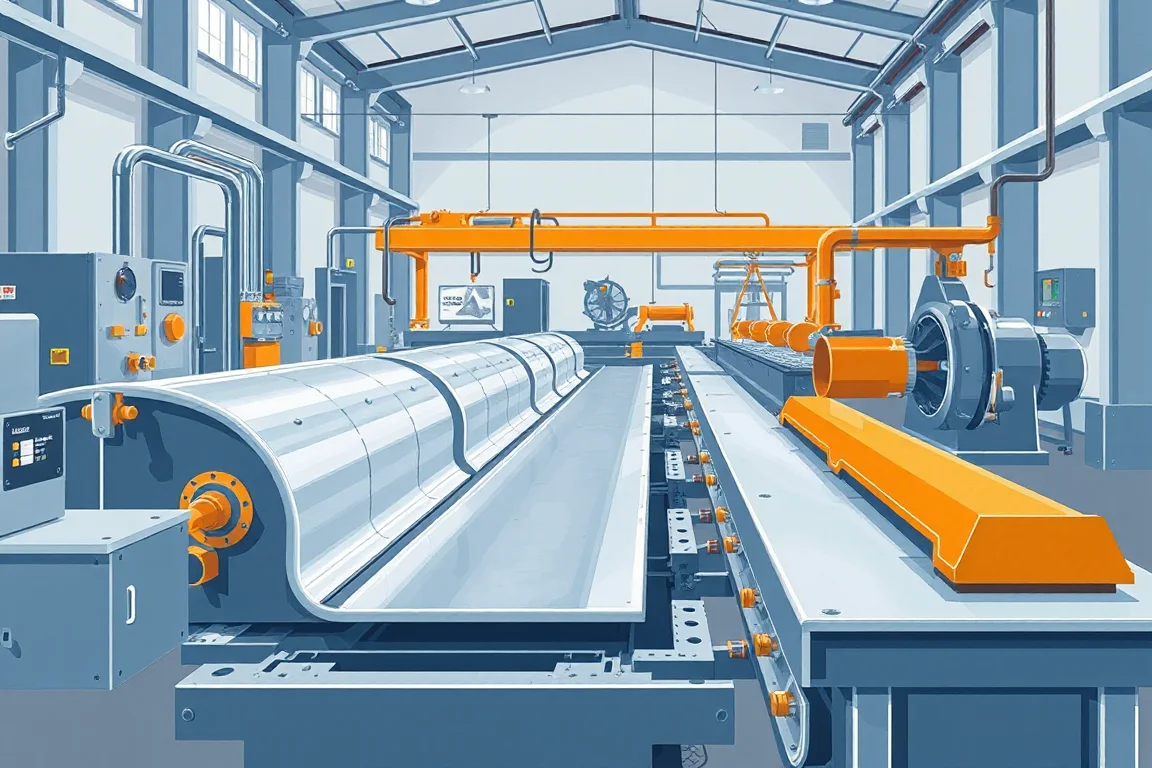
The basic transformation: flat coil into a continuous greenhouse profile
A roll forming machine does not carve or mould a greenhouse part from a billet. It takes a narrow strip of metal — usually supplied as a coil — and bends it progressively through a series of paired rolls until the cross-section matches a drawing. For greenhouse work, the profile might be a drainage gutter with a folded lip, a film-lock channel that grips plastic sheeting, a structural support section, or a connection rail that ties into a frame. The machine itself is a sequence of stations arranged along a common pass line. Each station performs one small increment of bending, and the cumulative effect produces the final shape. Understanding how the machine works means understanding that sequence, the interfaces between stations, and where the finished profile is measured against the greenhouse drawing.
Why greenhouse profiles suit roll forming
Greenhouses use long, uniform sections: gutters that run the length of a bay, film-lock channels that hold covering material, and support members that repeat across a structure. Roll forming is efficient for these because it can produce a constant cross-section in long lengths from coil, with connection holes punched in the same pass. The alternative — press braking or bending discrete sheets — interrupts the length and often requires separate hole-making. For a component whose function depends on a continuous channel or a consistent edge detail, a roll forming line can integrate forming and punching so the part exits ready for assembly. That integration is a key reason the process is chosen, but it also means the line layout must be planned around the actual component drawing, not around a generic machine description.
Stage 1: coil preparation and strip feeding
The process begins with coil handling. A coil is loaded onto a mandrel or reel, and the leading end is threaded into the line. Coil preparation includes checking that the strip width, base-metal thickness and grade match what the tooling was designed to accept, and that the coil is clean and free from edge damage that could mark the rolls. A straightener or flattener may be used to remove coil set — the residual curvature from coiling — so the strip enters the first forming station flat and square. If the strip is not presented consistently, every downstream station inherits that variation. Feed rolls then drive the strip forward at a controlled rate. The interface here is mechanical: the strip must be centred, supported and advanced without slipping, because the forming rolls depend on a predictable strip position to bend the correct amount.
Stage 2: connection punching before forming
Many greenhouse components need holes, slots or notches for fasteners, brackets, drainage connections or film-retaining hardware. In a typical line, punching or piercing occurs before or between forming stations, while the strip is still flat or only partly shaped. This is easier than punching a finished three-dimensional profile, because the tooling can act on a flat surface with predictable support. The process boundary matters: punching is a separate operation from forming, even if it is integrated into the same line. It requires its own tooling, its own tonnage and its own maintenance. If the quotation omits punching, the holes still have to be made somewhere — perhaps on a separate press, perhaps manually. The question for a buyer is not only whether punching is included, but how the hole positions are referenced to the forming stations so that the finished part matches the greenhouse drawing.
Stage 3: progressive section forming through roll stands
Forming is the core of the machine. The strip passes through a series of roll stands, each with a pair of contoured rolls. The first stands may only gently bend the edges; later stands close the section, create folds, or form a seam. The number and design of stands depend on the complexity of the profile: a simple channel might need few stands, while a gutter with a folded lip, a drainage slope and a film-lock groove may need many. Each stand adds a controlled amount of deformation. If a stand is misaligned or a roll is worn, the bend may be over- or under-formed, and the error can accumulate. The interface between stands is the travelling strip itself: it must remain aligned and supported as it moves from one pair of rolls to the next. The machine frame, roll shafts and bearings all contribute to keeping that pass line stable.
Stage 4: cutoff and end quality
After forming, the continuous profile is cut to length. Cutoff may be a shear, a saw or another method, but for greenhouse profiles it is usually a shear that severs the section without creating excessive distortion. The cutoff station is a process boundary because it changes the part from a continuous strip into a discrete component. The cut length is set by the control system, and the end quality — burrs, deformation, squareness — affects how the part fits during greenhouse assembly. Some lines integrate secondary operations after cutoff, such as notching or hole-punching on the finished profile. If those operations happen elsewhere, the part may need to be re-referenced, which introduces a handling step and a potential source of variation. A practical question is how the part is held and located for any post-cut operation, and whether that matches the way it will be held in the greenhouse frame.
Stage 5: greenhouse-interface checks
Once a part is formed and cut, its function depends on how it interfaces with the rest of the greenhouse. A film-lock channel must accept the retaining hardware that grips the plastic film. A drainage gutter must connect to downpipes or joints without leaking, and its section must shed water as intended. A support section must line up with brackets or posts. These are not machine settings; they are drawing and assembly checks. The roll forming line can produce a profile to a specified cross-section, but whether that cross-section actually works with the film, the nutrient solution, the cleaning regime or the structural connection is a separate question. For components in contact with nutrient solution, material and coating suitability need specialist confirmation. A channel described as hydroponic is not automatically suitable for that environment.
Integrated versus separate operations: what the line does and does not do
A roll forming line may integrate uncoiling, straightening, punching, forming, cutoff and even stacking. It may also leave some operations manual or off-line. The distinction matters because an operation omitted from the line still has to happen somewhere in the manufacturing route. For example, a line might form and cut but not punch; the holes are then made on a separate press. A line might punch and form but not notch; the notch is made later. The physical sequence of the line is not the same as the complete manufacturing route. A buyer should identify the input and output of each station and then trace the part through every step, including any manual handling, secondary machining, deburring or inspection. If an operation is not in the quotation, it is worth asking who supplies its tooling and who is responsible for the interface between the line output and the next step.
Comparing alternatives: roll forming versus other processes
Roll forming is one option among several. Press braking bends flat sheet in discrete operations, which can be flexible for low volumes or varied shapes but is slower for long, uniform sections and usually requires separate hole-making. Extrusion is common for plastic components such as hydroponic channels; a metal gutter line is not a substitute for a plastic extrusion system, because the material, tooling and process physics are different. Welding or fabrication from standard sections can produce structural members but may not deliver the seamless film-lock detail or the consistent drainage shape that a roll formed profile provides. The right choice depends on the component function. For a long gutter with a folded lip and punched holes, roll forming can integrate the steps. For a plastic growing channel, extrusion is the relevant process. For a one-off structural bracket, press braking may be more practical. The tradeoff is usually between tooling investment and per-part efficiency, and between process integration and flexibility.
Practical checklist for assessing a proposed line
- Identify the input and output of each station: what goes in, what comes out, and what is inspected.
- Distinguish the line's physical sequence from the complete manufacturing route. List every step from coil to assembled greenhouse part.
- Mark every point where the part is gripped, referenced, punched, bent, cut, joined or inspected.
- Confirm how the part is referenced again after cutting or any secondary operation, and whether that reference matches the greenhouse frame.
- Check that the profile's connection holes, drainage joints and film-retaining features match the greenhouse drawing.
- For components in contact with nutrient solution or cleaning chemicals, confirm material and coating suitability with a specialist.
- Confirm what operations are included in the quotation and what is assumed to happen elsewhere.
FAQ
Does a roll forming machine make the whole greenhouse frame?
No. It produces specific components such as gutters, film-lock channels, support sections or connection rails. The frame also includes posts, trusses, fasteners and other parts that may be made by different processes or purchased as standard items. The machine's role is to form the profile functions that suit roll forming, not to produce every piece of the structure.
Can the same line make both metal gutters and plastic hydroponic channels?
Generally not. Metal roll forming deforms coated steel strip through rolls; plastic channels are usually extruded, where molten polymer is forced through a die. The materials, tooling and process conditions are different. A metal gutter line is not a substitute for a plastic extrusion system, and a channel labelled hydroponic is not automatically suitable for contact with nutrient solution.
Where are the connection holes made?
They are typically punched before or between forming stations, while the strip is flat or partly shaped. This is easier than punching a finished profile. The punching station may be integrated into the line or performed separately. Either way, the hole positions must be referenced to the forming stations so the finished part aligns with the greenhouse drawing.
What determines the cut length?
The cut length is set by the control system and the cutoff station. It should match the greenhouse design and account for any end features or joints. The cutoff method affects end quality; a shear is common, but burrs or deformation can affect assembly. If secondary operations follow cutoff, the part may need to be re-referenced.
How do I know if the line is suitable for my profile?
Walk through the proposed process with one actual drawing. Mark every point where the part is gripped, referenced, punched, bent, cut, joined or inspected. Confirm that each operation is either included in the line or deliberately handled elsewhere, and that the interfaces between operations are defined. The drawing, not a generic machine description, should drive the assessment.
Can a roll formed channel be used for growing crops?
Only if the material and coating are suitable for the actual nutrient and cleaning environment. A channel may be described as hydroponic for shape reasons, but that does not confirm chemical compatibility. Material and coating suitability need specialist confirmation for the specific solution, cleaning agents and operating conditions.
Continue your research
- Greenhouse Profile Roll Forming Machines
- Greenhouse Gutter Roll Forming Machine
- Greenhouse Channel Roll Forming Machine
- Greenhouse Film Locking Channel Machine
- Greenhouse Crop Support Channel Machine
- Greenhouse Purlin Roll Forming Machine
- How To Choose a Greenhouse roll forming machine
- Greenhouse roll forming machine Price: What Affects the Cost?
- Materials and Thickness for Greenhouse roll forming machine