
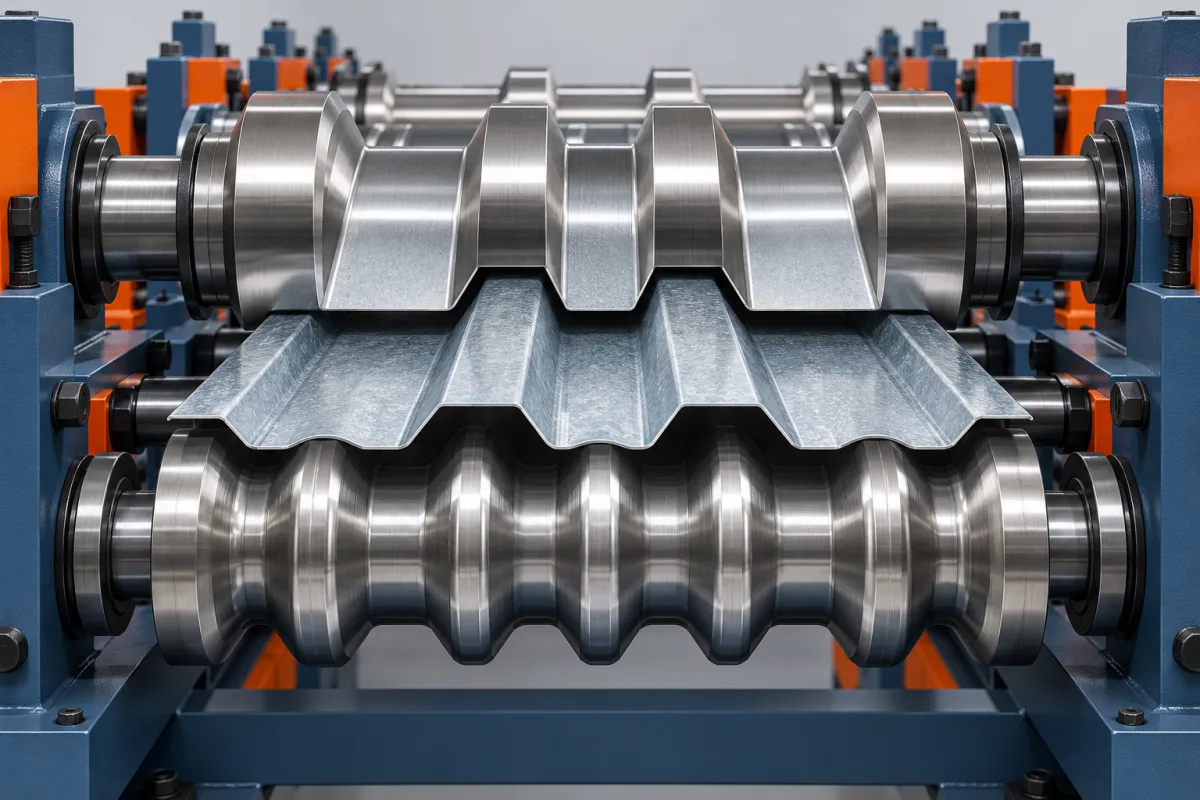
Roofing-sheet roll tooling must create the full cross-section, including the ribs, pans and two functional side laps. The visible central pattern is only part of the task. A useful tooling review explains how the flat strip develops into that section, which material combinations are covered, and how the final sheet will be measured and assembled.
Freeze the roof section before approving tools
The tooling drawing should distinguish overall width from effective installed cover and show both terminal edges. Include relevant bend geometry, rib spacing and fixing details. A photograph or local profile nickname does not reliably communicate these dimensions.
Place two adjoining profiles together in the drawing. This reveals the lap relationship and makes acceptance more meaningful. A tool set can reproduce an attractive repeating rib while still failing to make the correct overlap; the joint is therefore a primary design input, not a cosmetic check at the end.
Understand why progressive development matters
The strip reaches its final shape through a sequence of intermediate forms. The distribution of forming work can affect straightness, edge behavior and finish. Reviewing only the last pass overlooks how the preceding stages establish the material path.
Ask the tooling specialist to explain the proposed development around the difficult features, especially unequal laps or appearance-sensitive wide pans. The buyer does not need to prescribe unsupported roll settings. The goal is to understand the engineering rationale and the evidence used to validate it.
Do not use station count as a quality score
More stands are not automatically better, and fewer stands are not automatically more efficient. The required arrangement depends on the section, material and tooling concept. Compare accepted samples, material coverage and documented design boundaries instead of ranking machines by one count.
A proposal should identify which required products share tools and which require a different set or forming path. If a supplier describes a flexible arrangement, ask which dimensions can change and what physical components and checks are involved. Adjustable width is not the same promise as interchangeable rib geometry.
Treat the lap edges as functional tooling features
The overlap and underlap may look similar in an isolated sample but have different duties in the installed joint. Measure them using the drawing's references and check the assembled cover. Keep a mating sample so an edge is not approved solely because its outside height looks correct.
Pay attention to the condition near the sheet ends. The forming route and cutoff support must leave a usable joint there as well as in the middle. A short section cut from a convenient central area cannot represent the entire saleable panel.
Connect material approval to the tool set
Provide grade or alloy, thickness convention, strip width and finish for every intended product combination. The behavior of a material after bending can change the final shape. A successful trial on one coil is evidence for that condition, not proof of an unlimited range.
Surface requirements also belong in the tooling brief. Identify the exposed side and any protective layers. Inspect the contact areas and tight features with the actual finish after production handling. A tooling change intended to improve shape must not introduce unacceptable appearance damage.
Coordinate forming tools with cutting tools
The cutting arrangement should be reviewed as part of the route that delivers the final sheet. Where cutting occurs after forming, the section-specific support and cutting components need to suit the approved profile. Changing a rib or lap can have consequences beyond the forming rolls.
Ask the supplier to show the tools required for each product and explain how replacements are identified. Keep cutoff references with the profile setup record. This avoids fitting a component that appears similar but belongs to another version of the roof section.
Design changeover around recovered quality
For multiple profiles, document the tools, guides, references and controls associated with each setup. A changeover ends when the first sheet meets the agreed criteria, not when the last roll component has been moved. Include trial assembly of the side laps in the recovery check.
- Identify tools and change parts by profile and revision.
- Preserve the approved setup and inspection references.
- Define how the first recovered sheet is accepted.
- Demonstrate a return to a previous profile, not just a one-way change.
- Record any manual work omitted from the headline changeover claim.
Use samples to test design assumptions
A good trial matrix includes the combinations that challenge the tooling concept. Those might be a critical lap, a finish-sensitive material or a required boundary profile. Ask why the selected samples are representative rather than choosing them only because suitable coils happen to be available.
Record profile dimensions, assembled cover, straightness, surface condition and cut-end quality in defined inspection conditions. Keep the coil identity and setup with the samples. If results later diverge, these records help determine whether material, tools, measurement or handling changed.
Protect design intent during service and future modifications
Roll wear, damage and undocumented substitutions can move a once-accepted process away from its original condition. Maintenance and replacement work should preserve the profile's approved tooling references. Use qualified personnel and the maker's procedures for inspections and changes.
A new customer request for a slightly different cover width or lap is an engineering change, even when it looks small on a sketch. Determine the effect on forming, cutting and assembly before promising compatibility. Local rework without a controlled drawing can create a product that no longer matches either version.
Frequently asked tooling questions
Can one tool set make every trapezoidal roof sheet?
No. Rib spacing, heights, pans and terminal laps differ. A tool set covers the geometry and adjustments it was designed for. Obtain a defined profile envelope rather than relying on the broad trapezoidal label.
Is overall width enough to check a tooling sample?
No. Two sheets can have similar overall width but different effective cover or lap fit. Inspect the complete section and assemble adjoining panels using the intended reference conditions.
Should I ask for the highest possible roll hardness?
Tool material and treatment are engineering choices tied to the workpiece and duty. Request the supplier's specification, service expectations and replacement plan rather than selecting an isolated hardness value without the design context.
What proves a tool change was successful?
An accepted first-off sheet and a stable representative run, including functional lap checks and surface inspection. Completing the mechanical change is only one step toward recovered production.
Continue your research
- Roofing Sheet Roll Forming Machines
- Corrugated Roof Sheet Roll Forming Machine
- Trapezoidal Roof Sheet Roll Forming Machine
- R Panel Roll Forming Machine
- PBR Panel Roll Forming Machine
- IBR 686 Roofing Sheet Machine
- How Roofing sheet roll forming machine Works
- How To Choose a Roofing sheet roll forming machine
- Roofing sheet roll forming machine Price: What Affects the Cost?