
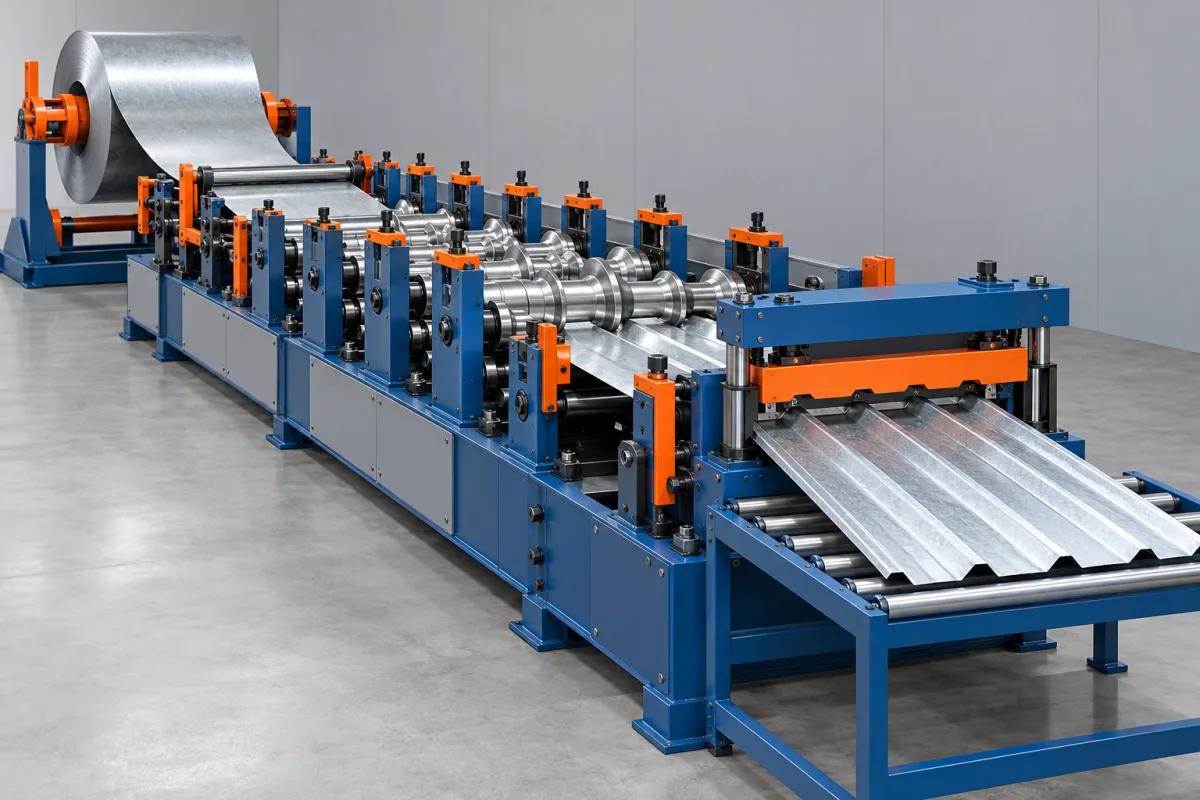
A roofing sheet roll forming machine converts flat metal coil into a repeating roof section by developing its ribs, pans and side laps through successive roll stages. The sheet becomes useful roofing only when the profile, material, cut length and joining edges match the intended roof system. Understanding that sequence makes it easier to specify a line, identify missing operations and diagnose why a sheet that looks acceptable in isolation does not fit its neighbor.
Begin with the installed sheet, not the machine silhouette
A trapezoidal roof, a corrugated sheet and a tile-effect panel are different forming targets. A repeated cross-section can usually be described by a transverse section drawing, but a tile effect also introduces a longitudinal feature that requires a defined additional operation. The production brief must show both directions when the finished appearance changes along the sheet.
Draw two adjoining sheets in their installed relationship. Identify the overlap edge, underlap edge, effective cover and fixing arrangement. These details explain what the tools must reproduce. A machine drawing showing many stands cannot establish compatibility with a particular roof profile without this product definition.
Coil payoff supplies a controlled material path
The payoff equipment supports the specified coil and supplies strip in the required orientation. The equipment layout needs an actual coil envelope, loading arrangement and entry path. A coil that fits a nominal weight description may still have an unsuitable bore, outside diameter or width, so those characteristics must appear separately in the enquiry.
Visible-face orientation matters for coated roofing. Record which side becomes the roof exterior and how the coil is loaded to obtain it. Include any protective film or backing in the process review; a coating trial with bare steel does not answer whether the saleable finished product can be produced without marking.
Entry guidance establishes the strip reference
The entry arrangement presents the strip to the roll passes. Its purpose is not to compensate for an incorrect slit width or an incompatible coil grade. Incoming material and the agreed setup need separate checks so a material change is not hidden by repeated undocumented adjustments.
For training and inspection, identify a consistent reference edge on the drawing and sample. That reference helps connect a dimensional deviation to its location in the sheet. If the underlap is wrong while the central ribs remain consistent, the investigation is different from a whole profile that has shifted relative to the strip.
Successive roll stages develop the ribs and laps
Each stage contributes to the cross-section rather than imposing the entire final shape at once. The development must account for the central ribs and the unequal terminal edges. The final pass geometry is therefore only one part of the tooling design; the route used to reach it also matters.
Ask the supplier to explain how the chosen sequence preserves the specified face, lap and cover width across the material combinations being purchased. Do not infer better results from stand count alone. Two lines with different tooling concepts can require different arrangements to produce the same accepted section.
Precut and postcut lines place the length operation differently
A precut arrangement cuts flat material before it passes through the forming section. A postcut arrangement cuts the formed profile downstream. That distinction affects material movement, cutoff tooling and the way the leading and trailing ends are supported. Neither label by itself establishes which option is best for a particular order mix.
Use actual short and long roofing orders in the comparison. Request sample ends and an explanation of length control, transitions and scrap handling. On a postcut line, assess the condition of ribs and laps close to the cut; on either route, the finished sheet must meet the same agreed dimensional and appearance requirements.
A roof-sheet line is not a complete roofing factory by default
The principal former may not supply ridge caps, valley pieces, eaves flashings, closures or gutters. Those items can require separate folding, cutting or forming equipment. Identify them in the business plan without assuming that a roof-sheet profile tool set also makes every trim used on the building.
- List the main panel profiles and their dedicated or shared forming paths.
- List accessory products and the equipment route for each.
- Identify any film, backing, punching or embossing operation.
- Define what reaches the packing station and what still needs fabrication.
Supported discharge protects the product already made
A long sheet leaving the cutoff needs an appropriate discharge and stacking method. If it is damaged there, a successful forming operation still produces a rejected order. Layout planning must include the longest required panel, bundle removal and access for inspection rather than just the footprint of the forming stands.
Consider color changes and small orders as well as continuous runs. Separation, identification and packing can become the practical constraint. Keeping order labels associated with the correct lengths helps prevent a dimensionally sound sheet from being delivered to the wrong roof area.
Measure output as usable coverage
Line speed describes strip movement; it does not directly describe roof area delivered. For an illustrative order of 60 accepted sheets at 4 metres long and 0.9 metre effective cover, nominal coverage is 60 × 4 × 0.9 = 216 square metres. These assumed values explain the calculation and are not equipment ratings.
Include the elapsed time for the agreed production boundary, such as setup, forming, cutting and stack removal. Count rejects separately. Do not use overall sheet width in place of effective cover, and do not confuse production coverage with a building takeoff that includes openings and installation waste.
Follow one trial order from coil to adjoining sheets
A useful acceptance demonstration retains the coil identity, drawing revision and setup reference. Inspect first-off sheets, sheets from the continued run and the required end lengths. Assemble adjoining sheets under the defined support condition to verify that the overlap works after normal production handling.
- Confirm the incoming grade, thickness convention, width and finish.
- Measure the profile and cut lengths using agreed references.
- Check both terminal edges and the assembled cover.
- Inspect bends, visible faces and cut ends for unacceptable damage.
- Record accepted quantity, stops and unresolved deviations.
Frequently asked questions about the working process
Does the machine heat the sheet before forming it?
Conventional cold roll forming develops the section mechanically without a heating stage being the defining process. Any special treatment or coating operation must be separately specified. Do not add an assumed heating requirement to a standard roof-sheet enquiry.
Why are the two outside ribs different?
They may perform different overlap and underlap functions. Their relationship determines how adjoining sheets cover the roof. Inspecting only a central repeating rib misses this important distinction.
Can a roof sheet simply be turned over for another product?
Not without checking the finish, lap orientation, fixing detail and intended system. The visible silhouette does not establish that the reversed sheet has a suitable weathering or attachment arrangement.
Does an accepted sheet prove the roof will not leak?
No. The equipment trial verifies manufacturing outputs. Roof performance also depends on the specified system, installation, supports, penetrations and project conditions. Keep manufacturing acceptance connected to, but distinct from, roof-system approval.
Continue your research
- Roofing Sheet Roll Forming Machines
- Corrugated Roof Sheet Roll Forming Machine
- Trapezoidal Roof Sheet Roll Forming Machine
- R Panel Roll Forming Machine
- PBR Panel Roll Forming Machine
- IBR 686 Roofing Sheet Machine
- How To Choose a Roofing sheet roll forming machine
- Roofing sheet roll forming machine Price: What Affects the Cost?
- Materials and Thickness for Roofing sheet roll forming machine