
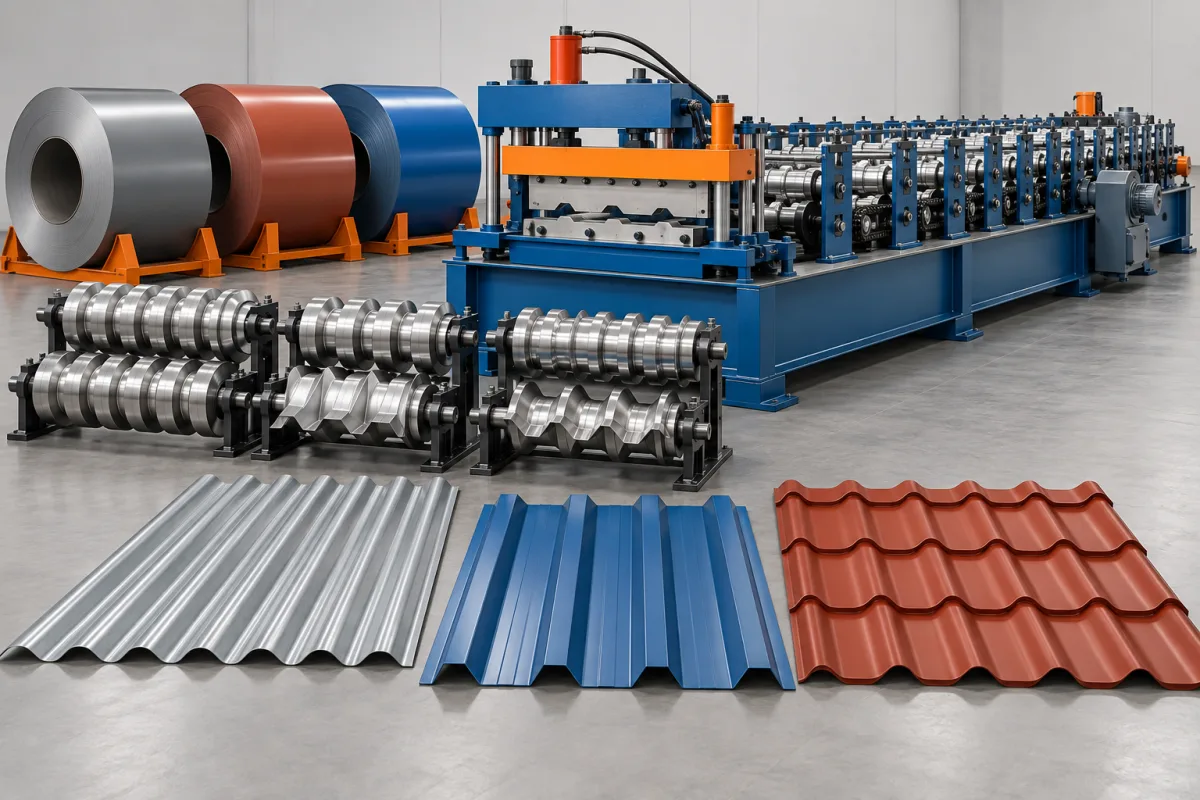
Choosing a roofing sheet roll forming machine starts with deciding which roof products must leave the factory, in what quantities and with what changeovers. The most useful comparison is between complete routes that make the same accepted sheets. A low purchase price or high advertised strip speed is difficult to interpret until the profile, coil and handling requirements are fixed.
Turn your intended market into a product list
Write down the roof sections customers actually need, including their laps, cover widths and finishes. Avoid using local nicknames as the only specification: two sheets sold under a familiar profile name can differ at an outside rib. Obtain drawings or measured reference samples before asking suppliers to propose tooling.
Separate the dominant product from occasional requests. A company producing one repeated industrial roof panel faces a different equipment decision from a service shop switching between several residential profiles and colors. This distinction matters more than a general ambition to serve every roofing application.
Build a matrix of material and profile combinations
For each profile, state the intended grade or alloy, thickness convention, coating, strip width and finished lengths. Show which combinations are genuinely required rather than presenting independent maximum values. The widest sheet, strongest grade and thickest material may not belong to the same product.
Identify the appearance standard for exposed surfaces. If protective film or a backing is included, make it part of the specification and trial. A seller's demonstration using different material can illustrate the line but should not replace confirmation of your own production envelope.
Choose one profile or several for a reason
A dedicated line concentrates the investment around a stable roof section. Its attraction is not simply fewer controls; it gives the production team one main tooling condition to document and recover. However, it may leave a separate market requirement unmet if another rib pattern is commercially important.
A multi-profile proposal should explain exactly what changes. Alternatives include distinct forming paths or replaceable tooling arrangements. Ask whether guides, cutoff parts, settings and discharge references change too. Having two profiles available does not necessarily mean producing them simultaneously.
Evaluate the actual changeover, not its label
Request a timed demonstration from the last accepted sheet of one required setup to the first accepted sheet of the next. Include threading, tool or path changes, checks and sample approval within the agreed boundary. Timing only the movement of one assembly gives an incomplete view of the production interruption.
For a planning example, assume five weekly changes each take 40 minutes more on one proposal than another. That is 200 minutes of additional weekly occupation before considering labor and scrap. Those assumed times do not predict a real line; they show why frequent changes can outweigh a modest difference in steady forming speed.
Compare precut and postcut against your orders
Review the intended minimum and maximum lengths, end condition and production sequence with each bidder. Cutting flat stock before forming and cutting the finished section create different equipment arrangements. The appropriate choice should emerge from sample quality, throughput, handling and lifecycle scope for your sheets.
Require representative short orders as well as long panels in the trial. A line demonstrated only on convenient middle lengths may leave the most difficult handling case unexplored. Inspect the profile close to both ends and confirm how the final order count is obtained.
Draw the movement of coils and finished panels
Plot receiving, coil storage, loading, entry, forming, discharge, inspection and bundle removal. Check the space required by the longest production sheet and the actual loading equipment. A quotation dimension for the mill alone does not define the floor area needed to operate the production route.
Identify where different colors and orders wait without becoming mixed. Consider whether a bundle can be removed while the next order is being prepared under the proposed operating arrangement. Treat safe access and required guarding as design inputs rather than items to squeeze into leftover space.
Price the equipment boundary consistently
Give every supplier the same inclusion schedule. Ask for coil handling, forming tools, required cutoff components, controls, supports, stacking and commissioning to be identified. Accessories and trim production need their own lines in the comparison so a bare panel former is not compared directly with a broader manufacturing package.
- Included profiles and the material combinations accepted for each.
- Required change parts, spare tooling and setup documentation.
- Loading and finished-panel handling equipment.
- Installation, training, utilities and transport responsibilities.
- Acceptance samples, measurement methods and unresolved exclusions.
Use a trial scorecard with weighted priorities
Separate mandatory requirements from preferences. A panel that cannot make the required lap should not be rescued by a high score for convenience or speed. Once mandatory requirements are met, compare changeover, scrap, supportability and handling using a consistent trial order.
For example, a shop supplying finish-sensitive architectural roofs might prioritize surface condition and bundle protection, while a stable industrial-panel schedule may place more weight on sustained accepted output. Write those priorities before demonstrations so an impressive feature does not distract from the business requirement.
Check support through an operational scenario
Ask how your staff obtain the correct replacement cutoff component, recover a documented setup and identify a part from the supplied records. Request an explanation of training and fault escalation. A generic promise of support is less useful than evidence that the actual product configurations will be documented.
Consider future profiles cautiously. Obtain a written boundary between adjustments already supported, additional tooling that can be engineered and changes that require another route. This prevents the word flexible from becoming an unsupported assumption in the investment plan.
Frequently asked selection questions
Should a new business buy the fastest line it can afford?
Only if the complete order flow can use that capability. For short mixed orders, coil preparation, changeover and packing may occupy more time than forming. A balanced route is more useful than unused speed at one station.
Is a double-level line automatically better than two separate lines?
No. Compare space, shared equipment, scheduling and profile availability. Separate lines and shared-path arrangements solve different business constraints; evaluate them against simultaneous demand and the actual change sequence.
Can I postpone choosing the exact lap until commissioning?
That risks changing the product after tools and cutting components have been designed. Resolve the mating edges and cover width before final tooling approval, then use them as acceptance references.
What should be in the first enquiry?
Send section drawings, material combinations, length ranges, an indicative order mix and the intended factory layout. Add finish and packing requirements. These inputs allow proposals to be compared on the same roof products rather than on vague machine categories.
Continue your research
- Roofing Sheet Roll Forming Machines
- Corrugated Roof Sheet Roll Forming Machine
- Trapezoidal Roof Sheet Roll Forming Machine
- R Panel Roll Forming Machine
- PBR Panel Roll Forming Machine
- IBR 686 Roofing Sheet Machine
- How Roofing sheet roll forming machine Works
- Roofing sheet roll forming machine Price: What Affects the Cost?
- Materials and Thickness for Roofing sheet roll forming machine