
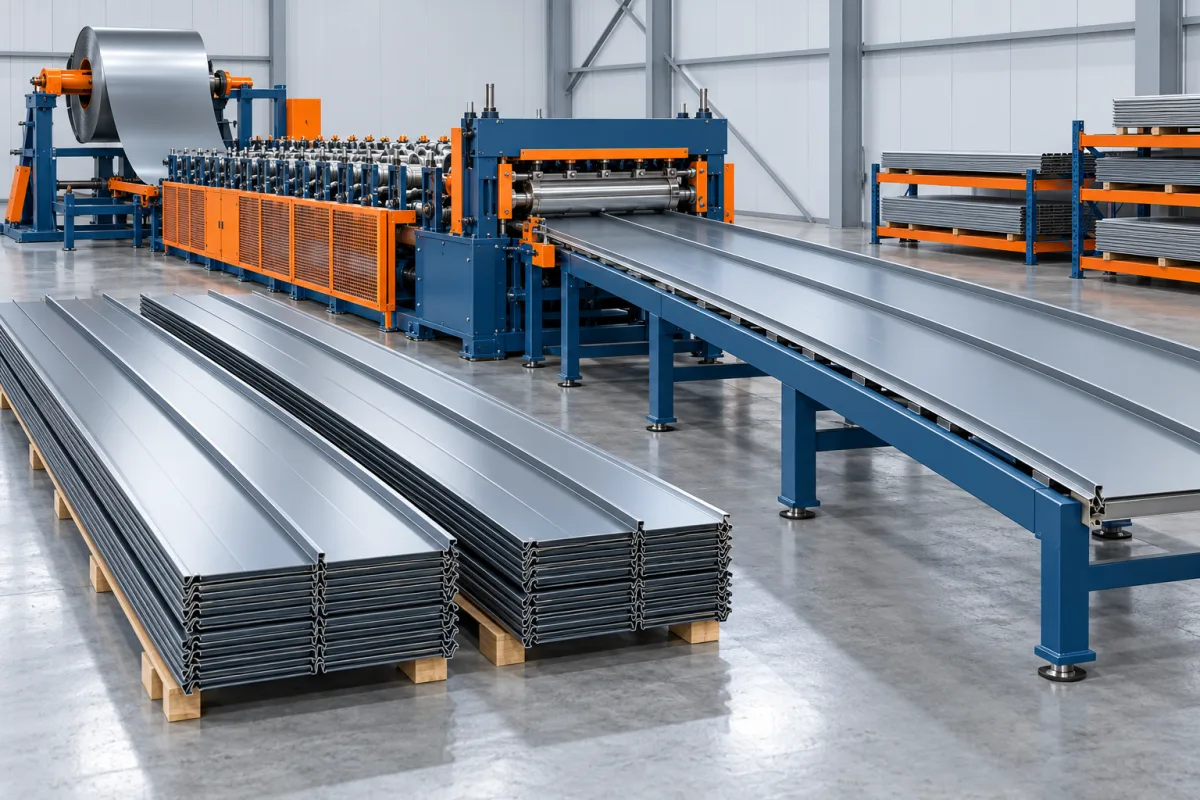
Standing seam production has at least two different rates: the rate at which panels are formed and the rate at which the complete workflow delivers accepted roof material. On a job site, movement and installation may constrain output. In a workshop, packing and transport may do so. A useful productivity study identifies its boundary before quoting metres per minute.
Keep panel forming and seam closing separate
The former produces the panel section. A mechanically closed roof has a later seaming operation, while a snap design follows its own engagement sequence. Combining those activities into one unexplained rate makes it difficult to locate a constraint or compare equipment.
Report forming output and downstream work separately where appropriate, then connect them in the project plan. The fastest panel former does not determine how quickly a roof can be installed, and a slow installation stage does not necessarily indicate poor forming performance.
Define accepted output after the relevant checks
Count panels that meet geometry, cut-end and surface requirements. If the study is intended to demonstrate seam compatibility, include representative assembly checks. Material that passes through the rolls but needs correction is not accepted output.
Record both pieces and linear metres, together with effective cover. The number of panels depends on length, while coverage depends on width. Retaining all three measures allows a later change in order mix to be explained rather than mistaken for a change in machine performance.
Use a length mix that reflects real roofs
Long panels challenge support and movement; short panels increase the number of cuts and individual handling events. A demonstration at one convenient length does not establish the route's performance across both conditions.
Build a representative order basket with required widths and materials. If profile changes are frequent, measure them separately or include them in the agreed study boundary. State whether loading, first-off inspection and packing are included in elapsed time.
Calculate coverage with transparent assumptions
Suppose a trial produces 75 accepted panels at 8 metres long and 0.4 metre effective cover. Nominal coverage is 75 × 8 × 0.4 = 240 square metres. Over a measured 120-minute production window, the average is 120 square metres per hour for that defined route.
These are illustrative inputs, not a capacity statement. If panel positioning and seaming occur afterward, their time remains outside this number and must be planned separately. Do not present the forming coverage rate as an installed-roof rate.
Portable production needs a site-flow study
Observe coil delivery, loading, machine setup, emerging-panel support and movement to the next operation. Access and staging can dominate the day even when the former runs smoothly. Include the approved operating and protective arrangements in the study.
Do not improve a demonstration rate by omitting the support needed for long panels or by allowing material to accumulate in an unsuitable location. A workable site route must remain repeatable as the order progresses and space fills with produced material.
Workshop output depends on packing and delivery
In a fixed facility, measure time spent separating, identifying and protecting panels for transport. A high gross output can become a delivery problem if the packing station cannot keep up or if handling damages seam edges.
Plan how bundles leave the production area and how different profiles or finish batches remain identifiable. The mill's occupation time and the shipping team's capacity are connected but not identical. Both belong in a realistic delivery schedule.
Profile changes consume more than tool-movement time
Measure from the last accepted panel in one configuration to the first accepted panel in the next. Include width or profile changes, required components, checks and a mating assembly where necessary. This boundary captures recovery of the product, not merely completion of a mechanical action.
For a hypothetical week with four changes, reducing complete recovery by 25 minutes per change frees 100 minutes. Whether that becomes more saleable output depends on demand and the rest of the route. Avoid counting freed time as guaranteed additional revenue.
Track the quality losses that hide behind speed
Separate rejected starts, seam-fit deviations, end damage and handling marks. These losses occur at different stages and need different improvements. A faster run that produces more unusable edges may deliver less accepted material overall.
- Record coil and profile identity for rejected starts.
- Check whether fit problems follow a particular configuration change.
- Compare cut ends before and after discharge.
- Track damage during workshop packing or site movement.
- Verify improvement using a comparable order basket.
Choose improvements from the measured constraint
Record weather or site-access interruptions separately from equipment stops when studying portable work. Combining them into one downtime figure can lead to an equipment investment that does not address the actual delivery constraint.
If the former waits for panels to be moved, investigate the handling route before purchasing more forming speed. If first-off approval dominates short orders, improve documented setup recovery and inspection workflow. If closing operations constrain the project, keep that problem distinct from panel manufacture.
Recalculate capacity after changes with the same measurement boundary. A new number is useful only if the product mix, acceptance requirements and included activities are understood. Keep a downside case for less favorable site access or more frequent changes.
Frequently asked standing seam output questions
Can a forming-speed figure predict roof installation time?
No. Installation includes supports, attachment, panel positioning, closing and project details. Use forming output as one input to the complete roof workflow.
Why can a portable former spend much of the day idle?
Coil preparation, site staging, panel movement and the next operation may occupy the available time. A stop log helps distinguish those constraints from a machine fault.
Should seam assembly checks be included in every output trial?
Use the checks required by the trial's acceptance plan. State their time boundary clearly. Production planning must still provide the quality resources needed to release compatible panels.
What is the best comparison between two proposals?
Accepted panels from the same material, profiles and order mix, with equal loading, inspection and handling boundaries. Supplement that result with documented changeover and logistics requirements.
Continue your research
- Standing Seam Roll Forming Machines
- Standing Seam Roll Forming Machine
- Snap Lock Standing Seam Machine
- 25mm Snap Lock Standing Seam Machine
- 38mm Snap Lock Standing Seam Machine
- 1 Inch Mechanical Lock Standing Seam Machine
- How Standing seam roll forming machine Works
- How To Choose a Standing seam roll forming machine
- Standing seam roll forming machine Price: What Affects the Cost?