
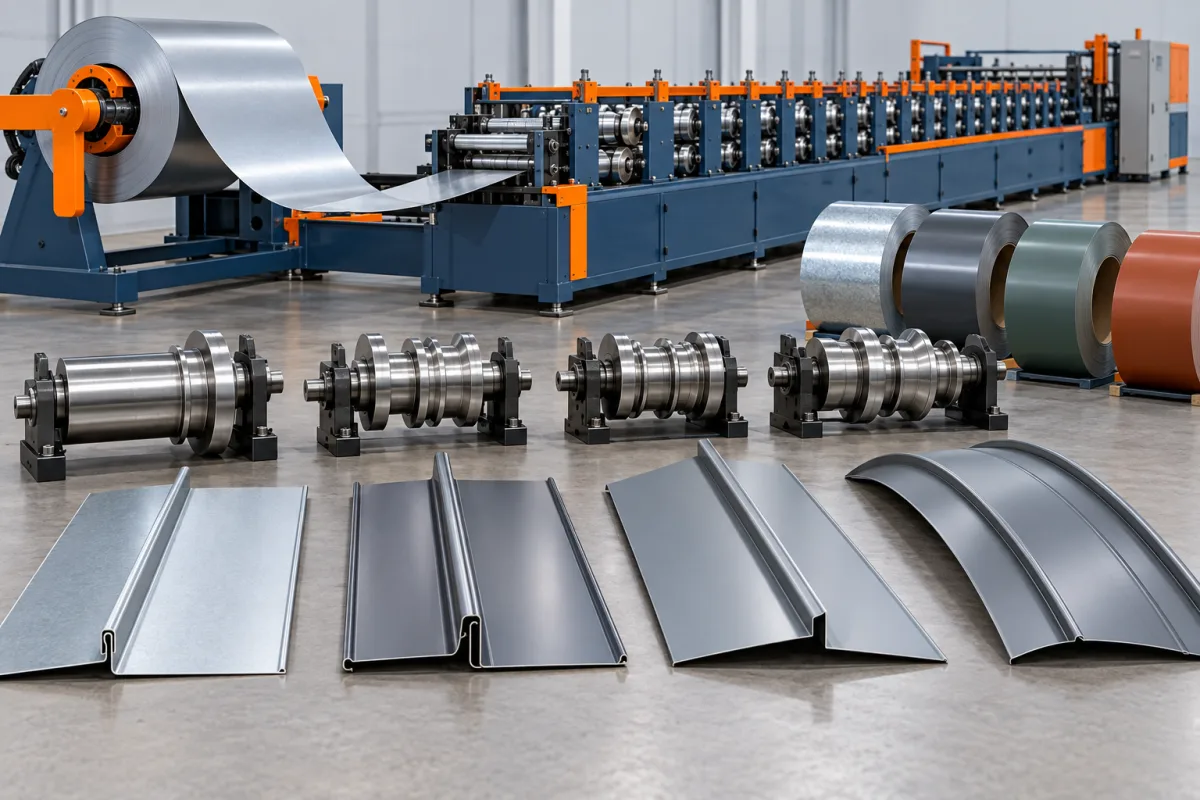
Choosing a standing seam roll forming machine begins with the roof systems the business intends to supply. The machine, panel tools, clips and any seaming equipment need to support those exact systems. A broad promise to make standing seam is not a sufficient basis for comparing equipment.
List the actual seam systems you need
Separate snap-lock, mechanically closed and fixing-flange arrangements using their complete drawings. Include the open section, assembled joint and attachment components. Nominal seam height is useful for identification but does not establish interchangeability.
Prioritize confirmed products instead of requesting every possible profile. A specialist making one established commercial roof system has a different need from a contractor serving several architectural designs. The tooling package should reflect that product strategy.
Let project requirements guide the profile choice
Use the documentation and design requirements of the selected roof system for its intended applications. Do not choose a generic seam category solely from an unsupported claim about slope, weather resistance or strength. Products within the same category can have different conditions of use.
The equipment decision follows the approved panel system. If the system has not yet been chosen, resolve it with the appropriate product and project specialists before final tool selection. Otherwise, an equipment purchase can lock the business into a profile that does not serve its intended work.
Compare workshop and portable production realistically
Workshop production offers one controlled location for material storage, inspection and packing. Portable production changes transport and panel-length logistics, but requires a workable site arrangement. Neither is automatically superior for every contractor or manufacturer.
For the portable case, review access, power, coil loading, machine placement and the supported path for finished panels. For workshop supply, review transport, bundle protection and the lengths that can be delivered practically. Compare complete logistics rather than the former's footprint alone.
Define a material matrix for each profile
Provide grade or alloy, thickness convention, coating and required widths. Steel and aluminum at the same nominal thickness should not be assumed to use identical settings or produce equivalent seam behavior. Require evidence for the combinations being purchased.
Include appearance and coating condition after joint assembly. Tight returns and closing operations can reveal issues that a flat material sample does not show. A useful trial includes the actual finish and the attachment components used in service.
Ask what each adjustment actually changes
Length control, pan-width adjustment and profile changeover are distinct functions. Request a configuration matrix showing the supported combinations, change parts and checks. A machine that adjusts panel width does not automatically make a different seam shape.
For frequent profile changes, time the transition through to an accepted assembled sample. Include guides, cutting components and first-off inspection. A fast tooling movement is valuable only if the complete process reliably returns to the correct panel geometry.
Include seaming and accessory equipment in the scope
If the chosen roof uses mechanical closing, identify compatible seaming equipment and its responsibilities in the package. Clips, end preparation and roof accessories also need a defined supply route. Do not compare a bare former with a broader roof-production package by headline price.
- Panel tool sets and supported widths.
- Required clips or fixing components for acceptance.
- Seaming equipment where applicable.
- Cutting and end-preparation requirements.
- Coil handling, discharge supports and transport arrangement.
Demonstrate the difficult order, not only the easiest panel
Select representative lengths, materials and transitions. Include the longest handling case and the profile whose mating features are most critical to the business. Ask the supplier to explain why the chosen trial matrix represents the requested capability.
Inspect the open edges and cut ends, then assemble the sample using the specified method. Record unusual resistance or any local modification. A single completed joint photograph is insufficient evidence if the process used to obtain it is unknown.
Evaluate output together with installation logistics
The former can produce panels faster than the next operation can use or move them. Onsite work may be limited by panel support, positioning or the installation sequence. Workshop work may be limited by packing and transport. Identify the relevant boundary before comparing production rates.
Use accepted panels over a measured order and count setup losses separately. A high linear rate does not help if the crew must repeatedly repair edge damage or stop to reorganize long panels. The productivity target should match the actual business workflow.
Check training and recovery before purchase
Include the crew that will perform the work in the demonstration. Their questions about loading, measuring and storing tool sets can expose practical gaps that a purchasing-only review misses. Document those gaps as scope items rather than informal promises.
Ask how the team learns first-off inspection, profile recovery and joint compatibility checks. The machine needs documented references for the tool sets being supplied. A support package should explain how operators identify the correct parts and escalate an unresolved fit problem.
Consider future additions as defined options. Obtain a boundary between currently supported adjustments, extra tool sets requiring purchase and profiles needing a new engineering review. This is more useful than assuming that one flexible machine will make every future roof design.
Frequently asked selection questions
Should I choose snap-lock because it has no field seamer?
The panel system must first suit the intended projects. Its closing method is only one decision factor. Attachment, application requirements and the exact design still need review.
Can two clips of the same height be treated as equivalent?
No. Mating surfaces and movement arrangements can differ. Use the specified component in tooling and acceptance trials and review any substitution.
Is portable equipment only useful for very long panels?
Long-panel logistics can be one reason, but the decision also involves order patterns, transport, site access and staffing. Compare your complete workflow rather than using one length threshold as a universal rule.
What is the strongest evidence before ordering?
A documented trial of the specified material and profile, with complete panels, the intended attachment and closing method, and clear records of accepted geometry and handling. Match that evidence to a written equipment scope.
Continue your research
- Standing Seam Roll Forming Machines
- Standing Seam Roll Forming Machine
- Snap Lock Standing Seam Machine
- 25mm Snap Lock Standing Seam Machine
- 38mm Snap Lock Standing Seam Machine
- 1 Inch Mechanical Lock Standing Seam Machine
- How Standing seam roll forming machine Works
- Standing seam roll forming machine Price: What Affects the Cost?
- Materials and Thickness for Standing seam roll forming machine