
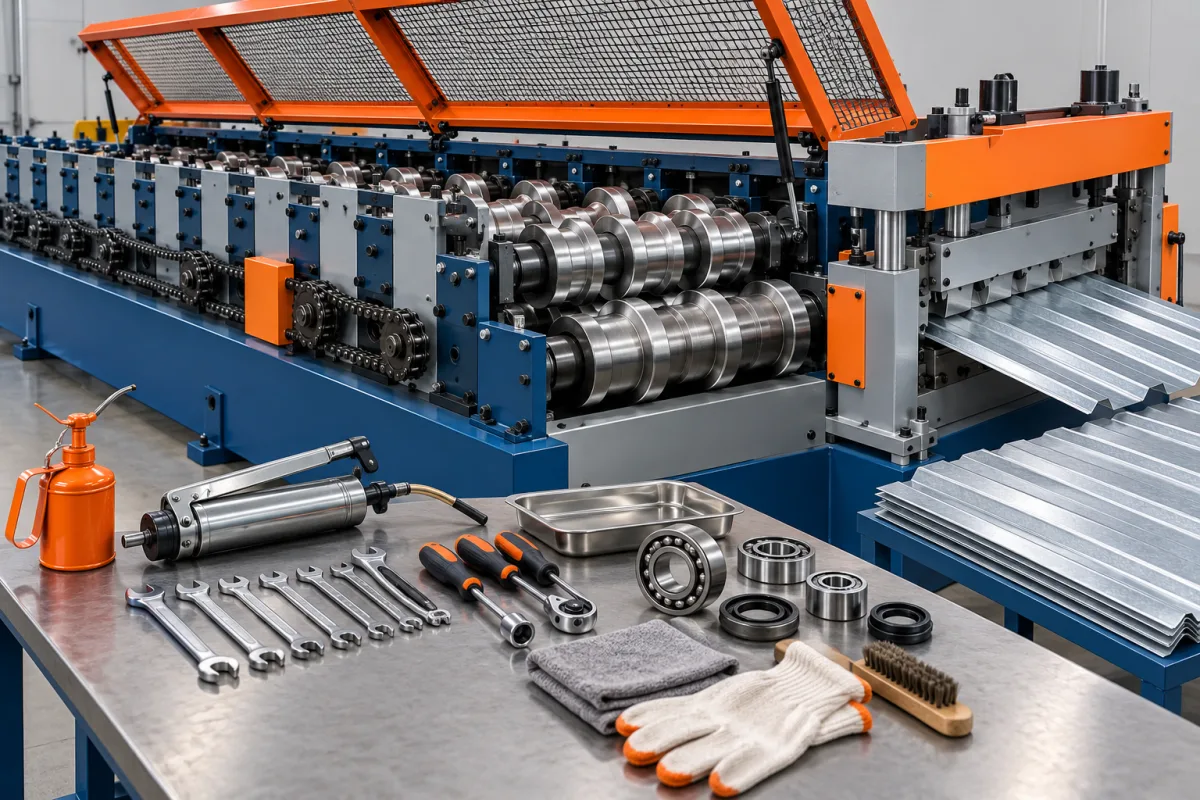
A roofing-sheet roll forming maintenance checklist should preserve three results: safe operation under the equipment's approved procedures, consistent profile geometry and protection of the exposed finish. The checklist needs to cover the whole material route, because damaged support surfaces or an incorrect cutoff component can reject good sheets even when the forming stands are functioning normally.
Use the maker's maintenance plan as the controlling document
Intervals, lubricant specifications, adjustment methods and isolation requirements belong to the particular machine. A general checklist helps organize responsibilities but cannot replace those instructions. Assign work to personnel qualified for the relevant mechanical, electrical and hydraulic systems.
Identify each asset and its documentation revision. Keep service records connected to the machine and profile configurations. A shared shop spreadsheet is useful only if it distinguishes which payoff, shear or forming path was inspected and what work was actually completed.
Separate operating observations from isolated maintenance
Operators can report unusual noise, repeated stops, visible product changes and alarms from the permitted operating position. Inspection, cleaning or work inside guarded areas requires the approved shutdown and isolation procedure. Do not turn a product-quality check into an instruction to reach near moving strip or rolls.
Include a clear escalation rule for damaged guarding, abnormal motion, leaks or other unsafe conditions. Production targets should not encourage bypassing protective devices. The responsible maintenance team should determine the investigation and return-to-service process.
Payoff and entry equipment need their own record
Review the equipment used to support, load and guide the actual coil envelope. Inspect according to the maker's instructions and document relevant wear, damage or abnormal behavior. Problems at entry can appear later as profile inconsistency, so the maintenance record should not begin only at the first forming stand.
Keep coil-loading accessories identifiable and within their specified use. Changes in coil dimensions or loading arrangements should receive the required review. An increase in production variety can introduce equipment demands that were absent when the original checklist was written.
Protect roll contact surfaces and profile references
Cleanliness and condition at contact surfaces matter especially for exposed coated roofing. Under the approved isolated procedure, inspect for contamination, damage and other conditions identified by the tool supplier. Record recurring marks on the product and correlate them with inspection findings rather than assuming every scratch comes from a roll.
Preserve the identification of tooling and setup references. If parts are replaced or repaired, verify that they belong to the correct profile and revision. Avoid mixing components from similar roof sections without engineering confirmation.
Include cutoff tooling and sheet support
The cutting station should be maintained for the actual profiles it processes. Check components, support and scrap arrangements according to the equipment documentation. Product inspections should distinguish burr, length deviation and nearby rib distortion because they may indicate different service needs.
Record the section-specific tooling fitted after a changeover. A maintenance task that leaves the wrong support component in place can create an immediate product defect. Before production release, inspect both cut ends of representative sheets rather than relying on a successful unloaded cycle.
Inspect discharge and stacking as quality equipment
Support rollers, pads and other contact surfaces can mark or deform finished panels. Include their condition in the maintenance route and investigate damage appearing after the sheet leaves the former. Long-sheet production is particularly dependent on an appropriate, maintained support path.
Review bundle separation and removal equipment within its own maintenance requirements. The checklist should identify who reports a damaged protective surface and how it is replaced. Otherwise a recurring finish defect may remain categorized as unavoidable handling damage.
Keep controls and measurement references recoverable
Maintain the approved configuration and backup process provided for the controls. Record authorized changes affecting lengths, profile setups or production sequences. A recoverable reference reduces the risk of rebuilding a production setup from memory after service.
Measurement tools used to accept roof sheets also need appropriate control. If cover or length checks are inconsistent, the team may alter a sound process in response to unreliable readings. Maintain the inspection method, reference samples and measuring equipment alongside the production assets.
Build a practical checklist with evidence fields
Use task descriptions that indicate what must be recorded. A tick beside machine checked gives little information when a defect recurs. The checklist should identify the asset, approved instruction, person, date, finding and disposition, with a separate release step where required.
- Payoff and entry: relevant condition findings and material-path observations.
- Forming section: contact-surface findings and tooling identification.
- Cutoff: correct section components and observed product-end quality.
- Discharge: support condition, protective surfaces and handling findings.
- Controls: authorized changes and recoverable configuration references.
- Quality release: coil, profile, trial lengths and accepted first-off results.
Verify the product after maintenance
Plan a first-off check proportionate to the work performed. If service involved tooling or cutting components, inspect the corresponding features and the complete lap assembly. If it involved discharge, check the panel before and after the handling stage to confirm the damage source has been removed.
For an illustrative scenario, replacing a damaged support pad might eliminate a repeated scratch but say nothing about profile dimensions. Record the scratch result while retaining the normal product-release checks. Conversely, a roll-tool change should not be released on appearance alone when it can affect cover and joint fit.
Use maintenance history to prioritize recurring losses
Link service findings with production defects and downtime. Repeated replacement of the same component may indicate a broader operating or application issue requiring specialist review. A maintenance calendar should evolve from documented evidence while remaining consistent with the manufacturer's requirements.
Stock critical spares using verified part references and the actual profile mix. A spare that does not match the current cutting arrangement is not useful resilience. Review the list when adding a roof profile, changing equipment or retiring an old configuration.
Frequently asked maintenance questions
Can rolls be wiped while the line runs slowly?
No. Cleaning near moving rolls introduces a serious entanglement hazard. Follow the specified shutdown, isolation and access procedure; low speed is not a substitute for safe maintenance conditions.
Should every roof-panel line use the same lubrication interval?
No. Use the instructions for the actual components, duty and environment. Record completed work and abnormal findings rather than applying an unsupported universal interval.
Why inspect stacking equipment on a forming-machine checklist?
It touches the finished product and can create scratches or deformation after correct forming. The saleable sheet depends on the entire route, so product-related maintenance must include discharge.
What confirms the machine is ready after service?
The required equipment release and representative product checks, documented against the approved profile and material. A machine that cycles successfully has not automatically demonstrated acceptable roofing sheets.
Continue your research
- Roofing Sheet Roll Forming Machines
- Corrugated Roof Sheet Roll Forming Machine
- Trapezoidal Roof Sheet Roll Forming Machine
- R Panel Roll Forming Machine
- PBR Panel Roll Forming Machine
- IBR 686 Roofing Sheet Machine
- How Roofing sheet roll forming machine Works
- How To Choose a Roofing sheet roll forming machine
- Roofing sheet roll forming machine Price: What Affects the Cost?