
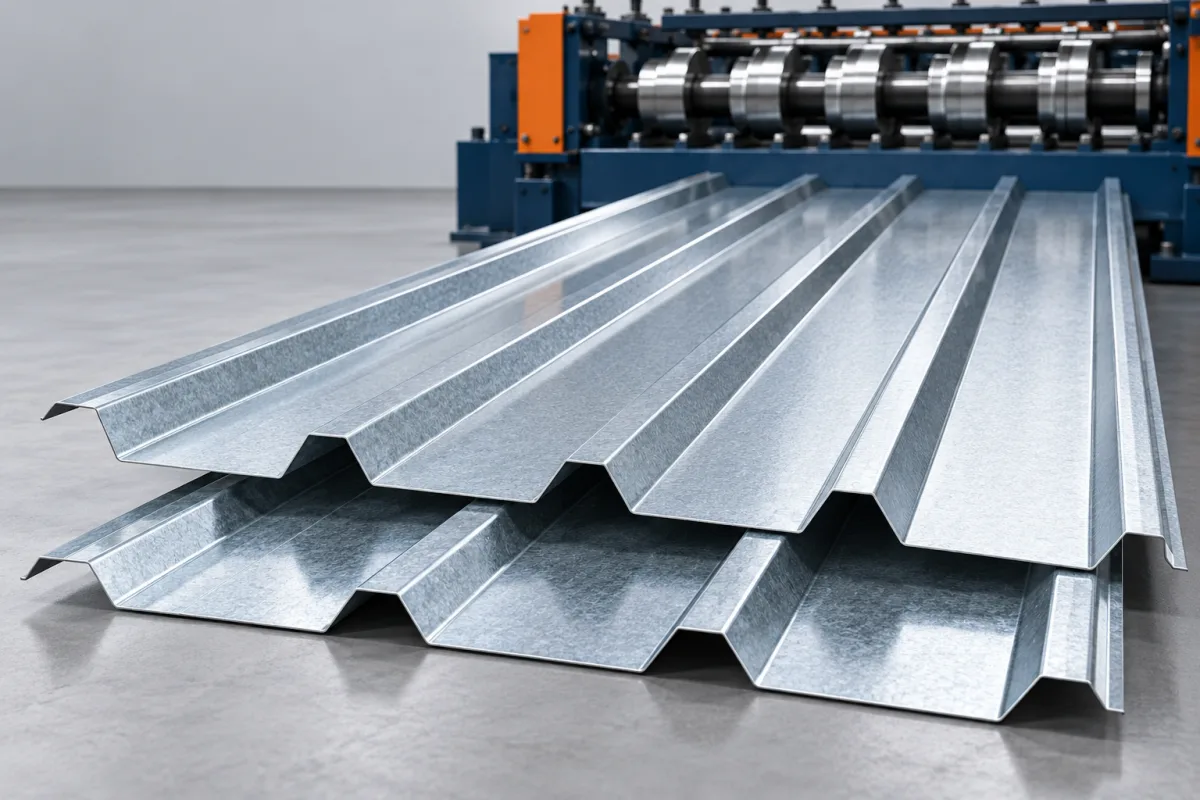
An IBR 686 roofing sheet machine is selected around an IBR profile whose specified effective cover is 686 mm. The number is a starting point for the product brief, not a complete description of its ribs or laps. Before tools are ordered, confirm whether the local product drawing uses 686 mm as installed cover and identify the exact cross-section intended for production.
The distinction matters when a manufacturer wants to match existing roofing, closures or customer stock. Two sheets can share a nominal coverage label while differing in rib height, spacing or terminal details. Successful production depends on reproducing the entire approved section, not just reaching one width.
What should 686 mm mean in the drawing?
Effective cover measures the useful width contributed by one panel after the specified side lap is assembled. Overall width measures the physical sheet, while input-coil width is the flat strip consumed by the section. These three quantities should have separate entries in the specification.
If the commercial name and drawing disagree, resolve that before comparing machine quotations. Do not adjust a cover figure by stretching or compressing the trial panel during measurement. Use a consistent relaxed condition and the intended overlap.
Which IBR details cannot be inferred from the name?
Provide the number and pitch of ribs, crest and valley shapes, bend radii and both terminal edges. Identify minor stiffening features if present. The chosen under-lap and over-lap determine the relationship between adjacent panels and should be drawn as an assembled pair.
- Mark the exposed coated face and the lap direction.
- Identify the section datums used by inspection.
- Show the overall and effective widths separately.
- Include matching closures or an accepted physical sample.
- State the required finished lengths and end condition.
Regional naming conventions can be useful for sales, but the tooling order should refer to a controlled drawing revision. That prevents a familiar name from concealing a different local profile.
How is the 686 profile produced from coil?
The coil enters through support and guiding equipment before progressive rolls develop the longitudinal shape. The tools distribute forming through successive stages until the specified ribs and lap edges are complete. Length control and cutoff then produce individual sheets for discharge.
Request the proposed sequence and identify any operations outside the forming mill. Film application, part marking and stacking may be important to the finished order even though they do not change the rib geometry. Their equipment and operating responsibilities belong in the layout.
Why must input width be confirmed rather than guessed?
The flat strip supplies material for rib sidewalls, crests, valleys and overlaps. Its required width therefore depends on the complete developed section. A coverage figure alone does not establish coil purchasing requirements or material yield.
Ask the equipment supplier to confirm input-strip specifications for the approved tooling. For cost planning, track consumed coil area against accepted covered area using the actual section and scrap records. Do not apply one arbitrary waste percentage to all IBR profiles and order mixes.
What changes between IBR 686 and IBR 762?
A change in nominal cover does not necessarily mean the same profile can be widened by a simple adjustment. Rib count, spacing and edge details may differ as well. Compare the two controlled cross-sections before deciding whether one machine can accommodate both.
A shared arrangement might require replacement tooling, a second forming path or another engineered solution. Ask for a change matrix identifying the guides, rolls, cutoff parts and inspection references for each profile. Include first-good-sheet recovery in the changeover trial.
How should material and appearance be agreed?
List the actual steel grade, base-metal thickness and coating combinations. If aluminum is part of the plan, treat it as a separate material review rather than automatically including it in a steel range. Show visible-face orientation and any film requirements.
Evaluate the rib bends and broad flats after normal forming and discharge. Use agreed lighting and support conditions when assessing appearance. Record finish marks, coating damage, end deformation and permanent shape deviations separately so each observation can be investigated meaningfully.
What is a useful production-rate comparison?
Compare accepted lengths or covered area from a defined trial order. Include the actual cut-length distribution and stacking arrangement. Long sheets may make handling the constraint, while short sheets increase the influence of cutoff and transfer cycles.
For planning arithmetic, ten accepted sheets each 4 m long at an approved 0.686 m effective cover represent 27.44 square metres of nominal coverage. This illustrates the unit conversion only; it says nothing about machine speed, roof waste or an installed building's performance.
How should a factory trial be structured?
- Confirm the IBR drawing and material identification.
- Produce representative lengths with normal supports.
- Measure ribs, terminal edges and overall width.
- Assemble several sheets and verify effective cover.
- Check closures and relevant accessory interfaces.
- Inspect cut ends and finish after stacking.
- Record accepted output and startup scrap.
Retain the measurement method as part of approval. Repeating a result later requires more than a photograph of one attractive panel; it requires the same drawing, material envelope and inspection references.
Frequently asked questions
Is 686 mm the required coil width?
No. When it denotes effective cover, it describes the installed panel contribution. Input width must account for the full developed ribs and laps and should be confirmed for the approved profile.
Can old roofing be matched from a photograph?
A photograph helps identify the general family but usually hides critical dimensions. Supply an undamaged sample and measurements of the lap, ribs and cover before requesting a matching tooling proposal.
Will any IBR closure fit?
Not necessarily. The closure needs the correct pitch and rib shape. Trial the intended accessory against formed sheets rather than relying on the IBR label alone.
Can the machine make wall cladding too?
It can produce the agreed section for suitable orders, but wall use should follow the specified cladding system. Different trims, fastening details or finishes may still be required.
What information should a buyer send first?
Send the 686 profile drawing, material matrix, finished lengths, coil envelope and a typical order. Add the desired stacking method and any second profile under consideration.
Define the section before comparing equipment
A precise IBR 686 brief connects installed coverage to the actual ribs, laps and material. That is the foundation for sensible tooling choices, reliable accessory fit and an acceptance trial that reflects saleable roofing.

Continue your research
- Roofing Sheet Roll Forming Machines
- Corrugated Roof Sheet Roll Forming Machine
- Trapezoidal Roof Sheet Roll Forming Machine
- R Panel Roll Forming Machine
- PBR Panel Roll Forming Machine
- IBR 762 Roofing Sheet Machine
- How Roofing sheet roll forming machine Works
- How To Choose a Roofing sheet roll forming machine
- Roofing sheet roll forming machine Price: What Affects the Cost?
Configuration & specification inputs
Match the configuration to your section drawing, material and production requirements.
| Parameter | Requirement / confirmation needed |
|---|---|
| Profile geometry | Controlled IBR section with 686 mm effective cover where confirmed by the approved drawing. |
| Material | Specified grade, coating and visible-face orientation for the selected IBR section. |
| Thickness & grade | Approved base-metal thickness and grade combinations; aluminum reviewed separately if required. |
| Process route | Coil support, guided entry, IBR rib and lap development, length cutting and supported stacking. |
| Cutting | Representative short and long roof sheets with intact terminal ribs and agreed end condition. |
| Output | Accepted lengths or covered area using the confirmed effective-cover dimension. |
| Electrical supply | Destination supply and auxiliaries sized from the agreed IBR line equipment schedule. |
| Acceptance | Rib pitch and height, terminal edges, assembled 686 cover, closure fit and finish after handling. |