
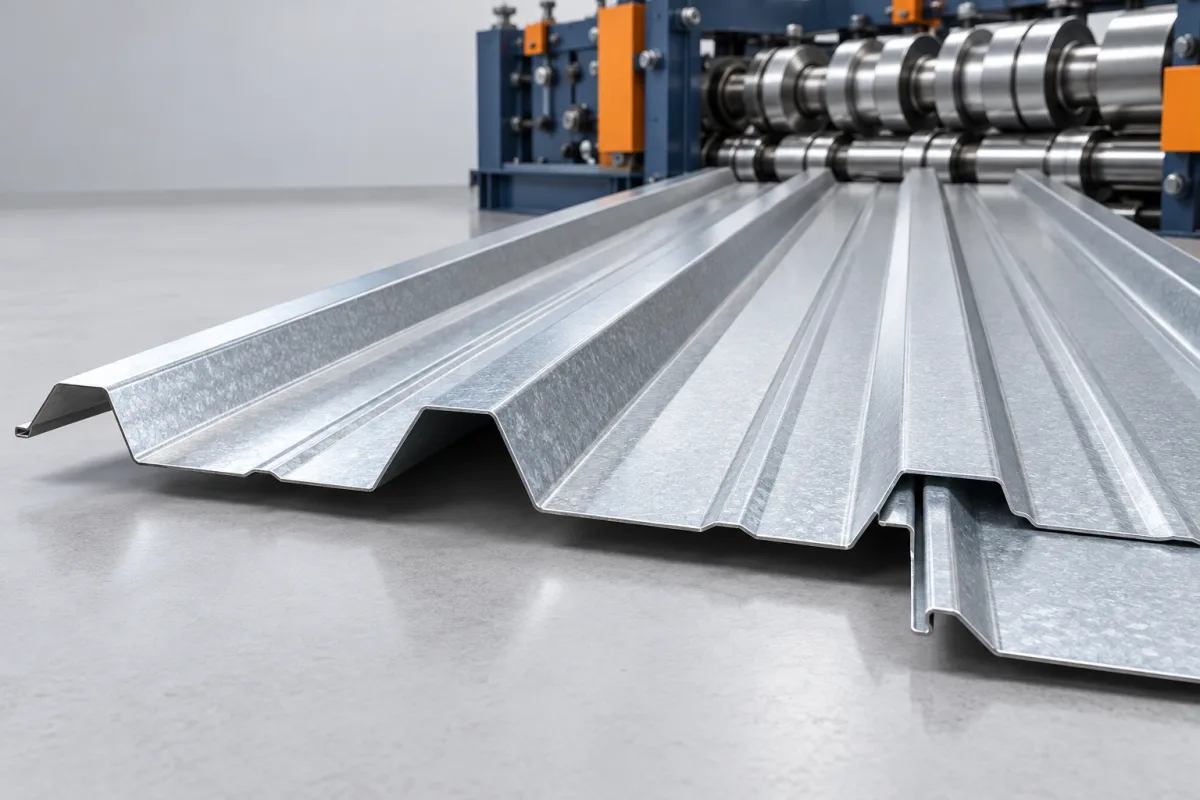
An R panel roll forming machine produces the ribbed metal sheet used for exposed-fastener roof and wall systems. The useful specification is the finished panel drawing, including its major ribs, smaller intermediate features and two different terminal edges. Those details determine how panels overlap, how much installed width they cover and whether new production matches the accessories already sold with the system.
R panel is a product family rather than a complete machine specification. A buyer replacing an existing supply should begin with an accepted sheet and controlled dimensions, while a new producer should define the whole panel system before ordering tools. A visually similar cross-section can leave a different lap, cover width or closure fit.
What distinguishes R panel from PBR panel?
The important distinction is the purlin-bearing extension used on a PBR profile. It changes the support beneath the overlapping panel edge. A standard R profile and a version with that extension may share most of the visible face while requiring different terminal-edge tools and cutoff support.
Make the chosen edge explicit in the drawing. If both products are needed, request a change-parts schedule covering entry guidance, forming tools and cutting components. Do not assume that changing the product name in a controller changes the physical lap geometry.
Which drawing dimensions should be fixed first?
Identify major-rib pitch and height, pan dimensions, intermediate ribs and the developed shape of each edge. Mark which face is exposed and which edge covers its neighbor. Measure effective cover in an assembled pair instead of using the sheet's overall width as a substitute.
- Use one reference edge for cross-section measurements.
- Show the final shape of the over-lap and under-lap separately.
- Include bend radii and required end squareness.
- Identify closures, trims and existing matching panels.
- State the accepted material combinations for the section.
Retain an approved sample alongside the drawing, but resolve discrepancies before tool manufacture. A damaged sample or a sheet pulled out of an old building is useful background, not a reliable dimensional master.
How does the production route work?
The route begins with coil support and controlled entry into the forming mill. Successive stages develop the longitudinal ribs and laps, after which the sheet is cut to order length and discharged onto supports. Optional film application, marking or other operations should have an identified position in that sequence.
Ask whether the proposed arrangement cuts flat strip before forming or cuts the finished profile. The choice affects length control, handling and the way short pieces move through the equipment. For a formed-profile cutoff, the cutting system must support the ribs and terminal edges without crushing the lap.
How should coated material be specified?
State steel grade, base-metal thickness and coating separately. Include the visible-face direction and any protective film. Different combinations can change bending behavior and appearance even when the nominal thickness is the same. Quote a material matrix rather than one large thickness range with no grades attached.
During a trial, inspect the crest and valley bends as well as the broad pans. Record scratches separately from waviness and coating cracking. This makes the acceptance discussion more useful than a general statement that the panel should look good.
Can one line serve both roof and wall orders?
The manufacturing route can supply the same approved section for different orders, but the intended roof or wall assembly still needs its own design details. Fasteners, supports, laps, closures and openings are not determined by the roll former alone. Keep the manufacturing drawing tied to the actual product sold.
For mixed orders, identify whether roof and wall work requires different edge variants, coatings or lengths. These practical differences affect scheduling, coil stock and inspection. They can matter more to daily output than the forming mill's maximum strip speed.
What changes when the order contains many lengths?
A cut-list controller is only one part of mixed-length production. The takeoff must keep short pieces stable and support long pieces without damaging their laps. Operators also need a clear method of identifying sheets and separating customer orders after cutting.
Evaluate a representative order containing the actual length distribution. Count accepted sheets after discharge, not merely the number of cutoff cycles. Include stack removal, labeling and coil changes in the trial if they are part of the required operating result.
How should matching accessories be checked?
Use closures and relevant trims with trial panels. Check that the closure follows the intended rib pattern and that the assembled lap does not create an unexpected step. Accessory fit can reveal a profile error that is less obvious when a single sheet is measured on its own.
Ridge caps, flashings and corner trims usually need their own fabrication route. List them separately in the purchase scope. A panel former should not be assumed to produce every component needed for a finished roof package.
What belongs in the acceptance trial?
- Confirm the drawing revision, material and chosen R or PBR edge.
- Measure rib geometry, overall width and relaxed panel shape.
- Join several sheets and measure effective cover.
- Inspect cut ends, coating and accessory fit.
- Run representative short and long order lengths.
- Check panels after normal stacking and handling.
- Record accepted output and the reasons for rejected pieces.
Use an agreed support arrangement during measurement. A long sheet hanging unsupported can look distorted even when its section is correct, while a sheet clamped into shape can conceal a manufacturing problem.
Frequently asked questions
Is every R panel interchangeable?
No. Commercial names do not establish the exact ribs, terminal edges or cover width. Compare controlled drawings and assembled samples when matching an existing system, especially if accessories come from another production source.
Can a bearing leg be added later?
That requires a tooling and cutoff review. Ask the supplier which parts must change and how both variants will be inspected. It is not simply a software option.
Does a higher line speed always mean more output?
No. Short cut lengths, stack removal and material changes can limit the complete route. Compare accepted orders over an agreed period with all included operations clearly listed.
Can aluminum use the same rolls?
Only after the material and tooling combination is reviewed. Alloy, temper, thickness and surface condition affect forming behavior. A successful steel trial does not establish an aluminum production range.
What should accompany a quotation request?
Provide the section drawing, mating samples, material matrix, order lengths and expected batch mix. Add the coil envelope, electrical supply and stacking requirements so quotations cover a usable production route.
Choose around the installed panel
For R panel production, the most valuable comparison connects the forming tools to the actual lap, cover and accessories. A clear product definition makes equipment scope, changeover requirements and acceptance much easier to compare.

Continue your research
- Roofing Sheet Roll Forming Machines
- Corrugated Roof Sheet Roll Forming Machine
- Trapezoidal Roof Sheet Roll Forming Machine
- PBR Panel Roll Forming Machine
- IBR 686 Roofing Sheet Machine
- IBR 762 Roofing Sheet Machine
- How Roofing sheet roll forming machine Works
- How To Choose a Roofing sheet roll forming machine
- Roofing sheet roll forming machine Price: What Affects the Cost?
Configuration & specification inputs
Match the configuration to your section drawing, material and production requirements.
| Parameter | Requirement / confirmation needed |
|---|---|
| Profile geometry | Approved R-panel ribs, intermediate features, over-lap, under-lap and assembled effective cover. |
| Material | Coil grade, coating and exposed-face direction matched to the approved roof or wall sheet. |
| Thickness & grade | Base-metal thickness paired with each grade and finish in the production matrix. |
| Process route | Coil entry, progressive rib and lap forming, length control, supported cutoff and order stacking. |
| Cutting | Specified order lengths with preserved terminal ribs and square, usable ends. |
| Output | Accepted R panels after cutting and handling for the stated length mix. |
| Electrical supply | Electrical supply and auxiliaries matched to the selected forming, cutoff and handling package. |
| Acceptance | Rib dimensions, assembled cover, correct R/PBR edge identity, accessory fit and finish after stacking. |