
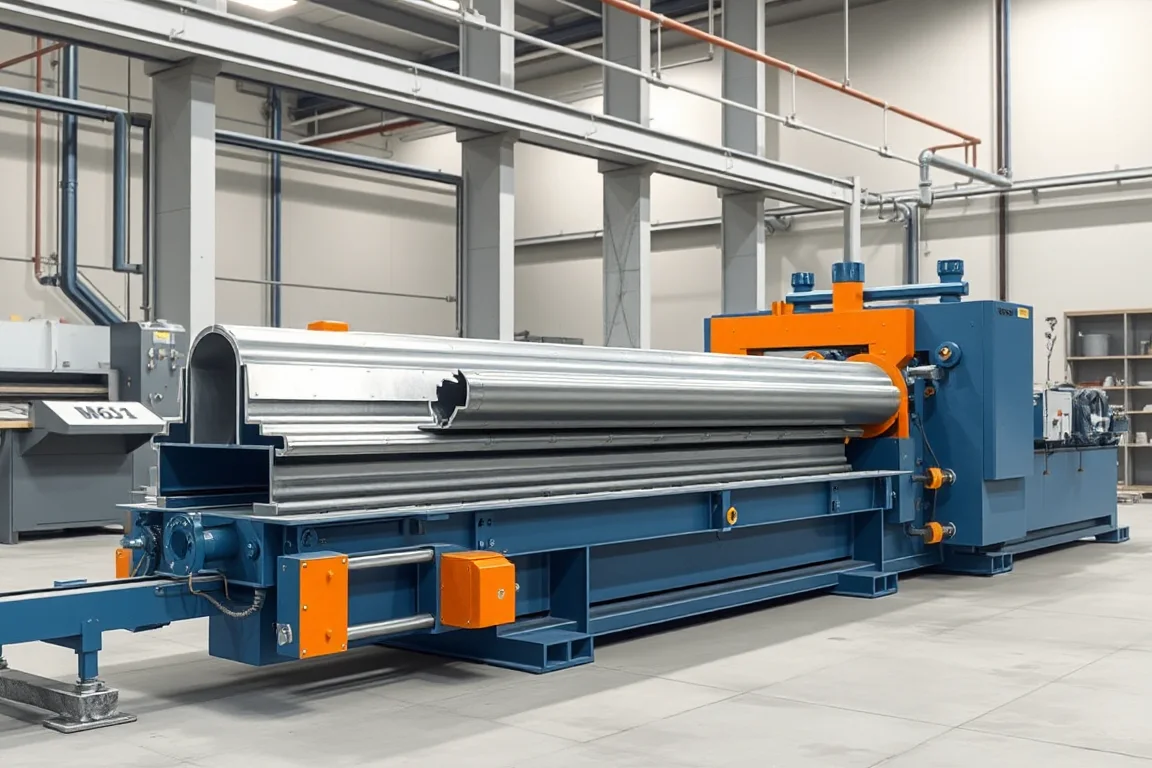
A garage door track roll forming machine produces the straight steel rails that guide the door rollers. The track is not the door skin; it is a structural guide profile, usually an open C or U section with an inward-facing running surface or returns that retain the roller wheel while providing the specified clearance for its stem. A complete door normally needs vertical tracks beside the jambs, horizontal tracks running back into the building, curved transition sections that link them, and brackets that tie the track to the structure and to the door springs. A roll forming line can economically form the straight vertical and horizontal runs; curved transitions and bracket welding are usually separate operations. This article explains what the machine must control so the finished track accepts real rollers and mates with real hardware.
Track function and finished geometry
The track's job is to keep each roller on a defined path as the door moves from closed to open. On a sectional door the roller travels up the vertical track, through a curve, and along the horizontal track into the ceiling area. That means the track has two distinct roles: it constrains the roller laterally, and it presents a smooth running surface that the roller can follow without catching or binding. The finished geometry therefore includes the profile cross-section, the position and orientation of the running surfaces, the length of each straight section, and the location of every punched hole or slot used for brackets and splices.
Track sections are typically roll formed from pre-punched or post-punched steel strip. Because the running surface is formed by bending, the final dimensions depend on material springback, bend radii and the sequence of passes. A machine that produces a good-looking section on one coil may drift when the coil changes, so the forming route and the adjustment range matter as much as the nominal profile.
Roller envelope and running-surface requirements
The roller envelope is the space the roller body and its stem occupy as they pass through the track. The track must be wide enough to clear the roller, deep enough to keep it captured, and shaped so the rolling surface contacts the track where intended. If the internal running surfaces are too tight, the roller drags; if they are too loose, the roller can cock and the door can rattle or jump. The critical features are the internal width between the running flanges, the flatness or crown of the running surface, and the smoothness of the transition where the roller enters the track.
Because rollers vary by manufacturer and by door weight class, the track profile should be developed against the actual roller that will be used. A sample roller is a better tool than a drawing alone: it reveals stem diameter, wheel width, tread shape and any shoulder that could rub. The forming line should be able to hold the running-surface dimensions within a band that the roller supplier and door assembler agree on. This is a joint tolerance decision, not a single number that applies to every door.
Straight track versus curved transitions
Straight vertical and horizontal tracks are the natural product of a roll forming line. These sections are long, constant in cross-section, and can be cut to length after forming. The machine's job is to keep the section consistent over the full length, keep the track straight, and place holes accurately. Vertical tracks are usually shorter and may carry different hole patterns from the longer horizontal tracks, so the line may run two families of parts.
Curved transitions are a different problem. A straight formed track can be curved using an appropriately designed secondary process. The method must preserve the running section, radius and joint interfaces; uncontrolled bending is not evidence of an accepted curved track. In many door systems the curve is a distinct part joined to the straight tracks, or the track is ordered in a pre-curved form. The roll forming machine's scope should be defined clearly: it forms straight track, and the curving, splicing and bracket attachment are handled off-line. Treating the curve as part of the same continuous line is possible in some installations, but it changes the tooling, the cutoff and the handling, and it should be evaluated as a separate process decision.
Material and surface requirements
Tracks are commonly made from coated or galvanized sheet steel because the running surface needs corrosion resistance in garages, which can be damp or unheated. The base-metal thickness and grade determine how much the section springs back and how much load the track can carry. Thicker material needs more forming force and may require larger bend radii to avoid cracking at the corners. A machine set up for one thickness may not hold the same dimensions on a significantly different thickness without tooling and pass adjustments.
Stainless steel and other alloys form differently from mild steel. They work-harden, spring back more, and may need different roll materials or surface treatments to avoid galling. A line that runs coated steel well is not automatically validated for stainless; the tooling and the forming route need separate confirmation. Surface condition matters too: scratches, roll marks and coating damage on the running surface can create drag points or rust sites, so handling and roll condition should be part of the acceptance check.
Forming route and mounting holes
A typical route begins with coil or blank preparation, then punching or notching of mounting holes and slots, then progressive forming through a series of roll stands, then cutoff. The order of punching and forming is a real decision. Punching before forming lets the line run continuous strip and place holes in the flat, but forming can distort holes near bends. Punching after forming requires access to the formed section and may be slower. Many lines use pre-punching for bracket holes that sit in flat regions and reserve secondary drilling for features that must be located from the formed surfaces.
Hole position accuracy is what makes the track assemble. Bracket holes must line up with the hardware, and splice holes must line up between adjoining sections. The line should be able to register hole patterns repeatably and hold the distances between the running surface and the hole centerlines. A practical checklist helps frame this:
- Confirm which holes are punched in the flat and which are added later.
- Check hole-to-bend distances so forming does not pull the holes out of position.
- Verify hole size against the fasteners actually used, including any slot for adjustment.
- Inspect the running surface after punching for burrs or raised edges.
- Record the pass settings and punch registration used for each track family.
Cutoff and ends
Cutoff is the operation that turns continuous formed strip into finished track lengths. A profile-supported cutoff uses support suited to the track section while cutting; profile support and flying versus stationary motion are separate design choices. Appropriate support helps preserve the section, so the section does not collapse or twist. The end quality matters because the track ends may slide into brackets or join to curved sections. A burred or deformed end can prevent assembly or create a sharp edge on the running surface. Cut length accuracy also matters: if vertical tracks are cut short or long, the door geometry changes and the horizontal track may not line up.
Some tracks need secondary end operations such as notching, swaging or drilling after cutoff. These should be defined in the process route, because they affect handling, cycle time and how the line is laid out. The cutoff should be confirmed on the actual profile and material rather than assumed from a catalog description.
Brackets, joining and off-line curving scope
Brackets connect the track to the wall, to the header and to the spring system, and they also join straight sections to curved transitions. In most production setups, bracket attachment is a separate welding, riveting or bolting operation. The roll forming line's contribution is the hole pattern and the dimensional consistency that lets those brackets fit. If the track's formed width or hole locations drift, the bracket operation absorbs the error or the assembly fails.
Joining straight track to a curve is another interface to control. The two parts must share a compatible cross-section and a splice pattern that keeps the running surface continuous. An off-line curving operation, whether it uses a dedicated bender, a press or a supplied curved section, must be matched to the formed straight profile. This is where the boundary between the roll forming machine and the rest of the door assembly should be written down: what the line delivers, what the curve supplier delivers, and who controls the splice dimensions.
Variants and setup recovery
Garage door tracks come in several variants: different widths and depths for different door weights, different hole patterns for different bracket systems, and sometimes a reinforced section for heavier doors. A roll forming line may run these as separate tooling sets or as adjustable passes. The choice affects changeover time and the risk of setting drift. Adjustable passes are flexible but need a repeatable setup record; dedicated tooling sets have their own exchange and recovery work, which should be measured rather than assumed to be faster.
Setup recovery is the ability to return to a known good setting after a change. The practical tools are written pass settings, reference marks, gauges and a first-article check. Without a recovery method, every changeover becomes a tuning session, and the running-surface dimensions can drift between runs. The comparison below frames the trade-off:
- Dedicated tooling: focused on the approved section; evaluate exchange effort, recovery repeatability and additional tools for each variant.
- Adjustable passes: cover a reviewed dimensional family; demonstrate setup recovery and include feature and cutoff adjustments in the comparison.
- Mixed line with some dedicated and some adjustable stands: compromise, requires clear setup discipline, most complex to document.
Trial with controlled rollers and mating hardware
A track trial should use the actual roller and bracket hardware, not substitutes. Use an isolated finished sample, handled under the approved inspection procedure, to check the specified roller through the section and check for drag, wobble and catch points. Check the splice between the straight track and the curved section, if the curve is available, and confirm the running surface is continuous across the joint. Measure the internal running dimensions at several points along the length to see whether the section is consistent, and check the hole positions against the mating brackets.
The trial should record material grade, thickness, coil condition, pass settings and cutoff results so the run can be repeated. Acceptance should focus on the internal running surfaces, joint transitions and bracket positions, with clear limits for marking and edge condition. A good-looking isolated sample does not prove a complete door system will operate correctly; that requires the assembled hardware. Keep the trial scope honest and bounded to the track's own function.
Accepted track production and five FAQs
Accepted production means the line reliably delivers track that fits the rollers and brackets, holds its running dimensions, and cuts to the required length with clean ends. The acceptance record should identify the track family, material, key dimensions, hole pattern, cutoff length and the hardware used to verify the fit. Once those are stable, the line can run production with a defined check interval and a defined reaction when a dimension drifts.
Does the roll forming machine also bend the curved track section?
Usually not as part of the same continuous operation. Straight vertical and horizontal tracks are the natural output of the roll forming line, while curved transitions are commonly produced off-line or supplied as distinct parts. If curving is integrated, it should be treated as a separate process with its own tooling, handling and cutoff implications, and the splice to the straight track must be dimensionally matched.
Why do running-surface dimensions matter more than the outside profile?
The roller only contacts the internal running surfaces. If those surfaces are too tight or too loose, the door will drag, rattle or jump regardless of how the outside of the track looks. Outside dimensions still matter for brackets and appearance, but the roller interface drives function, so it should lead the acceptance check.
Can one line run both vertical and horizontal tracks?
Often yes, provided the cross-section is the same and the difference is mainly length and hole pattern. Vertical and horizontal tracks may share a profile but use different punch patterns and cut lengths, so the line must handle more than one part family with reliable setup recovery. If the sections differ, separate tooling or an adjustable line is needed.
What should be checked before signing off a new track profile?
Check the internal running dimensions along the full length, the fit with the actual roller, the hole positions against the real brackets, the splice transition to any curved section, and the cutoff end quality. Confirm the material grade and thickness used in the trial, and record the pass settings so the result can be reproduced. Do not accept a profile solely on the appearance of a short sample.
Is stainless steel track formed the same way as galvanized steel?
No. Stainless steel work-hardens and springs back differently, and it can gall against tooling that works fine on coated mild steel. Forming stainless requires separate tooling validation, possibly different roll materials and revised pass settings. A line proven on galvanized sheet should not be assumed to run stainless without a dedicated trial.

Continue your research
- Door & Window Profile Roll Forming Machines
- Steel Door Frame Roll Forming Machine
- Window Frame Roll Forming Machine
- Hollow Metal Door Frame Roll Forming Machine
- Door Reinforcement Channel Roll Forming Machine
- Steel Door Threshold Roll Forming Machine
- How Door frame roll forming machine Works
- How To Choose a Door frame roll forming machine
- Door frame roll forming machine Price: What Affects the Cost?
Configuration & specification inputs
Match the configuration to your section drawing, material and production requirements.
| Parameter | Requirement / confirmation needed |
|---|---|
| Profile geometry | Garage-door track requires a defined roller interface and often curved sections. Separate straight-track forming from curving and joining; test with the actual door rollers. |
| Material | Specified sheet steel; stainless or other alloys need separate tooling validation |
| Thickness & grade | Buyer to specify base-metal thickness and grade; operating range requires supplier verification. |
| Process route | Blank/coil preparation → feature punching → frame forming → cutoff → corner assembly |
| Cutting | Confirm profile-supported cutoff, cut lengths, end quality and any secondary operations. |
| Output | Define accepted output per shift with the actual profile and material. |
| Electrical supply | Buyer to state voltage / frequency / phase. Installed power requires a confirmed equipment schedule. |
| Acceptance | Inspect the internal running surfaces, joint transitions and bracket positions with the intended hardware. Define permissible marking and edge condition. Do not claim a complete door-system result from the appearance of an isolated track sample. |