
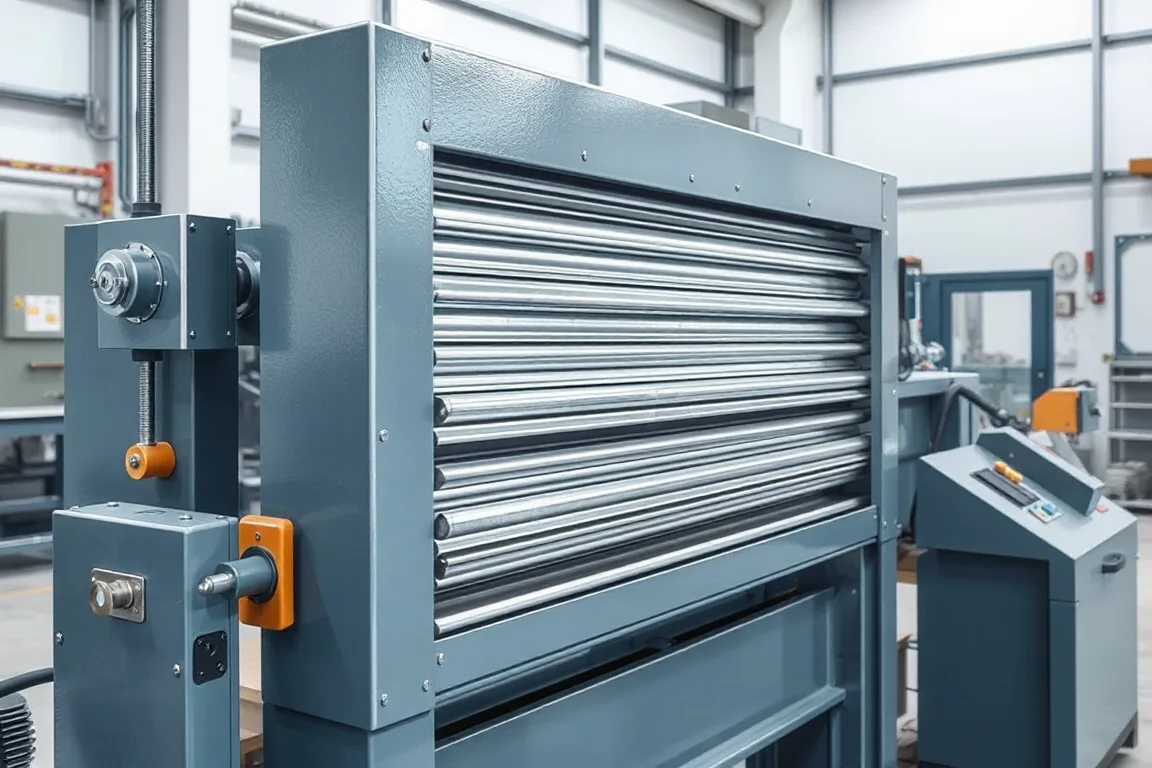
An insulated roller shutter slat machine produces metal slats with integrated insulation, combining roll forming, interlock development, and core or filling operations. It is not just a forming line; it merges profile creation with thermal and structural enhancements, demanding careful attention to material compatibility, cure or bonding, and assembly-level performance. This article explains the component interfaces, production routes, and acceptance checks that define the application, helping buyers ask precise questions and compare options without relying on unverified specifications.
What Is an Insulated Roller Shutter Slat?
An insulated shutter slat is a hollow-profile metal section, typically steel or aluminum, whose internal cavity is filled with an insulating material—often polyurethane foam, mineral wool, or other compatible core. The slat's outer face may be flat or curved, and its edges feature an interlock designed to articulate with adjacent slats when the curtain coils and uncoils. Insulation can be injected or inserted after forming, requiring additional processing steps. The machine that produces these slats must therefore handle not only the metal forming and interlock creation but also the insulation operation and any subsequent curing or bonding. The result is a component that contributes to thermal separation, but its performance depends on the entire assembly—slat geometry, guide fit, end locks, and bottom bar—not just the presence of insulation.
Profile and Interlock Geometry
The slat profile dictates how the curtain moves. Critical features include the hook detail that forms the interlock, the face curvature or flatness, and the end-lock accommodation. These features must be formed with precision so that when multiple slats are joined, they articulate smoothly and maintain alignment within the guide rails. A common mistake is to evaluate the profile only as a standalone length; the true test is how several slats behave as a curtain segment. Interlock geometry influences both coiling and resistance to pull-through. Slat face design affects rigidity and the space available for insulation. End-lock details determine how the curtain is secured at the sides, and guide clearance must allow thermal movement without binding. For insulated slats, the added core may alter stiffness and coiling behavior, so the metal forming and insulation processes must be developed together, not sequentially in isolation.
Material and Insulation Compatibility
Insulated roller shutter slats typically use coated steel or aluminum as the base metal. The coating—paint, zinc, or other finishes—must be compatible with the insulation material and any adhesives or foams used. Incompatibility can lead to poor bonding, coating damage, or corrosion. Insulation materials vary in density, curing characteristics, and chemical interaction. The production route must therefore confirm that the chosen insulation can be applied to the formed metal without degrading the coating or compromising the interlock function. Thermal performance claims require evidence for the defined construction; they cannot be assumed. The machine must also accommodate any perforation or surface treatment intended to improve adhesion or drainage. Material thickness and grade are buyer-specified, and the equipment's operating range should be verified by the supplier for the intended combination.
Production Route: Forming to Finished Curtain
A typical insulated slat production line follows a sequence: forming, interlock development, optional insulation or perforation, cutoff, and finally curtain assembly. Each stage has distinct requirements. Forming creates the basic profile from coil or strip; interlock development refines the edges for articulation. If insulation is included, it may be inserted as a core, injected as foam, or applied as a bonded layer. Perforation, when used, can affect slat stiffness and edge distortion, so its placement and pattern must be evaluated relative to the interlock. Cutoff must support the profile without collapsing it and produce clean ends; secondary operations such as end-lock punching or notching may be needed. Curtain assembly—joining slats, adding guides, bottom bar, and end locks—should be planned as part of the line scope. Comparing only bare strip speed is misleading because insulation, perforation, and assembly steps govern finished-curtain output.
Insulation Methods and Their Equipment Implications
Several insulation approaches exist, each with different machine interfaces. Injected foam requires metering, mixing, and dispensing equipment that synchronizes with the forming line; cure time may dictate buffer zones or handling procedures. Pre-formed core insertion involves aligning and feeding solid insulation into the formed slat, often requiring precise guiding and cut-to-length steps. Bonded panels use adhesives or films, which demand clean surfaces, controlled pressure, and sometimes heat. Each method affects the cutoff position, end quality, and post-processing. The machine must be configured to include the chosen insulation operation without compromising the forming accuracy. Chemical handling and cleaning should follow the chosen system supplier's controlled procedures, and the equipment scope must clearly state which insulation-related components are included.
Cutoff, End Treatment, and Secondary Operations
The cutoff station must be matched to the profile and insulation state. Cutting through insulated sections can crush the core, damage the interlock, or leave burrs that interfere with assembly. A profile-supported cutoff—often a flying die or similar mechanism—helps maintain shape. Cut lengths must be consistent, and end quality directly affects how slats fit into end locks and guides. Secondary operations such as punching holes for end locks, notching for guides, or deburring may be required. These should be identified in the equipment scope; they are not automatically included in a slat-forming machine. If insulation is present, the cutoff must account for the core material's behavior, potentially requiring slower feed or specialized blades. Inspecting cut ends for coating damage and insulation integrity is a basic acceptance check.
Curtain Assembly and System Integration
Finished slats must function as a curtain. Assembly involves joining multiple slats through their interlocks, adding end locks at the sides, securing the bottom bar, and threading the curtain into guide rails. The machine's output—individual slats—must be compatible with these components. Guide clearance, end-lock fit, and bottom bar attachment are assembly-level concerns. A slat that looks correct individually may fail to coil or may bind in the guide if the interlock geometry is slightly off or if insulation adds bulk. The production line scope should ideally include trial assembly or clear guidance for the buyer to assemble and test. Comparing a slat-machine price alone ignores the additional equipment and labor needed for guides, end locks, and bottom bar, which are essential for a complete shutter.
Inspection and Acceptance Criteria
Acceptance should be based on the assembled curtain, not just individual slats. A practical approach: assemble multiple slats with the intended guide and end locks, then check movement and clearances. Inspect the interlock coating and cut ends for damage. For insulated slats, also verify insulation distribution, bonding, and any cure requirements. Thermal claims require evidence for the defined construction—do not accept them without documented testing. Dimensional checks on profile, interlock gap, and straightness are useful, but the functional test is articulation and coiling. First-off pieces and steady-production samples should be inspected with agreed gauges. The acceptance process should also record changeover steps, setup scrap, and any secondary operation times to understand actual output.
Output, Power, and Installation Planning
Production target should be defined as accepted output per shift with the actual profile and material, not a bare speed claim. Insulation and assembly steps can reduce effective throughput. Power requirements depend on the total equipment schedule—forming, insulation, cutoff, and any auxiliary systems. Buyers should state their voltage, frequency, and phase; installed power must be confirmed through a detailed equipment schedule, as different configurations draw different loads. No verified model rating is assumed. Site layout, material flow, and operator stations also affect output. Planning should consider coil handling, insulation supply, finished slat storage, and assembly area. Installing a slat machine without planning for downstream operations can create bottlenecks.
Comparing Production Alternatives
Alternatives exist for producing insulated shutter components. One route uses a dedicated insulated slat machine that integrates forming and insulation. Another separates forming and insulation into distinct lines, which may offer flexibility but adds handling and floor space. A third option purchases pre-insulated slats and focuses on assembly. Each has trade-offs. Integrated lines can reduce handling and improve consistency but have higher initial scope. Separate lines allow specialized equipment for each step and easier upgrades, but require transfer and alignment. Purchasing finished slats lowers capital but limits control over profile and lead times. The choice depends on volume, customization needs, and the desired level of vertical integration. In all cases, the quotation should clearly separate slat production, guides, bottom bar, end locks, and assembly operations.
Practical Checklist for Specification and Acceptance
- Profile: Provide a detailed drawing including interlock, face curvature, end-lock detail, and guide clearance.
- Material: Specify base metal, coating type, and thickness; confirm compatibility with insulation.
- Insulation: Define method (foam, core, bonded), cure or bonding requirements, and inspection criteria.
- Process route: Confirm sequence from forming to assembly, including any perforation or secondary operations.
- Cutoff: Verify profile support, cut length accuracy, end quality, and handling of insulated sections.
- Output: Define accepted slats per shift with actual materials; account for insulation and assembly time.
- Power: State voltage, frequency, and phase; request complete equipment power schedule.
- Acceptance: Assemble slats with guides and end locks; check movement, clearances, interlock coating, and cut ends.
- Scope: Compare quotations for slats, guides, bottom bar, end locks, and assembly operations separately.
- Documentation: Require changeover steps, setup scrap records, and any thermal evidence for the defined construction.
FAQ: Insulated Roller Shutter Slat Machines
What distinguishes an insulated slat machine from a standard slat machine?
An insulated slat machine incorporates additional equipment for inserting or injecting insulation, such as a foam dispenser or core feeder, and may include curing or bonding stations. Standard slat machines only form the metal profile and create the interlock. The insulation process adds complexity in material handling, cutoff, and inspection, so the equipment scope and layout differ significantly.
How should I evaluate interlock quality?
Interlock quality is best evaluated by assembling several slats and checking articulation. The joint should allow smooth coiling without excessive play or binding. Inspect the interlock edges for coating damage and dimensional consistency. A first-off sample and a steady-production sample should be tested with the intended guide and end locks, as interlock performance depends on the whole curtain assembly.
Can I add insulation to an existing slat production line?
Retrofitting insulation equipment to an existing line may be possible but requires assessment of space, synchronization, and cutoff capabilities. The insulation method dictates additional components—foam mixing equipment, core feeders, or bonding stations—and may require changes to the cutoff to handle filled profiles. It is not simply an add-on; the entire process route should be reviewed.
What should be included in the acceptance test?
Acceptance should include dimensional checks on profile and interlock, visual inspection of coating and cut ends, and a functional curtain test using multiple slats, intended guides, and end locks. For insulated slats, verify insulation distribution and bonding. Any thermal performance claims require documented evidence for the specific construction. The test should use the agreed production material, not a demonstration substitute.
How does insulation affect production speed?
Insulation can slow the line because of injection time, cure requirements, or core insertion steps. It may also necessitate buffer zones or additional handling. Define output as accepted finished slats per shift with the insulation process included, rather than relying on forming speed alone. The equipment schedule should reflect the integrated cycle time.
What are the key differences between flat and curved insulated slats?
Flat slats have a planar face and simpler forming, while curved slats require shaped rolls to achieve the desired arc. Curvature can affect rigidity, insulation cavity shape, and coiling behavior. The interlock and end-lock details may differ. The production route must be adapted to the specific profile, and the equipment must be capable of forming the curve without distorting the interlock or insulation space.

Continue your research
- Roller Shutter Door Roll Forming Machines
- Roller Shutter Slat Roll Forming Machine
- Rolling Shutter Guide Rail Roll Forming Machine
- Flat Roller Shutter Slat Roll Forming Machine
- Curved Roller Shutter Slat Roll Forming Machine
- Perforated Roller Shutter Slat Machine
- How Roller shutter roll forming machine Works
- How To Choose a Roller shutter roll forming machine
- Roller shutter roll forming machine Price: What Affects the Cost?
Configuration & specification inputs
Match the configuration to your section drawing, material and production requirements.
| Parameter | Requirement / confirmation needed |
|---|---|
| Profile geometry | An insulated slat adds a core or filling operation to metal forming. Confirm material compatibility, cure or bonding requirements and the included inspection process. |
| Material | Specified coated steel or aluminum; insulated constructions require additional processing |
| Thickness & grade | Buyer to specify base-metal thickness and grade; operating range requires supplier verification. |
| Process route | Forming → interlock development → optional insulation/perforation → cutoff → curtain assembly |
| Cutting | Confirm profile-supported cutoff, cut lengths, end quality and any secondary operations. |
| Output | Define accepted output per shift with the actual profile and material. |
| Electrical supply | Buyer to state voltage / frequency / phase. Installed power requires a confirmed equipment schedule. |
| Acceptance | Inspect joint movement, fill distribution where specified and the finished end details. Thermal claims require evidence for the defined construction. Chemical handling and cleaning should follow the selected system supplier's controlled procedures. |