
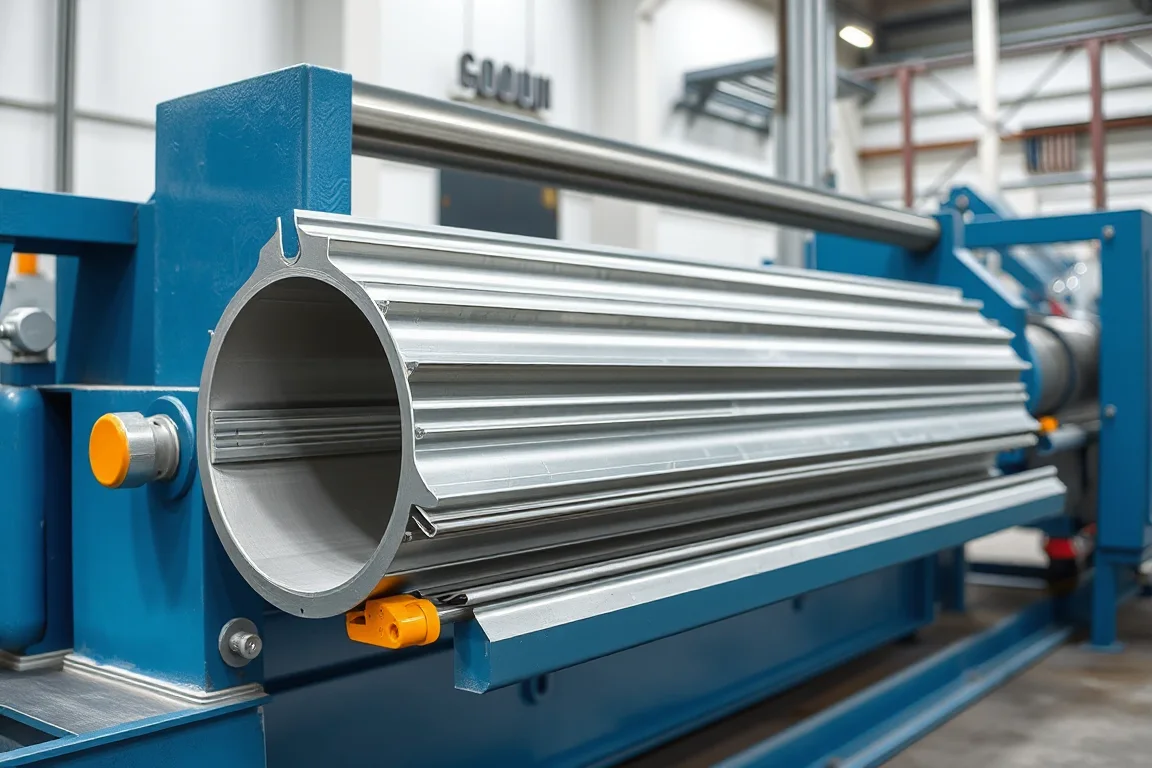
A curved roller shutter slat roll forming machine produces the individual metal slats that, when connected and wound, form a shutter curtain. The defining feature is the slat profile: a curved or shaped face runs between two interlocking edges. That face curvature is not cosmetic. It contributes to the slat's stiffness across its width and influences how the curtain coils. Because the slat must articulate at each interlock and then wind onto a drum or axle, the profile must be evaluated as part of a moving assembly, not as a stand-alone strip. This page focuses on that specific production route and the interfaces that determine whether the finished curtain functions correctly.
What makes a curved slat different from a flat slat
A flat-faced shutter slat and a curved-face slat can share a similar interlock concept, but they are not interchangeable in tooling terms. The curved face is formed by a sequence of rolls that progressively bend the strip across its width. That forming sequence has to be designed around the target face geometry, the material's springback behaviour and the position of the interlock edges. A flat-slat line typically uses simpler roll stands because the face remains largely flat between the edges. If a curved profile is run through tooling intended for a flat slat, the face shape may not develop correctly, and the interlock clearances can shift because the material is being pulled from the wrong starting condition. The practical consequence is that a curved slat machine should be specified from the profile drawing, not from a general shutter slat category.
The role of the curved face in curtain behaviour
The curved face affects more than appearance. A curved section resists bending across the slat width more effectively than a flat section of the same material and thickness, which can help the slat maintain its shape when the curtain is under load. The curvature also changes how adjacent slats nest when the curtain rolls. When the curtain winds, each interlock rotates. The face shape determines whether the slat surfaces contact evenly or concentrate pressure at one point. That contact pattern influences coating wear, noise and the effort required to raise or lower the curtain. For these reasons, the face profile and interlock geometry should be assessed together during first-off inspection, using the intended guide and winding hardware where possible.
Understanding the interlock and guide interfaces
The interlock is the feature that allows slats to connect while remaining free to articulate. In a curved slat, the interlock edges are formed from the same strip as the curved face, so any change in face forming can propagate into the hook or curl. The guides constrain the curtain laterally and keep the slats aligned as they travel. The clearance between the slat edge and the guide is a critical interface: too much clearance allows rattle and misalignment, while too little can cause binding when the curtain expands or when the interlock coating thickness varies. The end-lock detail also matters because it prevents lateral slat movement at the curtain ends. All three elements—face, interlock and end treatment—need to be checked as an assembly, not as independent features.
Material and coating considerations for curved profiles
Curved slats are commonly produced from coated steel or aluminum. The coating type and thickness can influence forming behaviour, especially at the interlock where the material is bent tightly. A coating that cracks or flakes during forming will create a weak point that may later corrode or interfere with articulation. The base-metal grade and thickness are also important because they determine springback and the force needed to close the interlock. Buyers should specify the intended base-metal thickness and grade, and the machine supplier should verify that the forming sequence can accommodate that material without damaging the coating. Insulated constructions add another layer of complexity, because foam or insulating material must be introduced without distorting the curved face or blocking the interlock.
Production route: forming, interlock development and cutting
A typical curved slat production route begins with strip feeding, followed by progressive forming of the curved face and the interlock edges. The interlock development stage is where the hook or curl is closed to the correct gap, and it often requires dedicated roll stands or a separate forming station. Perforation, if required, is usually introduced before or during forming; it can affect slat stiffness and may distort the profile if not supported properly. Cutoff comes after forming and must be matched to the profile so that the cut end is clean and square without crushing the curved face. For insulated slats, an additional insulation step is inserted before cutoff or during assembly. Each of these operations has its own tooling and setup requirements, and they should be quoted as separate scope items rather than assumed to be part of a bare forming machine.
Cutoff and end quality for curved slats
The cutoff operation is often underestimated on curved profiles. A shear or die set designed for a flat slat may not support the curved face adequately, leading to deformation at the cut end. Because the slat ends interact with end locks and guides, a distorted end can cause assembly problems or poor curtain movement. The cutoff should be designed to support the profile internally or externally during the cut, and the resulting end should be inspected for flatness, burrs and coating damage. If secondary operations such as end notching or hole punching are required, they should be integrated into the line or clearly identified as separate equipment. The goal is to produce a slat that can be assembled without rework.
Assembly boundaries: where the machine scope ends
A curved slat roll forming machine produces slats, but it does not produce a finished shutter. The finished curtain also requires guides, a bottom bar, end locks and sometimes a winding mechanism. These components are often sourced separately or produced on different equipment. When evaluating a production line, it is important to distinguish between the slat machine and the complete shutter workshop. The machine scope should be compared against the full list of operations needed to deliver a functional curtain. Assembly operations such as inserting end locks, joining slats and attaching the bottom bar are typically manual or semi-automated and should be planned separately. A quotation that covers only the slat machine may leave significant additional equipment and labour unaccounted for.
Application-specific inspection and acceptance checks
Acceptance testing for curved slats should go beyond measuring a single piece. The most informative test is to assemble several connected slats with their intended end locks and run them through a representative section of guide. This reveals whether the interlock allows free articulation without excessive play, and whether the curved face clears the guide as intended. Inspectors should look for coating damage at the interlock, distortion at the cut ends and any tendency for the slats to bind or jump. It is also useful to distinguish forming-induced distortion from a mismatch with guides or winding hardware. For example, if the slat curve is correct but the curtain binds, the guide clearance or end-lock fit may be the cause. Recording these observations during first-off and steady production helps separate machine issues from assembly issues.
Comparing alternative production routes
Several routes can produce curved shutter slats, and each has different implications for tooling, flexibility and secondary operations. A dedicated roll forming line with progressive dies is common for high-volume production of a single profile. It offers consistent interlock geometry but requires a significant tooling investment and is less flexible for profile changes. A line with interchangeable roll sets can handle multiple curved profiles but may require more setup time and careful changeover procedures. For lower volumes, a press brake or specialized forming machine might be used, but these methods often struggle to produce a continuous interlock with consistent coating integrity. Insulated slats add a further route decision: foam injection or insertion can be done inline or offline, and the choice affects line speed and equipment layout. When comparing options, focus on the finished curtain requirements—interlock performance, face shape, coating condition and assembly fit—rather than only on the forming speed of the slat machine.
Checklist for specifying a curved slat production setup
- Provide a complete profile drawing showing the curved face, interlock detail and end-lock interface.
- Specify the base-metal material, grade and thickness, including any coating type and thickness.
- State whether the slat will be insulated or perforated, and describe the required process for each.
- Confirm the cutoff method and required end quality, including any secondary operations.
- Define the intended acceptance test: number of connected slats, guide type and end-lock hardware to be used.
- Identify all components needed for a finished curtain—slats, guides, bottom bar, end locks—and clarify which are in scope.
- Request a trial run using the actual material and profile, and inspect first-off and steady-production samples.
- Ask for a changeover procedure if multiple profiles will be produced on the same line.
- Verify that the electrical supply requirements match the site's available power.
- Clarify what constitutes accepted output per shift for the specific profile and material.
FAQ: curved roller shutter slat roll forming
Can a flat slat machine be modified to run curved slats?
In some cases, additional roll stands or modified tooling can introduce a curved face, but this is not a simple change. The forming sequence must be redesigned to develop the curve without distorting the interlock, and the cutoff may also need modification to support the new profile. It is usually more reliable to specify a machine designed for the curved profile from the outset.
How does the curved face affect the interlock clearance?
The curved face is formed from the same strip as the interlock. If the face forming pulls material unevenly, the interlock gap can vary along the slat. This is why inspection should include assembled slats: a consistent interlock gap is easier to judge when several slats are connected and articulated.
What is the best way to inspect cut ends on a curved slat?
Check for deformation of the curved face, burrs and coating damage. The cut end should be square enough to fit the end lock without forcing. Visual inspection under good lighting, combined with a trial fit of the end lock, is more informative than measuring the end alone.
Does perforation change the required roll forming setup?
Perforation removes material and can reduce slat stiffness, which may require adjustments to the forming sequence or the addition of support rolls. It can also create stress concentrations that lead to distortion if the perforation pattern is not matched to the material and profile.
Why is it important to test with the intended guides and end locks?
The slat only functions as part of a curtain. Guides and end locks determine the actual clearances and constraints. Testing with the intended hardware reveals whether the slat profile is compatible with the rest of the system, rather than just acceptable as a loose piece.
What should be included in a quotation for a curved slat production line?
The quote should clearly separate the slat forming machine, cutoff, any perforation or insulation equipment, and the assembly components such as guides, bottom bar and end locks. It should also state the assumed material and profile, and define the acceptance test. This makes it possible to compare offers on a like-for-like basis.

Continue your research
- Roller Shutter Door Roll Forming Machines
- Roller Shutter Slat Roll Forming Machine
- Rolling Shutter Guide Rail Roll Forming Machine
- Flat Roller Shutter Slat Roll Forming Machine
- Perforated Roller Shutter Slat Machine
- Insulated Roller Shutter Slat Machine
- How Roller shutter roll forming machine Works
- How To Choose a Roller shutter roll forming machine
- Roller shutter roll forming machine Price: What Affects the Cost?
Configuration & specification inputs
Match the configuration to your section drawing, material and production requirements.
| Parameter | Requirement / confirmation needed |
|---|---|
| Profile geometry | A curved shutter slat has a face shape as well as interlocking edges. Check both against the guide and coil arrangement and avoid assuming it shares flat-slat tooling. |
| Material | Specified coated steel or aluminum; insulated constructions require additional processing |
| Thickness & grade | Buyer to specify base-metal thickness and grade; operating range requires supplier verification. |
| Process route | Forming → interlock development → optional insulation/perforation → cutoff → curtain assembly |
| Cutting | Confirm profile-supported cutoff, cut lengths, end quality and any secondary operations. |
| Output | Define accepted output per shift with the actual profile and material. |
| Electrical supply | Buyer to state voltage / frequency / phase. Installed power requires a confirmed equipment schedule. |
| Acceptance | Trial several connected slats with their end retention. Check free movement and nesting at the intended interfaces. Distinguish forming-induced distortion from a mismatch with guides or winding hardware. |