
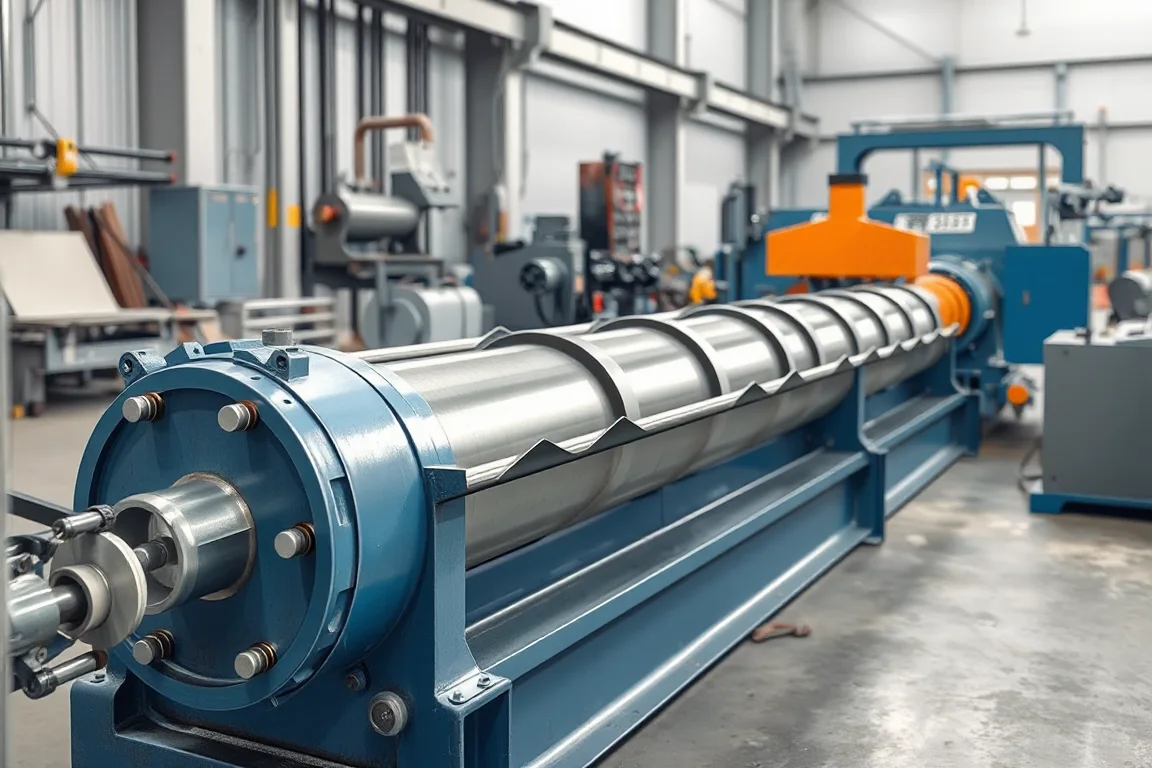
A half round gutter roll forming machine produces the long, arched trough that sits along a roof edge. Unlike an open angular gutter, the profile has a defined internal arc, a bead or hem at the front edge, and a back edge that must fit brackets and hangers. Those three interfaces—the arc, the bead and the support line—drive every decision about tooling, cut-off and acceptance. A machine that forms a convincing curved section but cannot hold the bead or meet the bracket line will still leave the installer with rework.
This page is about the half round gutter itself, not about k-style, box or downspout formers. The distinctions matter because the forming route, the joining method and the inspection criteria are different. The supplied selection data treats the profile drawing, material, thickness, process route, cutoff and production target as buyer-defined inputs rather than fixed machine ratings, and the guidance below follows that logic.
What the half round profile actually requires
A half round gutter is a continuous open channel. Its open top is the water inlet, its curved bottom is the flow surface, and its front and back edges are attachment details. The front edge often carries a bead or a folded hem that stiffens the rim and gives the bracket something to grip. The back edge is usually flat or slightly flanged so it can sit against fascia or a hanger strap. The arc itself matters because a distorted trough will not drain evenly and may not seat in the bracket at all.
The profile drawing therefore has to define the true radius or the chord across the open top, the bead form, the back edge, and the intended joining detail at stop ends and outlets. Because the gutter is open, it is more sensitive to springback than a closed tube. A formed section can look correct on the line and then relax after cutting, leaving the installer to force it into shape.
Coil payoff and material decisions
The line begins with coil payoff. Coated steel and aluminum behave differently in the same forming route: coated steel generally holds a formed arc with different springback than aluminum of comparable base-metal thickness, and the coating can be marked or cracked if the rolls or guides are not suited to it. Copper requires its own process review because its work-hardening and surface behavior differ, and because copper gutters often use soldered or riveted joints rather than the folded or sealed joints used on coated steel.
Base-metal thickness and grade are buyer inputs. There is no responsible way to publish a single operating range as a machine fact, because the acceptable range depends on the profile, the material and the required edge quality. Instead, the buyer should state the thickness and grade they intend to run, and the equipment scope should be confirmed against that stated input.
Section forming and edge or seam closure
The core of the machine is the section forming station sequence. For a half round profile, the rolls progressively bend the coil into an arc while forming the bead and back edge. The number of stations and the roll geometry are chosen for the combination of material, thickness and arc depth—not for a generic "gutter" shape. A shallow arc in thin coated steel and a deep arc in a harder material do not follow identical forming logic.
Edge and seam closure refers to the front bead or hem and any folded joint along the back or at a seam. Closure quality controls stiffness and appearance. An incomplete hem can leave a sharp or loose edge; an over-closed hem can distort the arc. For downpipes made on the same premise, a closed seam is the analogous operation, but a half round gutter is an open section, so the closure is at the rim rather than around a tube.
Why half round and angular gutters take different routes
A k-style or box gutter relies on bends that meet at corners, generally producing a flatter face with a defined front profile. Its brackets bear on flat surfaces. A half round gutter needs a continuous arc and a bead that a round or half-round bracket can capture. Substituting one tool set for the other is not a simple change, because the arc generation and the rim detail differ. The joining method also differs: angular gutters often use slip joints and sealant at defined laps, while half round gutters may use internal or external connectors, stop ends and outlets shaped to the arc.
Similarly, a round downspout former and a half round gutter former are separate applications. A downspout is a closed tube; it needs a seam closure that a half round gutter does not. A gutter former does not establish drainage capacity, and a downspout former does not necessarily produce elbows.
Cutoff and the relaxed shape after cutting
Cutoff must be profile-supported. If the die or shear does not support the arc, the cut can collapse the trough, flare the bead or leave a distorted end that will not accept a connector. The cut length, end squareness and end quality should be defined for the actual profile and material. Secondary operations such as punching bracket holes or notching for outlets may or may not be part of the same line, and they should be listed explicitly in the equipment scope.
The behavior after cutoff is especially important for half round profiles. A section that is held round by a fixture during forming may spring open once released. Acceptance should be judged on the relaxed piece, not on a sample that is still constrained.
Outlets, elbows and joining as separate operations
Gutter forming produces the long run. Outlets, stop ends, elbows and connector pieces are normally separate operations. An outlet may be a formed and punched detail, a welded or sealed fitting, or a separate molded or fabricated component, depending on the material and the drainage design. Elbows for downpipes generally require a dedicated secondary forming process. If the intended business includes these parts, they belong in the written equipment scope and in the trial, because a line that only makes straight gutter cannot deliver a finished rainwater system on its own.
Drainage design must account for the building and local requirements. The machine does not establish capacity, fall or outlet sizing.
Workshop line versus portable site work
Some buyers want a workshop line that runs coil continuously and cuts to length. Others want a portable gutter machine that is taken to the site because long runs are difficult to transport. These are different productivity questions. A workshop line's line speed is only one part of installed productivity; coil loading, changeover, setup scrap, punching and unloading time all count. A portable machine trades throughput for access and transportability. The comparison should be made against the actual job pattern, not against a single headline figure.
Integration with brackets, stop ends and hangers
The formed gutter is only useful if it accepts the intended brackets, hangers and stop ends. The bead form and the back edge determine whether the bracket grips correctly. A bracket that requires a specific bead depth or a specific back-edge flat will not fit a profile that was formed to a different detail. The buyer should assemble a trial with the actual brackets, stop ends and outlets, because the fit at these interfaces is more revealing than the appearance of the bare section.
Quality checks specific to half round gutters
Inspection should focus on the bead or hem, straightness along the run, and joining fit. Straightness matters because a gutter that curves in plan view will not sit correctly against fascia. The bead should be consistent and complete along the length. End quality after cutoff should allow connectors and stop ends to seat. For any downpipe produced alongside the gutter, check the seam and the mating outlets or elbows. These checks are application-specific; they are not the same as the checks used for a flat angular gutter or a closed tube.
Practical acceptance checklist for a half round gutter line
The checklist below is written for a trial run using the agreed material and profile. It avoids the common mistake of accepting a demonstration piece that is not representative of production.
- Confirm the trial uses the intended material, grade and base-metal thickness, not an easier substitute.
- Inspect the first-off piece and a sample from steady production with the agreed gauges.
- Check the arc for uniformity along the run and across successive cut lengths.
- Check the bead or hem for completeness, consistency and freedom from sharp or loose edges.
- Check straightness in plan and elevation as the section relaxes after cutoff.
- Assemble the gutter with the intended brackets, stop ends and outlets.
- Confirm that the cut end accepts connectors and that end quality is repeatable.
- Verify that any punching or notching aligns with the bracket or outlet pattern.
- Record changeover steps, setup scrap and unloading time for the real shift pattern.
- Compare the written equipment scope against every secondary operation needed for a finished part.
Comparing production routes and equipment scope
A buyer can reasonably consider several routes. A dedicated half round gutter line forms the arc and bead in one continuous process, which suits a defined product family. A line that combines gutter and downpipe forming may offer more scope but needs careful separation of the two forming logics, because the open gutter and closed downpipe have different closure requirements. A portable machine suits site-based installation but changes the productivity trade-off. A workshop line with separate outlet and elbow operations may deliver the most complete finished system but requires more equipment and more space. There is no universal route; the correct choice depends on the profile family, material and the proportion of fittings in the finished work.
Quotation scope should include decoiling, cutoff, profile options and the accessories that form the finished assembly. Elbow, outlet and joining tools belong in the comparison when they are part of the intended business. Otherwise the buyer may compare a gutter former against a complete system and misread the difference.
Frequently asked questions
Can one half round gutter roll forming machine run coated steel, aluminum and copper?
Not without a process review. Coated steel and aluminum can be formed on a suitably arranged line for a given profile, but copper behaves differently in terms of work-hardening and surface handling, and copper joints are often made differently. Treat copper as a separate material decision rather than an extension of a steel or aluminum setup.
Does a half round gutter former also make the outlets and elbows?
Usually not in the same pass. Outlets are often formed, punched, welded or fabricated as separate parts, and elbows generally require a dedicated secondary forming process. If fittings are part of the business, they should be listed in the equipment scope and included in the trial.
Why does the cut end distort on a half round profile?
An open arc is less rigid than a closed tube, so a cutoff that does not support the trough can collapse or flare it. The fix belongs in the tooling and support design, not in a post-cut correction. Acceptance should be based on the relaxed end quality that a connector will actually see.
How is a half round gutter different from a k-style gutter on the same line?
The forming logic differs. A half round gutter needs a continuous arc and a bead or hem that a matching bracket captures, while an angular gutter relies on flat faces and corner bends. The joining method and bracket interface also differ, so tool substitution is not a simple change.
What should be inspected before accepting a produced gutter?
Inspect the bead or hem, straightness and joining fit, and assemble the section with the intended brackets, stop ends and outlets. Compare the relaxed shape after cutoff rather than a sample held artificially round by a fixture that will not exist during installation.
How should production target be stated?
Define accepted output per shift using the actual profile and material, and record the changeover, setup and unloading time that surrounds it. A single line-speed figure does not describe installed productivity, and no model rating should be assumed from a general description.
Electrical supply and installed scope
Voltage, frequency and phase are buyer inputs. Installed power requires a confirmed equipment schedule rather than an estimate from a general profile. Because these values depend on the final machine configuration and the site supply, they should be settled as part of the equipment specification, not inferred from the application type.
Closing view on interface-driven selection
The useful question is not whether a machine can bend a curve. It is whether the line can hold the arc, bead, back edge and cut end to the tolerances that brackets, stop ends, outlets and connectors require, using the material and thickness the buyer actually intends to run. That is why the profile drawing, material, process route, cutoff and acceptance checks are treated here as inputs to be defined, not as published machine ratings. A trial with the real interfaces tells more than a demonstration with a convenient substitute.

Continue your research
- Gutter & Downspout Roll Forming Machines
- Gutter Roll Forming Machine
- Downspout Roll Forming Machine
- K Style Gutter Roll Forming Machine
- Box Gutter Roll Forming Machine
- Round Downspout Roll Forming Machine
- How Gutter roll forming machine Works
- How To Choose a Gutter roll forming machine
- Gutter roll forming machine Price: What Affects the Cost?
Configuration & specification inputs
Match the configuration to your section drawing, material and production requirements.
| Parameter | Requirement / confirmation needed |
|---|---|
| Profile geometry | A half-round gutter needs a defined arc, bead and bracket fit. Compare the required forming route and joining method with open angular gutters rather than assuming a simple tool substitution. |
| Material | Coated steel or aluminum; copper requires its own process review |
| Thickness & grade | Buyer to specify base-metal thickness and grade; operating range requires supplier verification. |
| Process route | Coil payoff → section forming → edge/seam closure → cutoff → outlets or elbows as separate operations |
| Cutting | Confirm profile-supported cutoff, cut lengths, end quality and any secondary operations. |
| Output | Define accepted output per shift with the actual profile and material. |
| Electrical supply | Buyer to state voltage / frequency / phase. Installed power requires a confirmed equipment schedule. |
| Acceptance | Trial the gutter with the intended brackets, stop ends and outlets. Compare the relaxed shape after cutoff. Avoid accepting a sample held artificially round by a fixture that will not exist during installation. |