
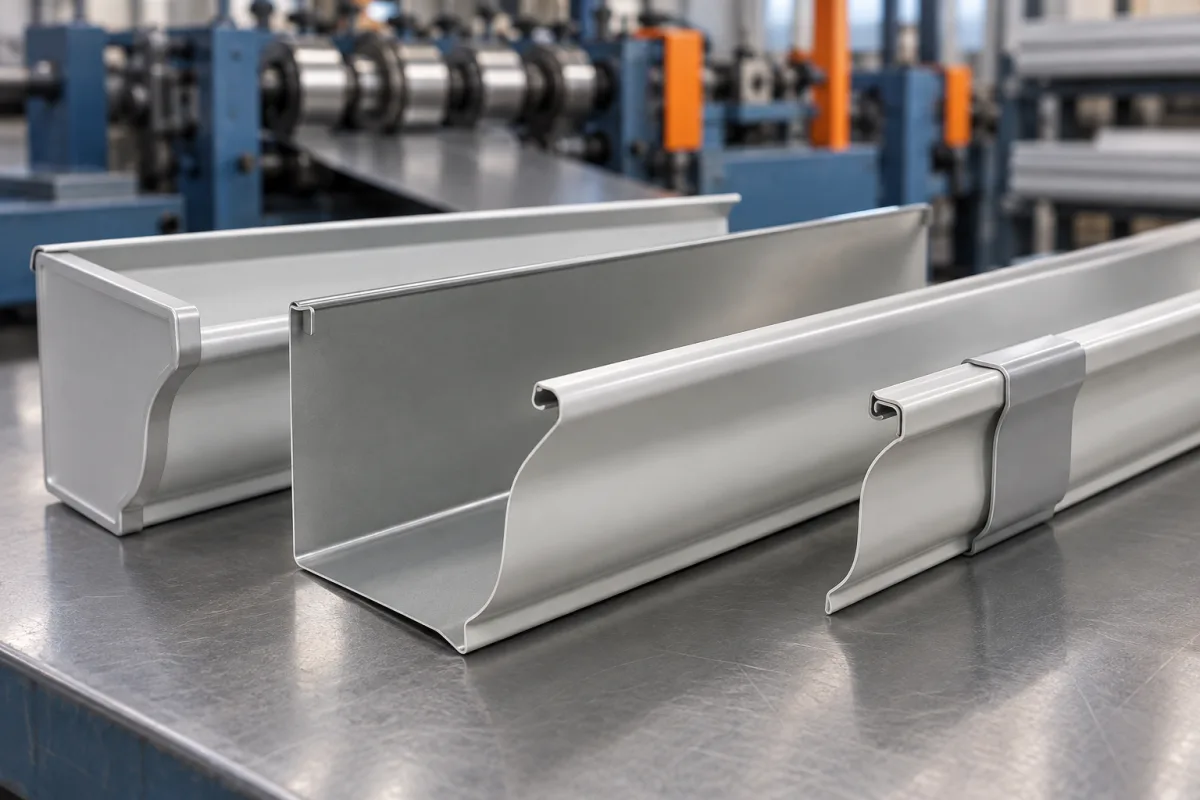
A K style gutter roll forming machine produces the long, decorative front-face rainwater gutter commonly called K-style or ogee. The machine's job is narrow in scope but deep in consequence: it turns coated steel or aluminum coil into a formed open section with a defined decorative face, a rear edge, and a bead or hem that interacts with hangers, end caps, outlets and splice joints. Buyers who treat this as a single machine purchase rather than one stage of a complete rainwater system often discover later that the line cannot deliver the finish details their installers and customers expect. This article explains the component interfaces, the appropriate production routes, where forming ends and fabrication begins, and how to inspect what actually matters.
Why K style is an application, not just a profile name
K-style and ogee are labels that describe overlapping gutter shapes. Two suppliers may use the same term for gutters with different decorative face curvature, different rear-edge geometry, and different bead or hem treatment. The practical consequence is that a tool set built for one drawing will not necessarily produce an interchangeable part for another. Before any forming question is answered, the buyer should consolidate terminology around one approved profile drawing showing the exact decorative face, rear edge, bead or hem, and the material thickness and grade the drawing assumes. That drawing becomes the reference for tooling, cutoff, inspection and every downstream accessory.
What the machine actually forms, and what it does not
A K style gutter roll forming machine handles coil payoff, progressive section forming, edge or seam closure as required by the profile, and cutoff to length. It does not, by itself, produce miters, ends, outlets or the hangers and closure components that make the gutter installable. A straight gutter former does not necessarily make miters or outlets, and no forming line establishes drainage capacity. Drainage design must account for the building and local requirements, and that design work sits outside the machine scope. Understanding this boundary early prevents the common mistake of quoting a finished installation against a line that only produces the open section.
Material choices and why copper is treated separately
Coated steel and aluminum are the usual inputs, and each material family brings its own forming behavior. Coated steel demands tooling and handling that preserve the coating through bending, because coating damage becomes a corrosion site. Aluminum forms differently, tends to mark more easily, and interacts with hardware and other metals in ways that affect long-term appearance. Copper requires its own process review: it is not simply another color in the same tool set, and the same roll configuration that suits steel or aluminum may not produce an acceptable copper section. Finish durability, bendability and joint compatibility should be reviewed together, because a finish that survives forming but fails at the joint still produces a failed installation. Thickness and grade are buyer-specified inputs; the operating range requires supplier verification, so the buyer should supply the base-metal thickness and grade rather than assume a broad window.
Forming route: open gutter sections versus closed downpipe seams
Closed downpipe seams and open gutter sections need different forming sequences. A gutter section is formed as an open channel with a decorative face, rear edge and bead; the forming stations shape the outer profile and the hem without closing a tube. A downpipe, by contrast, typically involves a closed seam, which changes the number and character of forming stations and the way the edge is closed. This is why K style gutter tooling and round or square downspout tooling are separate purchases even when the same contractor installs both. If a buyer intends to supply both gutters and downpipes, the equipment scope should name each former separately rather than assuming one line covers both.
Coil payoff, section forming, seam closure and cutoff
The process route to review is coil payoff, then section forming, then edge or seam closure, then cutoff, with outlets or elbows as separate operations. Coil payoff determines how consistently material enters the first forming station; inconsistent entry shows up as twist or bow many stations later. Section forming establishes the decorative face and rear edge. Edge or seam closure completes the hem or bead geometry. Cutoff must be confirmed as profile-supported, because not every cutoff method produces a clean end on an open decorative section without deforming the face or the bead. Cut lengths and end quality should be agreed in writing, along with any secondary operations the buyer expects the line to perform. Treating cutoff as an afterthought is a frequent source of scrap and rework.
Cutoff requirements and end quality on a decorative profile
On a K style gutter, the visible end is part of the delivered product. A cutoff that leaves a distorted bead or a crushed decorative face creates a part that looks unacceptable even if the cross-section is otherwise correct. The buyer should confirm what the cutoff is expected to do for this specific profile, what cut lengths are required, and whether any secondary operation such as deburring or end forming is needed. Cut length consistency matters because gutters are joined end to end and mitred at corners; small length variations accumulate across a long run. Inspection of the first-off piece should include the cut end, not only the formed section, because end quality is where a marginal cutoff setup becomes visible.
Outlets, elbows and joining components as separate fabrication
Outlets and elbows normally require separate operations from the gutter forming line. An elbow is not produced by a straight gutter former, and an outlet is a distinct component with its own interface to the gutter and to the downpipe. When a buyer plans to supply a complete rainwater system, the equipment scope should list elbow, outlet and joining tools explicitly. If those tools are absent from the scope, the quotation covers only the long formed section, and the business must either fabricate the remaining parts another way or purchase them. This distinction separates component production from assembly and from in-service performance, and it is one of the most common gaps between a machine quotation and a working installation.
Portable and workshop configurations serve different businesses
Portable gutter work includes coil loading, site access and support of long runs, and those factors change what the machine needs to do. A portable configuration prioritizes transportability and handling of long lengths at the building, while a workshop line prioritizes steady forming and cutoff in a fixed location. Workshop line speed is only one part of installed productivity, because changeover, setup scrap, punching and unloading time all consume the working day. When comparing alternatives, compare portability, decoiling, cutoff, profile options and accessories rather than a single headline figure. A line that forms quickly but requires long changeovers may deliver less accepted output per shift than a slower line that is easier to set up for the actual mix of lengths and profiles.
Output definition and what a production target should contain
No verified model rating applies here. The buyer should define accepted output per shift using the actual profile and material, not an easier demonstration substitute. That means specifying the profile, the material and grade, the range of lengths, the proportion of changeovers, and the acceptance criteria that determine whether a piece is salable. Installed power is not a single number either: the buyer should state voltage, frequency and phase, and the installed power follows from a confirmed equipment schedule listing each motor and load. A production target that ignores changeover and scrap is optimistic; one that includes both is usable for planning.
Inspection and acceptance: what to check on a formed gutter
Acceptance should inspect the bead or hem, straightness and joining fit. The formed lip should be checked with the intended hangers and closure components, because a bead that meets the drawing but does not fit the hanger is not acceptable in service. For downpipes, check the seam and the mating outlets or elbows. Straightness matters along the full run, since a gutter that bows will not sit correctly against the fascia. Joining fit matters at every splice and miter. Run the agreed material and profile, inspect first-off pieces and a representative steady-production sample with the agreed gauges, and record changeover steps, setup scrap, punching and unloading time. Compare the written equipment scope with all secondary operations needed for a finished part.
A practical checklist before approving a K style gutter line
- One approved profile drawing showing decorative face, rear edge, bead or hem.
- Confirmed material family, with copper held as a separate process review.
- Base-metal thickness and grade specified by the buyer, not assumed.
- Written process route from coil payoff through cutoff, with closure steps named.
- Cutoff confirmed as profile-supported, including cut lengths and end quality.
- Outlets, elbows and joining tools listed in or excluded from scope explicitly.
- Voltage, frequency and phase stated, with an equipment schedule for installed power.
- Accepted output per shift defined with the real profile, material and length mix.
- First-off and steady-production samples inspected with agreed gauges.
- Changeover steps, setup scrap and unloading time recorded during the trial.
- Bead checked against the actual hangers and closure components.
- Downpipe seam and mating outlets or elbows checked where downpipes are in scope.
Comparing alternatives: single-purpose former, portable unit, or accessory-inclusive line
A single-purpose gutter former is the narrowest option: it forms the open section and cuts to length, leaving outlets, elbows and joining to other means. A portable unit adds transportability and site handling but may simplify cutoff or decoiling to save weight, which changes what can be produced at the building. An accessory-inclusive line bundles gutter forming with outlet, elbow and joining tools, which reduces the number of separate purchases but increases the scope to specify and inspect. The right choice depends on whether the business sells formed sections to fabricators or installs complete systems. A fabricator may need only the former and a reliable cutoff; an installer needs the accessory tools as well. Comparing alternatives on portability, decoiling, cutoff, profile options and accessories gives a clearer picture than comparing a single capability in isolation.
FAQ: specific questions about K style gutter roll forming
Can one K style gutter line also produce round or square downspouts?
Downspout production involves a closed seam, and closed downpipe seams and open gutter sections need different forming sequences. A gutter former is configured for an open channel with a decorative face and bead, so downspout forming is normally a separate machine or a separately specified line. If both are needed, name each former in the equipment scope rather than assuming one covers both.
Why does copper require its own process review?
Copper behaves differently in forming, surface handling and joint compatibility compared with coated steel or aluminum. Tooling and roll configuration suited to one material may not produce an acceptable copper section, and coating or finish assumptions do not transfer. Copper should therefore be treated as a separate review with its own material, thickness and grade inputs supplied by the buyer.
Does the machine make the outlets and elbows, or are those bought separately?
Outlets and elbows are normally separate operations from the gutter forming line. A straight gutter former does not necessarily make miters, ends or outlets. The buyer should list the accessory and fabrication steps needed to supply an installation, and confirm whether elbow, outlet and joining tools are inside or outside the quoted scope.
How should cutoff be specified for a decorative K style profile?
Confirm that the cutoff is profile-supported for the approved drawing, agree the required cut lengths, and define acceptable end quality. The visible end should not crush the bead or distort the decorative face. If secondary operations such as deburring or end forming are needed, they belong in the written scope so the quotation matches the finished part.
What should be inspected on a first-off K style gutter sample?
Inspect the bead or hem, straightness and joining fit. Check the formed lip against the intended hangers and closure components, and review the cut end as well as the cross-section. For downpipes, check the seam and mating outlets or elbows. The first-off piece should be made from the agreed material and profile, not an easier substitute.
Why is workshop line speed a weak basis for comparison?
Workshop line speed is only one part of installed productivity. Changeover steps, setup scrap, punching and unloading time consume working hours, and accepted output per shift depends on the actual profile, material and length mix. A comparison based on a single speed figure ignores the time the line spends not forming salable parts.

Continue your research
- Gutter & Downspout Roll Forming Machines
- Gutter Roll Forming Machine
- Downspout Roll Forming Machine
- Half Round Gutter Roll Forming Machine
- Box Gutter Roll Forming Machine
- Round Downspout Roll Forming Machine
- How Gutter roll forming machine Works
- How To Choose a Gutter roll forming machine
- Gutter roll forming machine Price: What Affects the Cost?
Configuration & specification inputs
Match the configuration to your section drawing, material and production requirements.
| Parameter | Requirement / confirmation needed |
|---|---|
| Profile geometry | K-style and ogee labels can describe overlapping gutter shapes. Use the exact decorative face, rear edge and bead drawing, and consolidate the terminology around one approved profile. |
| Material | Coated steel or aluminum; copper requires its own process review |
| Thickness & grade | Buyer to specify base-metal thickness and grade; operating range requires supplier verification. |
| Process route | Coil payoff → section forming → edge/seam closure → cutoff → outlets or elbows as separate operations |
| Cutting | Confirm profile-supported cutoff, cut lengths, end quality and any secondary operations. |
| Output | Define accepted output per shift with the actual profile and material. |
| Electrical supply | Buyer to state voltage / frequency / phase. Installed power requires a confirmed equipment schedule. |
| Acceptance | A straight gutter former does not necessarily make miters, ends or outlets. List the accessory and fabrication steps needed to supply an installation. Inspect the formed lip with the intended hangers and closure components. |