
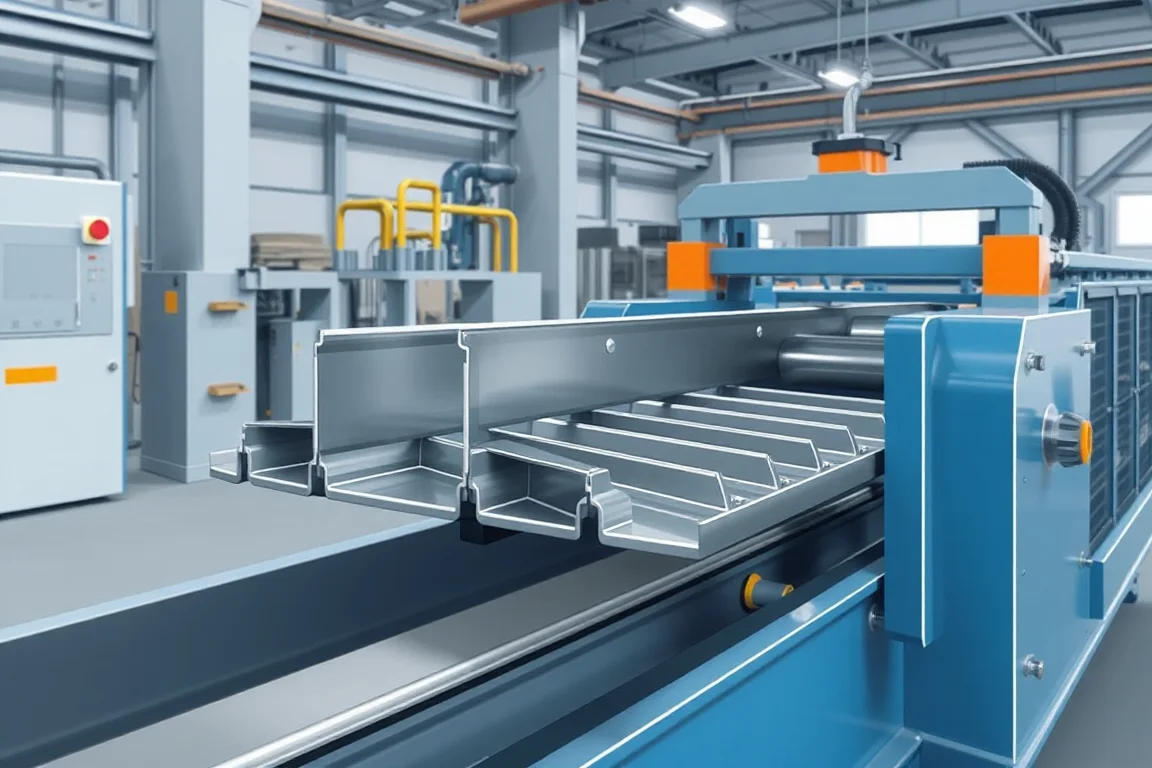
A B deck roll forming machine makes the specified B-type structural roof-deck profile. In common North American usage, B deck is a wide-rib roof deck with a nominal 1.5-inch depth. The equipment still needs the complete section, side-lap variant, material and optional features; the B designation alone is not a tooling drawing.
Deck production differs from ordinary decorative roofing sheet because the manufactured section belongs to a structural deck system. The line must reproduce the approved geometry and material, while design and testing establish the system's permitted uses and capacities.
What should the B-deck drawing contain?
Show rib depth, pitch, top and bottom widths, web angles and both terminal edges. State effective cover and the selected side-lap construction. Include the dimensional references used by the deck product's inspection plan.
Do not assume that every B-type product uses the same terminal detail. Nested and interlocking side laps can require different edge tools and acceptance assemblies even where the central rib pattern is similar.
How does B deck differ from a general roof panel?
The deck is specified as part of a structural support system beneath the roof assembly. Its material, geometry and attachment details are tied to that system. A panel former that makes a visually similar rib does not automatically produce an approved B-deck product.
Keep roof finishes, insulation and deck accessories separate in the product scope. The roll former makes the specified steel deck sheet; it does not manufacture the entire roof assembly or determine its design values.
Which side-lap variant will be produced?
Provide the exact nested or interlocking edge drawing and the intended joining reference. If multiple variants are planned, identify their change parts and inspection methods. A different lap can affect entry width, final edge forming and cutoff support.
- Show both terminal edges in their loose condition.
- Include the joined relationship between sheets.
- Identify the reference used to measure cover.
- State any required joining-tool interface.
- Retain representative mating sheets for acceptance.
Measure the lap as well as the repeating ribs. The hidden edge is a functional part of the deck product, not an optional detail at the edge of the drawing.
What does the production route include?
Coil handling and entry preparation feed material through progressive deck-forming tools. Optional punching, venting or other features have a defined place in the route. The cutting arrangement produces ordered lengths and the takeoff supports the deck for inspection and stacking.
Review the proposed cutoff with the actual B profile and lap variant. Check local rib distortion and edge condition near the cut. A mid-length section measurement does not establish the quality of the complete delivered sheet.
How should material and finish be specified?
State steel grade, base-metal thickness and coating or paint condition for each product. Use a matrix that pairs material with the approved profile. Different thicknesses or strengths are not interchangeable merely because the section label is unchanged.
Trial production-intent material and keep its identification with the measurements. Inspect bends, cut edges and any feature areas. The machine's approved range should be based on actual combinations rather than unrelated maximum claims.
What if vented, acoustical or cellular products are required?
These variants can add perforations, slots, liners or other manufacturing operations. Define the complete product construction and identify the equipment responsible for each feature. A basic B-deck former should not be assumed to produce every enhanced variant.
Review feature registration and downstream assembly separately. A perforated top sheet, a liner and an assembled cellular product are different manufacturing deliverables. The quotation and trial should state exactly which one is included.
How should output and changeover be compared?
Use accepted deck lengths or sheets from a stated order mix. Include cutting frequency, feature operations, coil changes and stack removal where relevant. Maximum forming speed alone does not describe complete deck production.
If another deck profile or lap is planned, request a full changeover matrix. Time the transition through the first accepted sheet and joined lap, including cutoff changes and inspection. This reveals the real flexibility of the proposed line.
What should acceptance verify?
- Confirm profile, lap variant and material identity.
- Measure ribs, webs, cover and terminal geometry.
- Inspect cut ends and optional features.
- Join representative sheets using the specified lap arrangement.
- Check straightness and condition after stacking.
- Demonstrate required profile or material transitions.
- Record accepted output and deviations.
Manufacturing acceptance should not be confused with structural-product qualification. The deck system's engineering and applicable tests remain distinct responsibilities.
Frequently asked questions
Does B deck always mean a 1.5-inch product?
That is a common designation, but the actual drawing controls. Confirm the profile and local naming convention rather than ordering tools from the letter alone.
Can roof-panel tooling make B deck?
Only if the complete geometry, material and lap are within the engineered scope. Visual similarity does not establish an equivalent structural deck product.
Are interlocking and nested laps interchangeable?
No. They are distinct edge arrangements with different joining references. Specify the intended variant and its tools and acceptance method.
Does the line include cellular-deck assembly?
Only if that construction and the required joining operations are explicitly included. A formed top deck alone is not a completed cellular product.
What should a buyer provide?
Send the controlled B-deck section, lap details, material matrix, lengths and optional features. Identify other profiles and the intended structural-product qualification responsibilities separately.
Specify the complete B-deck product
A useful B-deck proposal connects central ribs to side laps, material and any enhanced construction. That gives the forming trial a clear target and prevents a familiar product name from replacing the necessary manufacturing detail.

Continue your research
- Floor Deck Roll Forming Machines
- Floor Deck Roll Forming Machine
- Roof Deck Roll Forming Machine
- N Deck Roll Forming Machine
- H Deck Roll Forming Machine
- 1.5 Inch Roof Deck Roll Forming Machine
- How Floor deck roll forming machine Works
- How To Choose a Floor deck roll forming machine
- Floor deck roll forming machine Price: What Affects the Cost?
Configuration & specification inputs
Match the configuration to your section drawing, material and production requirements.
| Parameter | Requirement / confirmation needed |
|---|---|
| Profile geometry | Approved B-type rib section with drawing-defined nominal depth, cover and selected side lap. |
| Material | Specified deck steel grade, coating or finish paired with each product variant. |
| Thickness & grade | Base-metal thickness combinations reviewed with the actual rib and lap geometry. |
| Process route | Coil preparation, required features, deck and lap forming, supported cutoff and stacking. |
| Cutting | Ordered deck lengths with intact terminal edges and controlled local rib distortion. |
| Output | Accepted complete B-deck sheets for the stated feature, length and changeover mix. |
| Electrical supply | Utilities for deck forming, feature tools, cutoff and package handling. |
| Acceptance | Ribs, cover, joined lap, optional features, cut ends and package condition with qualification separately scoped. |