
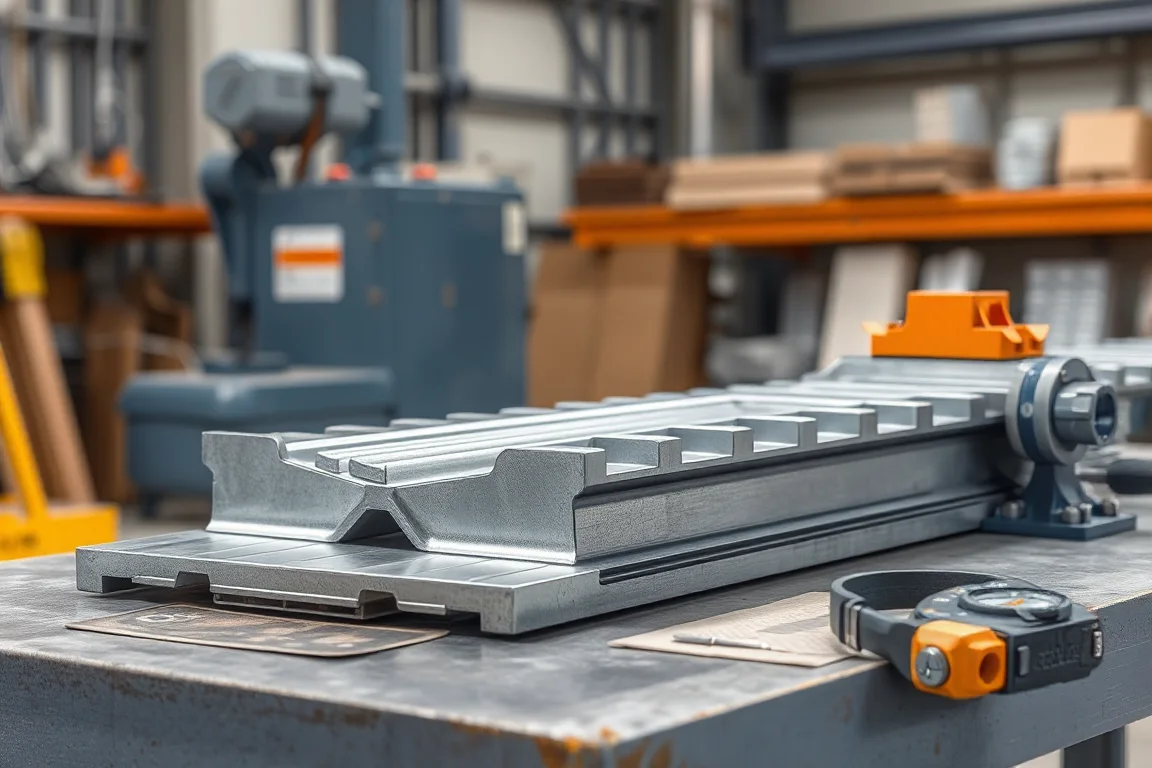
Choosing a floor deck roll forming machine requires a defined deck system and a complete production route. Profile depth alone does not describe the product. Ribs, bearing surfaces, side laps, embossments, material and handling all need to be included before equipment proposals can be compared meaningfully.
Choose the deck product before the machine
Identify whether the intended output is form deck, composite floor deck or another approved profile. Provide the complete drawing and product requirements. A generic deep-rib machine should not be assumed to make a structurally equivalent substitute for a specified deck.
Resolve the product design and its performance responsibilities with the appropriate specialists. The equipment supplier needs a manufacturing target, not an invitation to infer a floor rating from a section nickname.
Define the profile and material matrix
List required ribs, laps, effective cover, lengths and functional surface features. Pair each profile with grade, thickness convention, width and coating. Independent maximum values can imply combinations the business does not need and the equipment may not support.
Prioritize the common high-volume product and the essential boundary cases. This allows a proposal to balance everyday production with necessary flexibility instead of offering a broad but poorly defined range.
Review embossment and feature capability explicitly
Where the deck design includes embossments, slots or other features, specify their geometry and location. Ask how they are produced and inspected. Do not accept a sample with merely similar-looking marks as proof of the required product.
Identify which feature changes require additional tools or engineering review. A profile revision can affect more than the forming rolls. Keep feature scope tied to the approved deck drawing.
Compare single-profile and changeable arrangements
A dedicated route may serve a stable deck catalog efficiently, while a changeable arrangement offers broader product coverage. The value depends on actual order volumes and transition frequency. Ask what physical components change for every required profile.
Measure recovery through the first accepted complete sheet, including feature and lap checks. A quick tool exchange is only part of the change if cutting components, guides or inspection references still need work.
Evaluate cutting with the real section
Require representative short and long sheets and inspect the deep ribs and side laps at both ends. The proposed cutting route should preserve the product's usable geometry, not simply achieve nominal length.
Ask which section-specific supports and tools are included. A second deck profile can require different components even when its nominal depth is similar. Include those items in the price and maintenance comparison.
Plan the complete stack and bundle route
Draw coil loading, entry, forming, cutting, inspection, stacking and bundle removal. Check the longest intended sheets and their supported movement. A line that fits the building but cannot discharge its product is not a complete layout.
Where nesting or automated stacking is proposed, test the actual profile combinations. Include the side-lap and finish condition after handling. The rate at the roll exit is less useful than the rate of undamaged accepted bundles.
Keep accessories outside the main-sheet assumption
Floor packages may need closures, edge details or other fabricated components. List them and identify their production or supply route. The principal deck former does not automatically make every accessory used on a project.
This scope review also clarifies what the customer receives. If the business intends to supply a complete package, missing accessory capacity can constrain deliveries even while the main deck line has spare time.
Use a product-specific acceptance trial
Choose production-intent material and representative lengths, including an important profile transition if flexibility drives the purchase. Inspect complete sheets and an adjoining-sheet assembly after normal handling.
- Rib pitch, depth and specified bearing surfaces.
- Terminal edges and effective cover.
- Required embossments or other features.
- Length and cut-end condition.
- Stacking compatibility and handling preservation.
- Accepted quantity over a stated time boundary.
Test the business case with a realistic scenario
Use a quotation worksheet to distinguish included equipment from buyer-supplied work. Coil loading, feature tools, cutoff supports, inspection fixtures and bundle removal should each have an owner. Add transport, utilities, commissioning material and training. A blank item is not an included item; resolve it before ranking total prices. This prevents a bare forming mill from being compared with a complete deck-production package as though they delivered identical results.
Also include the people who will operate, inspect and maintain the route in the demonstration. Ask them to identify the correct profile tools, locate the accepted reference and explain how the first sheet is released. If recovery depends on undocumented knowledge, the support scope needs improvement. A technically capable line still needs a practical process for changing coils, recovering profiles and identifying finished bundles. Those operational details influence whether the equipment can repeat its acceptance result during ordinary production, especially when an experienced commissioning specialist is no longer present.
Suppose most orders use one composite deck, but a second profile is required for occasional projects. Compare the incremental tool and changeover cost with that demand and the consequences of sourcing it elsewhere. Do not buy flexibility solely because more profiles sound attractive.
Also review support recovery: how are the correct embossment tools, cutoff components and setup references identified after service? Documentation and training should match the actual deck catalog. A line capable of a one-time demonstration still needs a repeatable operating process.
Frequently asked deck-equipment selection questions
Can nominal deck depth define the enquiry?
No. Rib geometry, laps, cover, features and materials are also essential. Provide complete drawings and approved combinations.
Does a machine trial approve the deck's structural use?
It verifies manufacturing results. Structural design and product-system evidence remain separate requirements and should have clear responsible parties.
Should stacking be evaluated after the former is chosen?
Evaluate it with the line because it affects layout, product preservation and usable output. A faster former can simply create a downstream bottleneck.
What makes quotations comparable?
The same deck drawings, material matrix, features, lengths, handling and acceptance boundary. Then compare complete scope and accepted output rather than isolated machine dimensions.
Continue your research
- Floor Deck Roll Forming Machines
- Floor Deck Roll Forming Machine
- Roof Deck Roll Forming Machine
- B Deck Roll Forming Machine
- N Deck Roll Forming Machine
- H Deck Roll Forming Machine
- How Floor deck roll forming machine Works
- Floor deck roll forming machine Price: What Affects the Cost?
- Materials and Thickness for Floor deck roll forming machine