
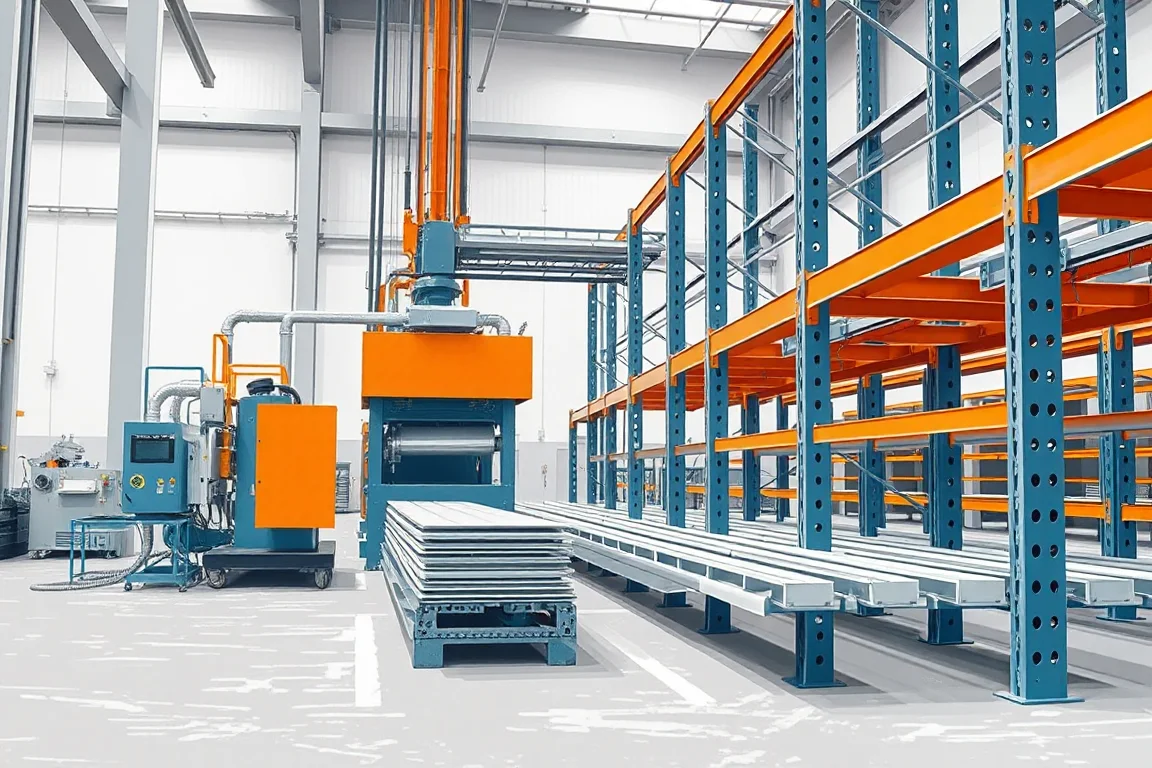
A storage rack roll forming machine is a production line that converts flat steel strip into the profiled components of a racking system. The machine itself is only one part of the manufacturing route. Understanding how it works means following a part from the uncoiler through punching, forming, cutting and any joining or inspection step, and knowing which of those operations are inside the line, which are manual, and which happen elsewhere. That distinction shapes what the machine can produce, what downstream equipment is required, and how acceptance should be judged.
The product being made: uprights, beams and connectors
Racking is an assembly, not a single profile. Upright frames carry vertical load and provide the perforated pattern that beams engage. Beams carry shelf load between uprights and depend on connector geometry to seat correctly. A machine may form uprights, beams, shelf returns or a combination, but it does not make a rack by itself. The component drawing defines the section shape, the hole pattern and its datums, the material grade and thickness, and the post-forming finish agreed for the part. The machine's job is to reproduce that drawing repeatedly. The finished rack's load capacity is a property of the complete racking design, not of the forming line.
The sequence inside a roll forming line
Most storage rack lines follow a recognizable order: material is paid off and fed, holes and slots are punched, the strip enters a series of roll stands that progressively bend it into section, the formed profile is cut to length, and where the product requires it, joining or secondary work follows. Inspection is not a station so much as a discipline applied at defined points. The order matters because each operation changes the reference surfaces available to the next. Punching before forming, for example, means the holes are located relative to the flat strip; forming then has to preserve those positions as the material bends.
Punching: holes, slots and datums
The hole pattern is often more critical than the overall channel width. Upright perforations accept beam connectors and may also carry accessory fittings; beam ends carry connector geometry that must mate with the upright pattern. Each hole type should be defined by its size, shape, position, and the datum from which it is measured. The press or punching unit may be integrated into the line or a separate operation. Integrated punching keeps a single handling sequence but constrains tooling changes and line layout. Separate punching can offer more flexibility at the cost of an extra handling step and a second setup. The decision should follow the number of hole variants, the frequency of product changeover, and whether the same pattern serves several profiles.
Forming: how the section takes shape
Roll forming passes the strip through matched rolls that bend it gradually. The number and arrangement of stands depend on the section complexity and the material. A simple open channel needs fewer forming stages than a closed or return-flanged section, and a profile with bends close together may need more gradual sequencing to avoid distortion. Roll design also has to account for springback: steel does not stay exactly where a roll leaves it, so the finished shape is the result of the whole roll train, not any single station. Forming decisions influence whether a section can be produced on a given line and how much adjustment is needed when material or thickness changes.
Cutoff and end condition
After forming, the profile is cut to length. The cutoff must suit the profile: a method that works on an open channel may crush or distort a closed or return-edged section. The end quality matters because rack components are assembled and handled. A cut end may need deburring, a particular squareness, or a form that allows a subsequent joining operation. The cutting operation also creates a new handling boundary. If the part is referenced again after cutting, the reference method should be defined; if it is not, downstream operations may inherit positional variation.
Integrated versus separate operations: the real layout question
The useful comparison is not machine speed but which operations are inside the line. An integrated line performs punching, forming and cutting in one pass. A partly integrated route forms the section but leaves punching or joining to separate equipment. A separate-operations route may form, cut, then punch and assemble in a different area. Each choice trades handling, floor space, changeover time and capital against flexibility and the ability to balance production across products. A quotation that omits an operation has not removed it; the operation still has to happen somewhere, with its own tooling, labour and quality checks. The line layout should show every point where the part is gripped, referenced, punched, bent, cut, joined or inspected.
Box beams and built-up sections
Some beam designs are assembled from more than one formed section rather than produced as a single profile. In that case the roll forming line produces the constituent parts, and the joining operation, whether welding or mechanical fastening, is separate. Joining brings its own quality checks: alignment, joint consistency and dimensional control. A former does not automatically include welding, connector attachment or rack-system approval. If the intended product is a built-up beam, the manufacturing route must include the joining process and its acceptance criteria.
Material and thickness: why the line is not material-independent
A roll forming line is set up for a material grade and thickness range. Within that range, the same rolls may produce acceptable parts; outside it, springback, forming loads and hole quality can change. The buyer should specify base-metal thickness and grade, and the operating range should be verified against actual trials rather than assumed. Thickness variation affects the forming sequence and the punch tooling, and a line set for one range may not reproduce the same section from a different grade without adjustment. This is a boundary to establish before purchase, not a universal recipe that transfers between profiles or materials.
Acceptance: what to inspect and why
Acceptance should verify an agreed component drawing. Practical checks include connector engagement between a beam end and the upright pattern, the repeatability and position of holes, and section straightness relative to the drawing. For built-up beams, the joining operation and its quality should be included. These checks matter because the machine can be dimensionally correct in isolation yet produce parts that will not assemble: a hole pattern shifted relative to the section, or a connector that does not seat, is a functional failure. Testing with the actual mating components, not only with gauges, is the clearest evidence that the line produces usable parts.
Output: define accepted parts, not a nominal figure
Output should be defined as accepted parts per shift for the actual profile and material, including changeover, punching, cutting and any manual handling. A nominal line speed does not describe how many usable parts leave the line when tool changes, setup and rework are included. The buyer and supplier should agree what counts as accepted output and how it is measured. That figure is only meaningful when tied to a specific product, so it should not be treated as a universal machine property.
Selection and cost: comparing decisions and quote scope
Choosing a storage rack roll forming machine is mainly a matching exercise between the product range and the process route. Key decisions include which profiles the line must make, how many hole variants are needed, whether punching and joining are integrated, how often changeover occurs, and what floor space and services are available. On cost, the quote scope matters more than a headline number. A quotation may cover the roll forming line only, or include uncoiling, punching, cutting, joining, tooling, controls and commissioning. It may or may not include spare tooling, training, or acceptance testing. The cost of accepted output follows from that scope: a lower-cost line that omits an operation or requires more manual work may produce a higher effective cost per accepted part. Buyers should compare quotes on the same scope and the same product, and should treat any figure as an estimate for a defined configuration rather than a fixed market price.
Practical checklist
- Identify the input and output of each station in the proposed line.
- Separate the line's physical sequence from the complete manufacturing route.
- Define each hole type and its datum on the component drawing.
- Confirm how a part is referenced again after cutting or a secondary operation.
- Walk one actual drawing through the proposed process from coil to finished part.
- Mark every point where the part is gripped, referenced, punched, bent, cut, joined or inspected.
- Confirm which operations are integrated, which are manual, and which happen elsewhere.
- Establish who supplies tooling for any omitted operation and who owns the interface.
- Agree the material grade and thickness range, and verify it with trials.
- Define accepted output per shift for a specific profile and material.
- State voltage, frequency and phase, and confirm the equipment schedule.
- Include test connector engagement, hole repeatability and section straightness in acceptance.
- Compare quotations on identical scope and product, not headline price.
FAQ
Does the roll forming machine make a complete rack?
No. It makes profiled components such as uprights or beams. A complete rack also requires connectors, assembly, and a racking design whose load capacity is established separately. The machine's acceptance should therefore be tied to component drawings and mating checks, not to finished rack performance.
Why can the hole pattern matter more than the section width?
Because the holes and connector geometry determine whether beams and uprights actually fit together. A section that measures correctly but has a shifted or inconsistent hole pattern will not assemble reliably. When assessing a line, inspect punched features relative to their datums as carefully as the formed section itself.
Is punching always done inside the line?
Not necessarily. Punching can be integrated before forming, performed on a separate press, or combined with other operations. Integrated punching reduces handling but constrains changeover and layout. Separate punching adds a handling step and a second setup but can be more flexible for many variants or shared patterns.
How should output be judged before purchase?
Define accepted output per shift for the actual profile and material, including changeover and any manual operations. A nominal speed figure does not capture usable output. The meaningful test is how many parts meet the agreed drawing and assembly checks over a realistic production period.
Can one machine make both uprights and beams?
Sometimes, but it depends on the profile range, roll tooling and changeover design. Uprights and beams differ in section, hole pattern and sometimes material. A line intended for both should be assessed for tooling change time, setup repeatability and whether forming and punching can handle each product without compromise.
What belongs in a scope comparison of two quotations?
List the operations, tooling, controls, commissioning and acceptance testing each quote includes. Note anything omitted that still has to happen, and who supplies it. Two quotes are comparable only when they cover the same product, the same process route and the same acceptance requirements.
How is technical troubleshooting approached without adjusting a running machine?
Symptoms such as inconsistent hole position, section distortion or poor connector fit are diagnosed from evidence: inspection records, drawing tolerances, material certificates and setup history. The aim is to identify which operation changed the part, not to intervene on moving equipment. Corrective work should follow the equipment maker's procedures and be carried out by competent personnel.
Continue your research
- Storage Rack & Shelving Roll Forming Machines
- Rack Upright Roll Forming Machine
- Pallet Rack Beam Roll Forming Machine
- Teardrop Rack Upright Roll Forming Machine
- Pallet Rack Box Beam Roll Forming Machine
- Pallet Rack Step Beam Roll Forming Machine
- How To Choose a Storage rack roll forming machine
- Storage rack roll forming machine Price: What Affects the Cost?
- Materials and Thickness for Storage rack roll forming machine