
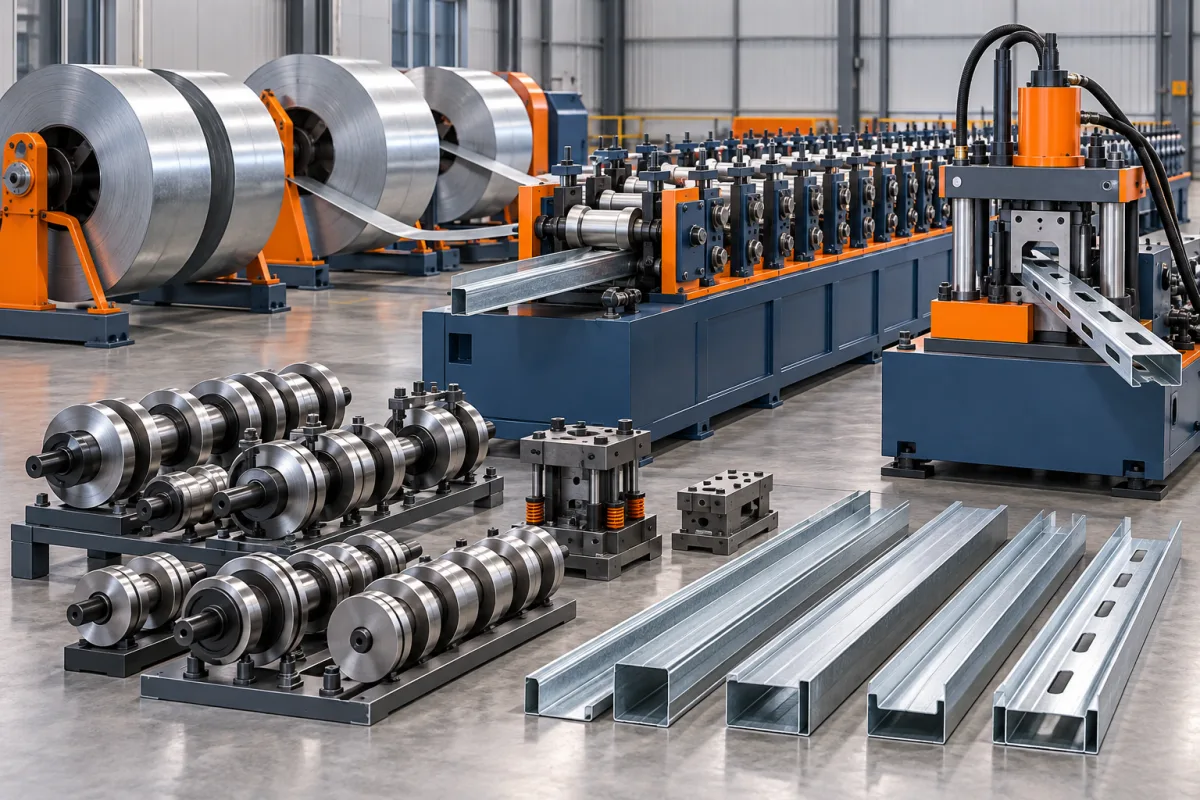
Stud and track equipment cost should be evaluated as the cost of delivering accepted framing bundles, not just forming channels. The quotation needs to cover the paired sections, material envelope, feature operations and packaging route. A low mill price may leave substantial work in separate punching, collection or bundling operations.
Define the product family being purchased
Separate drywall products, structural sections and more highly fabricated frame components. Supply actual stud and track drawings with material combinations. A proposal for one product family should not be compared directly with a broader package without normalizing the scope.
Include the required mating relationship. Two nominally matching trade sizes can require different actual dimensions. The tools and acceptance work must produce the specified pair rather than simply two channels carrying the same size label.
Tooling flexibility changes the investment
List web, flange and lip combinations and identify which are adjustments and which need additional components. A wider catalog may increase tooling and setup requirements. Ask what future additions would cost and whether they require a new feasibility review.
Relate flexibility to demand. Buying tools for many rarely ordered products can tie up capital, while omitting a common matching track can weaken the usefulness of the whole line. The commercial unit is often the framing package, not one isolated section.
Feature-making needs its own scope
Service holes, fixing features and specified embossing may require dedicated equipment and tools. State the pattern and final-member references. Identify inline, optional and offline operations clearly.
Include tooling replacement, scrap handling and inspection responsibilities. A quotation that omits features can appear cheaper while shifting recurring cost into another station. Compare the complete route needed to finish the product.
Packaging is a major production boundary
Collection, nesting, counting, strapping and labeling turn loose sections into saleable bundles. Evaluate the required format and whether the equipment supports both studs and tracks across the range. A fast former without a suitable packing route may spend time waiting.
Separate a fully automated package from a route relying on manual work. Neither is automatically the right choice; staffing, volume, product mix and floor space determine the value. Make the assumed labor and handling arrangement explicit in the cost model.
Normalize installed project costs
Use one inclusion schedule for all bids. Identify transport, site preparation, power and utilities, installation, training and trial material. Mark unresolved items rather than allowing them to disappear from the comparison.
- Stud and track tool configurations.
- Required feature-making and cutoff components.
- Coil loading and entry equipment.
- Collection, bundling and identification.
- Change parts, documentation and spares.
- Commissioning and acceptance responsibilities.
Calculate conversion cost per accepted bundle
Assume a hypothetical order yields 80 accepted bundles, each containing 20 sections. If the route consumes 16 labor-hours, labor input is 16 ÷ 80 = 0.2 labor-hour per accepted bundle. Multiply by your actual loaded labor rate and add the measured material and other operating costs on a consistent basis.
These inputs are illustrative. Bundle quantity and product length must remain visible, because a bundle of long members is not the same workload as one of short members. Rejected or incorrectly counted bundles should not remain in the accepted denominator.
Test a bundling investment with explicit assumptions
Suppose an additional packaging system costs 25,000 budget units and a representative study indicates a net saving of 250 labor-hours annually. At an assumed loaded rate of 28 units per hour, gross labor benefit is 7,000 units per year. Before extra maintenance, financing and other effects, simple recovery is about 3.57 years.
Replace the assumptions with real quotations and trials. If the system also reduces damage or counting errors, calculate those benefits separately and avoid double counting. If demand is low, released labor time may not become a cash saving unless work or staffing can actually be reorganized.
Include changes between products in operating cost
Stud-to-track and size transitions consume time, first-off material and inspection effort. Measure the complete return to an accepted pair. A short tool-movement claim is not sufficient for pricing frequent mixed orders.
Group similar work where delivery requirements permit, but include the cost of extra inventory and sorting if grouping creates them. A high daily metre count can look attractive while the factory struggles to complete matched customer orders.
Budget for identification and compatibility errors
Include a downside sales case when comparing ownership cost. A packaging upgrade justified by continuous stock-length production may be used differently if orders become smaller and more varied. Recalculate changes, inspection and packing labor for that mix. The purpose is not to predict the market precisely but to reveal which financial assumptions carry the investment decision.
A wrong bundle label or mismatched track can make otherwise sound sections unsuitable for the order. Track these losses separately from forming scrap. The cost may include sorting, repacking, transport or delayed installation, not merely the scrap value of steel.
Use a mixed-order acceptance trial to verify counts, identities and mating fit. For example, produce two similar nominal sizes and confirm that the correct track, label and bundle remain associated with each. This tests the commercial delivery process rather than only the mill's ability to run.
Frequently asked stud and track cost questions
Why is a complete line more expensive than a channel former?
It may include feature-making, paired tooling, cutting, packaging and controls absent from the bare former. Compare included operations before treating the price difference as a premium for the same scope.
Is bundling automation only useful at very high speed?
Its value depends on labor, order format, counting accuracy and handling as well as speed. Evaluate it against the actual sales-order route.
Should all sizes be purchased as tooling options immediately?
Prioritize credible demand and understand the cost of later additions. A defined staged plan can be sensible, provided essential interfaces and matching products are not overlooked.
What is the fairest final price comparison?
Installed scope and operating cost for the same accepted, identified bundle mix. Include changes, features, packing and support so every proposal is evaluated against the product the business actually sells.
Continue your research
- Stud & Track Roll Forming Machines
- Drywall Stud Roll Forming Machine
- Drywall Track Roll Forming Machine
- C89 Light Gauge Steel Framing Machine
- C140 Light Gauge Steel Framing Machine
- Top Hat Light Steel Framing Machine
- How Stud and track roll forming machine Works
- How To Choose a Stud and track roll forming machine
- Materials and Thickness for Stud and track roll forming machine