
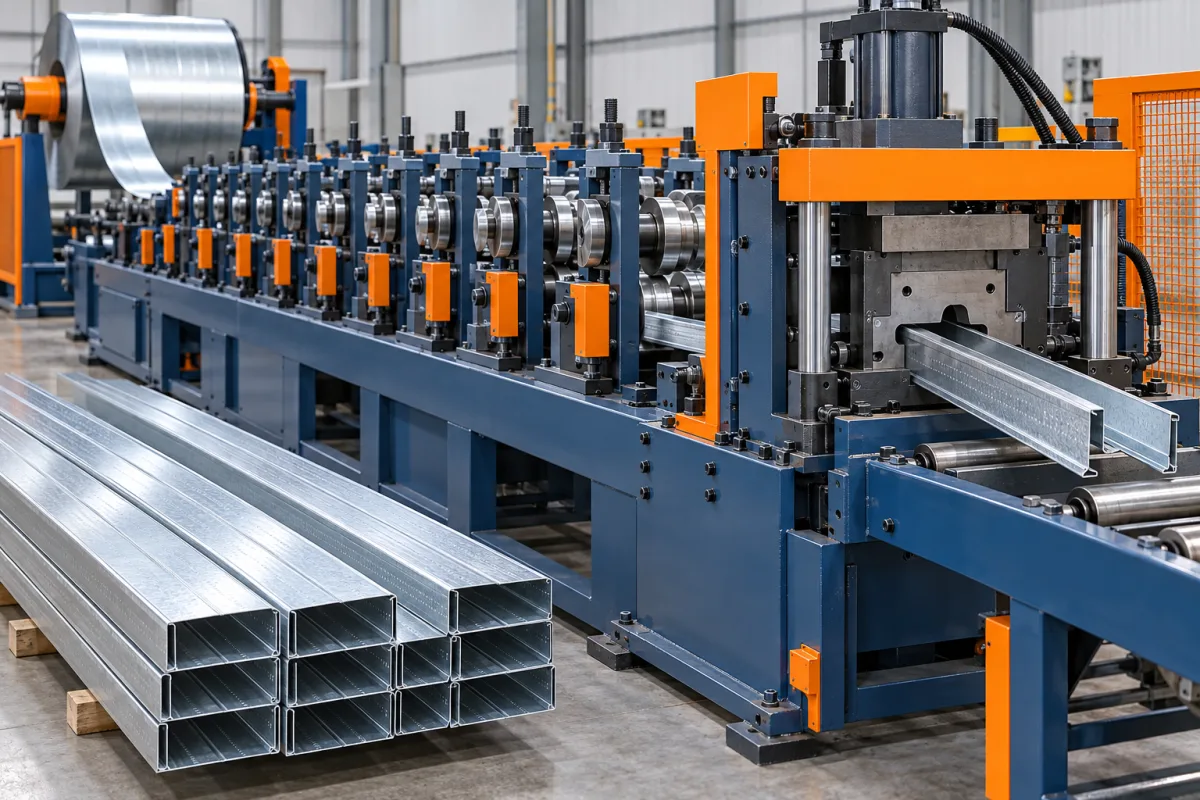
A drywall stud roll forming machine produces the vertical metal members used with matching tracks in a specified partition or lining system. Its principal product is usually an open, lipped section, but the useful manufacturing target is more detailed than a letter C: the web, flanges, return lips, fastening faces and service openings must work together in the wall assembly.
Choosing the line starts with the studs the business intends to sell. A distributor supplying stock lengths needs a different order-handling arrangement from a manufacturer delivering room-specific bundles. Both need consistent section geometry, practical coil changes and a clear distinction between the stud's manufacturing specification and the wall system's design requirements.
What distinguishes a drywall stud from other light steel sections?
A drywall stud provides a defined face for attaching lining boards and fits into its companion track. The return lips help establish the section's geometry, while any web openings must occupy the positions allowed by the product design. Small dimensional differences can affect installation even when two studs carry the same nominal size.
Do not treat drywall, structural framing and ceiling channels as interchangeable machine categories. A non-loadbearing partition stud may have a different material and feature schedule from a structural wall member. The equipment enquiry should list the actual products rather than asking for a machine capable of making anything described as light gauge steel.
Which drawings and samples should define the tooling?
Provide a section drawing with the web, flange, lip and bend geometry. Identify whether the dimensions are internal, external or measured to a reference surface. Include the mating track drawing because stud-to-track clearance is a functional requirement, not simply a consequence of choosing matching nominal widths.
- Cross-section: web size, each flange, lip direction and bend radii.
- Features: service openings, identification marks and any prescribed stiffening or fastening details.
- Material: grade, base-metal thickness, metallic coating and incoming-strip condition.
- Lengths: stock sizes, project lengths, permitted end condition and bundle quantities.
- Assembly: representative track and board-fixing references for the selected wall product.
Retain an approved sample alongside the drawing. A sample is helpful for handling and fit checks, but its dimensions should not silently override the controlled specification. Record any intended difference before manufacturing the roll tools.
How does a stud production line operate?
The route normally combines coil payoff, strip entry control, required feature-making, progressive forming, cutting and collection. The exact sequence of punching and cutting depends on the proposed equipment. Ask where each operation occurs and how its position is referenced to the finished stud.
- The payoff presents the selected strip without exceeding the specified coil-handling envelope.
- Entry guides establish the path through feature tools and forming stands.
- Required web openings or other features are produced using the approved pattern.
- Successive roll passes develop the flanges and lips while controlling the section along its length.
- Length control and cutoff deliver the ordered member with acceptable ends.
- Takeoff equipment supports, counts and groups studs into identifiable bundles.
A proposed line should explain how punched scrap is managed and how product changes affect the sequence. Those details influence reliable daily operation even though they are less visible than the roll stands themselves.
How should the material envelope be specified?
List the combinations actually needed: grade, thickness, strip width and finish for each stud family. A single maximum thickness does not describe the complete forming duty. Bending response, springback and the condition of the coating need to be reviewed with the narrowest and widest required sections.
Distinguish base-metal thickness from a coated measurement and establish how incoming material is identified. The receiving and production records should connect the coil to finished bundles. That makes it easier to investigate a fit or surface issue without assuming that every variation was caused by the machine setup.
If the catalogue includes a deliberately stiffened web or fastening face, include that geometry in the trial. It is a product feature with its own tooling and inspection implications, not an optional decorative pattern that can be added after the forming sequence is approved.
What matters about service openings?
Specify opening shape, orientation, spacing and the permitted relationship to member ends. Where the opening pattern changes with the order, explain how that information enters the control system. A stock-length route with a repeated pitch differs from project-specific feature positioning.
Inspect the opening after forming and cutting, not only on the flat strip. Check burr condition, local distortion and position relative to the finished datums. Any bushings or service-protection components required by the wall design should be considered in the assembly review rather than assumed to fit every opening with a similar outline.
Dedicated stud production or a combined stud-and-track line?
A dedicated line can suit a business with sustained demand for one section family. Its handling and setup controls can concentrate on that product. A combined arrangement may be attractive when order quantities vary, but its real value depends on how the complete transition is carried out.
Ask which rolls, spacers, guides, punches and cutoff parts change when moving between studs and tracks. A powered width adjustment does not automatically change the lip geometry or punching arrangement. Compare the time from the last accepted product to the first accepted product of the next order, including inspection and bundle identification.
For several web sizes, request a configuration matrix. It should show which flange and lip dimensions remain fixed, which dimensions adjust and which products need different tools. This is more useful than an unrestricted claim of automatic size change.
How are straightness, twist and track fit checked?
Inspect studs under a defined support condition so handling or gravity is not mistaken for permanent deformation. Measure the section at agreed locations and examine the ends separately from the middle. A short, carefully selected sample cannot establish the behavior of the longest commercial member.
Fit production studs into the intended track without improvised reshaping. Record resistance, looseness and any visible flange interference. Keep that manufacturing fit check separate from the partition's load, height, fire or acoustic design: an easily assembled pair is only one part of a complete wall system.
When a deviation appears after a coil or size change, compare the material record, approved setup and measured symptom before making adjustments. Corrections should follow the equipment supplier's procedures with the required isolation and authorized personnel.
What should bundling and order control include?
Studs are often handled as repeated units, so counting and identification deserve attention early in the layout. Define nesting orientation, bundle size, label information and how different lengths remain separated. A line that forms quickly but mixes project members creates avoidable work downstream.
Consider removal of both short and long products, access for packing, and the space occupied by completed bundles. If manual collection is proposed, assess it against the intended order pattern. Automatic stacking should likewise be demonstrated with the actual sections rather than accepted on a general description.
How should practical output and investment be compared?
Use accepted studs per representative shift or order, with the material, lengths and feature pattern stated. Coil loading, size changes, punching, cutoff and bundle removal all contribute to the result. Nominal strip speed alone is not a reliable comparison between different production packages.
For planning arithmetic only, an order of 800 studs at 3 metres each contains 2,400 metres of finished members. Turning that quantity into a production time requires the agreed operating cycle and delays. It does not follow from the order length alone and should not be presented as a machine capacity.
Compare quotations for the same tools, product range, handling equipment and commissioning scope. Include gauges, training, spare tooling arrangements and the process for introducing another stud size. A lower initial price can omit items needed to produce and verify the intended catalogue.
What should the acceptance run demonstrate?
- Produce representative small and large sections in the agreed material combinations.
- Measure web, flanges, lips, length, straightness and finished end condition.
- Check service-opening position and quality on complete studs.
- Assemble studs with their specified tracks and relevant reference components.
- Demonstrate one meaningful size change and recovery to accepted production.
- Count, label and remove a representative bundle while recording accepted and rejected pieces.
The written result should identify the exact setup and outstanding deviations. This gives the production team a usable reference when it later repeats the same order.
Frequently asked questions
Can one machine make every drywall stud size?
Only the agreed size and material envelope should be assumed. Width adjustment may leave flange, lip or feature geometry unchanged. Supply a complete catalogue matrix and identify the tooling required for each transition before selecting the line.
Can the machine also produce structural studs?
A suitable configuration may produce specified structural members, but that requires a separate review of material, geometry and production features. The word stud does not establish a common forming duty or the completed wall's structural suitability.
Are web openings always required?
No. They depend on the product drawing and intended use. Specify the required pattern, end distances and quality checks. Unnecessary punching adds scope and should not be included merely because another manufacturer's stud happens to contain openings.
Why test studs with tracks?
The two sections form an installation interface. Individual dimensions can appear reasonable while their combined clearance is wrong. A controlled fit trial complements dimensional inspection and exposes incompatible assumptions about nominal sizes.
Is higher forming speed always more productive?
Not when punching, cutting or bundle handling constrains the route. Compare accepted finished bundles for the same order mix, including changes and inspection. Material moving through the stands is not the same as saleable output.
What should be sent with an enquiry?
Send stud and track drawings, material combinations, lengths, opening patterns and expected quantities. Add bundle and label requirements. This allows the proposed equipment to be evaluated as a complete drywall-stud production process.

Continue your research
- Stud & Track Roll Forming Machines
- Drywall Track Roll Forming Machine
- Light Gauge Steel Framing Machine
- C89 Light Gauge Steel Framing Machine
- C140 Light Gauge Steel Framing Machine
- Top Hat Light Steel Framing Machine
- How Stud and track roll forming machine Works
- How To Choose a Stud and track roll forming machine
- Stud and track roll forming machine Price: What Affects the Cost?
Configuration & specification inputs
Match the configuration to your section drawing, material and production requirements.
| Parameter | Requirement / confirmation needed |
|---|---|
| Profile geometry | Stud web, flanges, return lips, bends and mating-track clearance |
| Material | Drawing-specified grade and metallic coating; retain coil identification |
| Thickness & grade | Define base-metal thickness by stud size and grade |
| Process route | Payoff, entry guidance, required openings, progressive forming, cutoff and bundling |
| Cutting | Inspect stud ends and lip condition at the required length range |
| Output | Accepted identified stud bundles for a representative length and opening mix |
| Electrical supply | Confirm supply and installed-load requirements for the complete quoted line |
| Acceptance | Measure complete studs, verify service openings and track fit, and repeat a meaningful size change |