
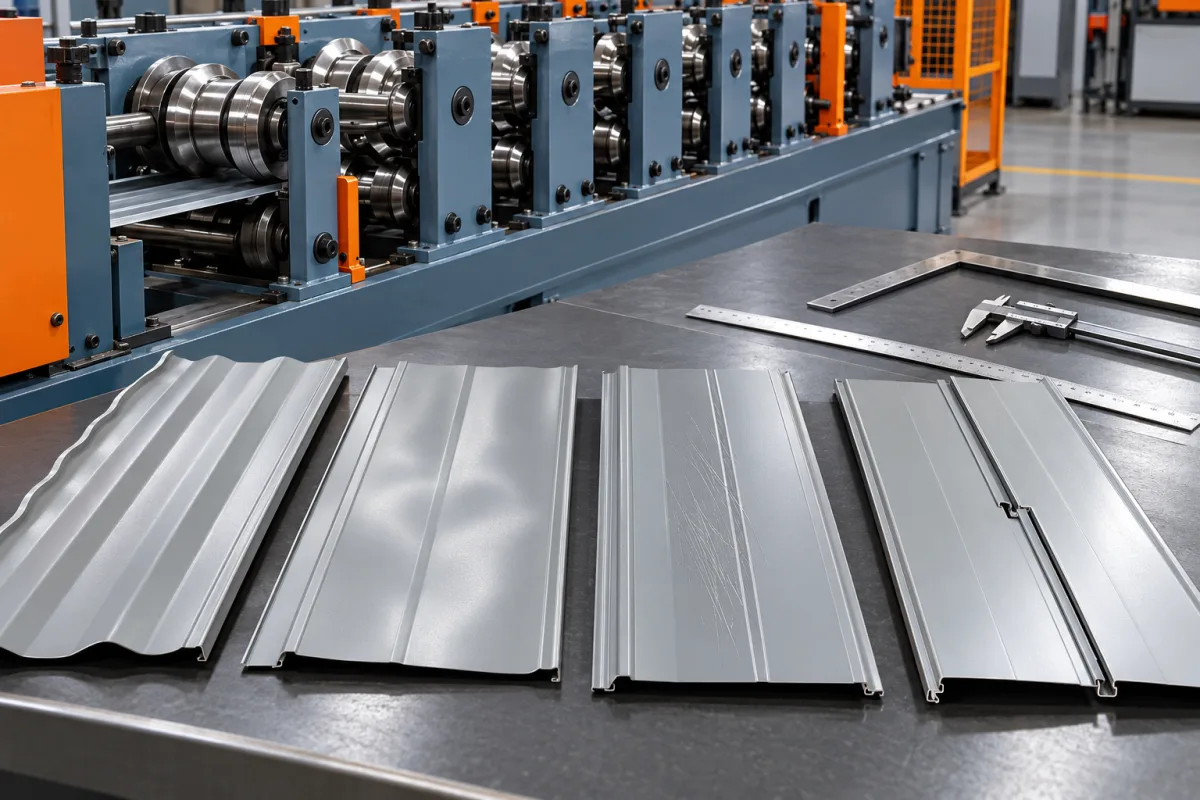
Wall cladding defects need to be separated into geometry, joint fit, visible finish and handling condition before a correction is chosen. These categories can interact, but they are not interchangeable. A scratched panel, an uneven reveal and a face that appears wavy under grazing light require different evidence and may originate at different stages.
Describe the defect in the facade's own terms
Identify the approved profile, material, finish and assembly revision. Mark the location and extent of the deviation on a panel sketch. Distinguish visible-face width, effective cover and reveal; using the word width for all three can send an investigation in the wrong direction.
Retain the inspection conditions. A loose panel on a bench and a fastened assembly do not necessarily present the same appearance. Record supports, viewing direction and lighting so another person can reproduce the observation rather than interpret an unlabelled photograph.
When the concealed joint will not engage
Confirm that the panel and mating clip or adjacent edge belong to the same approved system. Compare functional returns with the drawing using the specified references. Inspect both the central section and cut ends, since local end distortion can obstruct an otherwise correct joint.
Record whether the resistance is continuous or limited to a location. Do not force the assembly or reshape the return merely to produce a successful photograph. Qualified personnel should investigate the relevant material, tooling or component issue through a controlled process.
When reveals vary across adjoining panels
Check the complete assembly relationship rather than measuring only one visible face. The variation may involve edge geometry, panel straightness, mating components or the support condition. Use several identified panels to determine whether the deviation repeats consistently.
Compare results before and after installation on the agreed support. If individual panels meet their criteria but the assembly does not, the interface deserves attention. This does not automatically absolve manufacturing, but it prevents an unsupported assumption that moving one roll will solve every reveal problem.
When broad faces appear wavy
Distinguish appearance observations from other defects such as dents, scratches or a permanent handling bend. Visible waviness can involve incoming material, production and installed support conditions. Establish when it first becomes observable and compare with the accepted product reference.
Do not evaluate one batch under harsh reflected light and another under diffuse light, then attribute the difference solely to the machine. Consistent inspection conditions make the evidence useful. Any design or process change should be reviewed for its effect on the entire panel and joint.
When scratches or repeating marks appear
Identify whether marks arrive with the coil or first appear after entry, forming, cutting or packing. Their position and repetition can help locate the source, but inspection must remain within approved safe access procedures. Never follow a mark by reaching into a moving material path.
Check protective film status and inspect the underlying finish by the agreed method. A scratch revealed during installation may have occurred earlier while hidden. Keep samples from different process boundaries to avoid blaming the last person who handled the panel simply because that is where the damage was noticed.
When returns are damaged only near the ends
Compare the profile immediately after cutting with its condition after discharge. Verify the correct section-specific cutting and support components through the equipment documentation. Similar cladding sections can have different functional returns, so a nearly matching component is not necessarily suitable.
Distinguish shape damage from a length-reference problem. Both can affect assembly but need different corrective work. Retain a sample from each end and document whether the issue appears on every piece or only after a particular order or setup transition.
When finish or orientation appears inconsistent
Trace coil identity, exposed-face orientation and bundle labels. Not every apparent facade mismatch is a forming defect. A mix-up between finish batches or panel orientations can create a visible problem even when every individual section meets its dimensions.
Review how information travels through production and packing. If identification is lost at a finishing station, improving roll-tool accuracy will not solve the issue. Correct the traceability boundary while preserving the evidence needed to determine which delivered panels are affected.
Use a one-change investigation with full-product checks
Keep a baseline sample and document any authorized corrective action. After the change, inspect the feature being corrected and the complete joint and face. A local improvement that worsens engagement or appearance elsewhere should not be accepted as a solution.
- Confirm the deviation against agreed product criteria.
- Locate its earliest observable process boundary.
- Review material, setup, component and handling changes.
- Apply the approved correction with qualified personnel.
- Verify representative panels and their assembly.
- Record release conditions and preventive action.
Close the issue with evidence the next team can use
The final record should state the confirmed cause, the affected product boundary and the evidence showing recovery. Avoid entries such as adjusted machine until good. They do not help distinguish a recurring tooling condition from a material or packing problem.
Use recurrence and loss data to prioritize improvements. Appearance defects discovered after packing can waste more work than early dimensional rejects. A process-boundary check that detects the problem earlier may therefore be valuable even before a permanent engineering change is completed.
Frequently asked cladding troubleshooting questions
Is every wavy facade panel caused by the roll former?
No. Material, manufacturing, handling and installed supports can contribute. Compare identified samples at consistent process and viewing conditions before assigning the cause.
Can a tight concealed joint be opened manually to finish the order?
Uncontrolled modification can change the approved assembly. Use the responsible quality and engineering process to determine disposition rather than treating field reshaping as routine acceptance.
Why does a scratch appear only after protective film removal?
The film may have hidden earlier damage. Inspect at agreed boundaries and retain the material history so the point of discovery is not mistaken for the point of origin.
What information makes technical support faster?
Provide the profile and joint revision, coil and finish identity, annotated measurements, process-boundary samples and consistent photographs. Include recent changes and the exact assembly condition where the issue occurs.
Continue your research
- Wall Cladding Roll Forming Machines
- Wall Panel Roll Forming Machine
- Metal Siding Roll Forming Machine
- Box Profile Wall Panel Roll Forming Machine
- Corrugated Wall Cladding Roll Forming Machine
- Trapezoidal Wall Cladding Roll Forming Machine
- How Wall cladding roll forming machine Works
- How To Choose a Wall cladding roll forming machine
- Wall cladding roll forming machine Price: What Affects the Cost?