
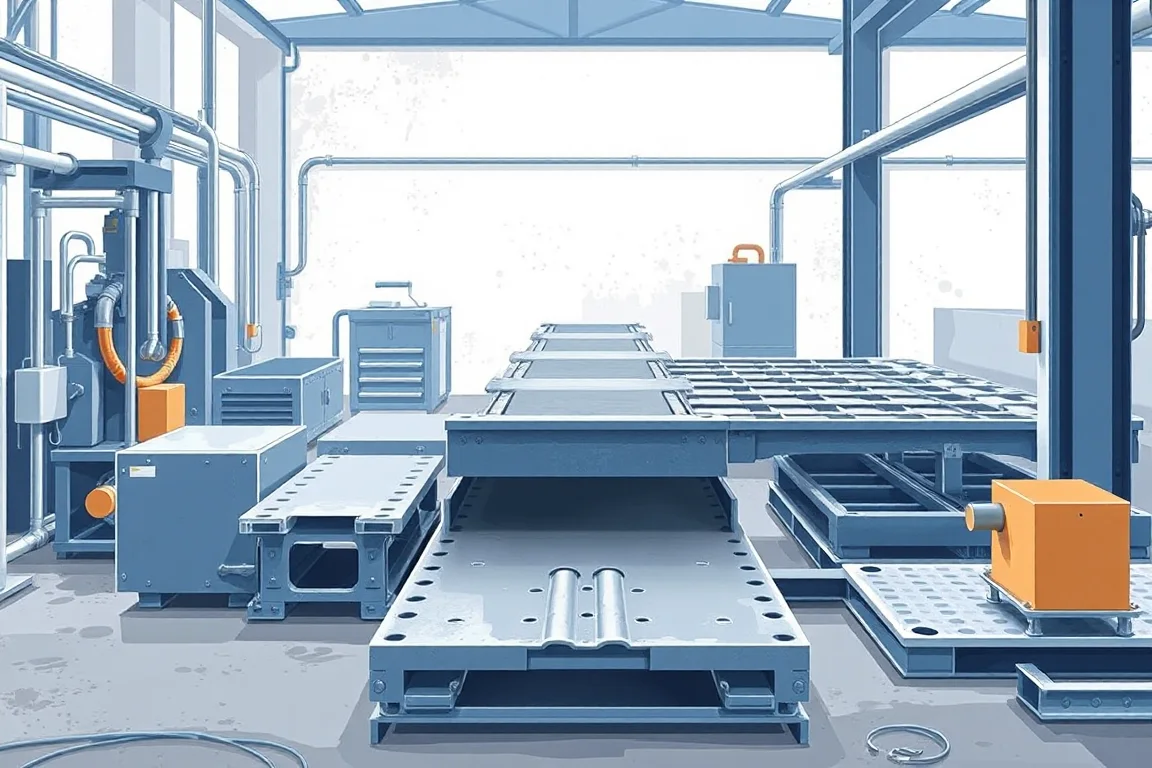
A scaffolding roll forming machine is a production line that transforms flat steel strip into longitudinal profiles used in scaffold systems. The machine works by pulling strip from a coil through a series of driven roller stands, each of which progressively bends the strip toward a finished cross-section. Before, between or after forming, the line may punch holes, emboss anti-slip patterns, cut the profile to length and prepare ends for later joining. Understanding how these operations are sequenced, and where the line stops and the rest of the manufacturing route begins, is essential for anyone specifying scaffold plank, board or related components.
The input: strip, coil and material consistency
The process starts with coil-fed strip. The strip's grade, thickness and surface finish influence every downstream decision: the number of forming passes, the risk of edge cracking, the punch force required and the joining method used at the ends. A scaffold plank or toe board may require a specified structural steel grade and a particular finish. The line cannot compensate for incoming material that varies in thickness or mechanical properties, so incoming inspection and consistent coil supply matter as much as the machine itself.
Punching and embossing before forming
Punching and embossing are often performed on the flat strip before the profile is developed. Pre-punching is common when holes are needed for hooks, end plates or attachment points. Embossing creates anti-slip patterns on the walking surface or stiffening ribs. Coordinating these operations with the forming sequence is critical because a hole or embossed feature placed too close to a bend line can distort or tear. The order punch/emboss then form then cut is a typical editorial sequence, but the actual arrangement depends on the product drawing and the required feature positions.
Progressive forming: how the profile develops
Roll forming is a gradual process. Each roller stand applies a small bend to the strip, and the cumulative effect produces the final cross-section. The number of stands and the roll design depend on the profile complexity. A simple plank rib may need fewer passes than a complex channel with returns or stiffening flanges. The strip is guided and referenced through the stands; misalignment or excessive tension can cause twist, bow or edge wave. Lubrication is sometimes used to reduce friction and heat, but it must be compatible with later joining or coating operations.
Cutting to length: cutoff options and end quality
After forming, the profile is cut to the specified length. The cutoff method must suit the profile: a shear cut may collapse thin walls or distort open sections, while a saw cut may leave burrs. The cut end quality affects downstream joining, especially if end plates or hooks are welded or mechanically attached. Some lines integrate the cutoff within the forming line; others cut offline. The choice affects handling, part accuracy and the need for secondary operations. The quotation should define who supplies the cutoff tooling and how the cut length is set and verified.
End fitting and joining: where the roll former stops
Most scaffold components require end fittings: hooks, end plates, spigots or connection interfaces. These are rarely formed on the same roll forming line. They may be produced separately, then welded, riveted or bolted to the formed profile. This is a separate manufacturing operation with its own tooling, fixtures and quality checks. A roll forming machine that produces a plank profile does not automatically produce a finished, certified scaffold plank. The joining process, and the inspection of that joint, are distinct steps that must be planned and resourced.
Inspection and acceptance: formed sample versus finished component
Inspection along the line typically checks profile dimensions, hole positions, emboss pattern depth and cut length. However, acceptance of the finished scaffold component involves load and slip requirements that apply to the assembled system, not just the formed section. A formed sample cannot demonstrate the performance of a welded end plate or a hook under load. The acceptance criteria for the finished component must be defined separately, and the roll forming line is only one contributor to that outcome.
Alternative process routes for different scaffold parts
Not every scaffold part suits roll forming. A ledger, for example, is often a conventional tube with welded end fittings. Ringlock and cuplock are connection systems, not proof that a ledger is made on a sheet-profile roll former. Tube production and welded fabrication are a different route. A scaffold plank, toe board or guardrail may be roll formed, but the decision should start from the approved scaffold-system drawing. The drawing determines whether the part is an open sheet section, a closed tube or a hybrid. The machine category should follow the drawing, not the other way around.
Integrated versus manual operations
A roll forming line can be highly integrated, combining decoiling, punching, embossing, forming, cutoff and stacking. Alternatively, some operations may be manual or offline. The right balance depends on volume, part variety and the cost of handling. An integrated line reduces manual handling and can improve consistency, but it also increases changeover complexity and capital cost. A manual or semi-automatic arrangement may be more flexible for low volumes or frequent profile changes. The key is to distinguish the line's physical sequence from the complete manufacturing route, and to identify every point where the part is gripped, referenced, punched, bent, cut, joined or inspected.
How to assess a proposed line for your drawings
Walk through the proposed process with one actual drawing. Mark every operation required to turn coil into the finished component. Compare that list with the quotation. Any operation omitted from the quotation still needs to happen somewhere, whether in-house or by a supplier. Ask who supplies its tooling and who is responsible for the interface. Confirm how the part is referenced again after cutting or a secondary operation. This exercise reveals whether the line matches the product and exposes gaps in responsibility.
Decision checklist for specifying a scaffolding roll forming machine
- Start from the approved scaffold-system drawing, not a generic machine category.
- Identify the input and output of each station: decoiler, punch, emboss, forming stands, cutoff, run-out table.
- Distinguish the roll forming line from the complete manufacturing route, including end fitting, joining, coating and inspection.
- Confirm how the part is referenced and located at each operation, especially after cutting.
- Verify that punching and embossing are coordinated with the forming sequence to avoid distortion at bends.
- Define cut length, end quality and any secondary operations required.
- State the required voltage, frequency and phase; installed power requires a confirmed equipment schedule.
- Specify material grade and thickness range, and confirm the supplier can verify the operating range.
- Clarify who supplies tooling for each operation and who is responsible for interface dimensions.
- Plan for inspection of the formed profile and separate acceptance of the finished component.
- Define accepted output per shift using the actual profile and material, not a generic rating.
- Review changeover time and tooling change procedure for different profiles.
FAQ: practical questions about scaffolding roll forming machines
Can a roll forming machine produce a complete scaffold plank?
No, a roll forming machine typically produces the profiled plank or board section. End hooks, end plates or other connection interfaces are usually manufactured and joined separately. The finished component requires additional operations and inspection before it can be considered a complete scaffold plank.
How do I choose between an integrated line and separate offline operations?
Consider volume, part variety and handling cost. An integrated line can reduce manual handling and improve consistency for a stable, high-volume product. Separate offline operations may offer more flexibility for low volumes or frequent changes. The decision should follow the manufacturing route derived from your drawing.
Why is punch and emboss sequencing important?
Punching and embossing performed before forming can place features on flat strip where they are easier to locate and control. If placed too close to a bend line, they can distort or tear during forming. Coordinating the sequence with the forming passes helps maintain feature integrity and profile accuracy.
What determines the cutoff method for a scaffold profile?
The cutoff method must suit the profile shape and wall thickness. A shear cut may deform open sections, while a saw cut may leave burrs. The choice affects end quality and downstream joining. The quotation should specify who supplies the cutoff tooling and how cut length is verified.
Can a formed sample prove the load capacity of a scaffold plank?
No. Load and slip requirements apply to the finished component and system. A formed sample demonstrates profile dimensions and surface features, but not the performance of welded or mechanical joints. Acceptance of the finished component requires separate evaluation.
How should I specify output for a scaffolding roll forming machine?
Define accepted output per shift using the actual profile and material. Output depends on line speed, cutoff time, changeover frequency and handling. A generic rating is less useful than a realistic estimate based on your specific product and production plan.
Continue your research
- Scaffolding Roll Forming Machines
- Scaffold Plank Roll Forming Machine
- Scaffolding Deck Roll Forming Machine
- Ringlock Scaffold Ledger Roll Forming Machine
- Cuplock Scaffold Ledger Roll Forming Machine
- Scaffold Frame Profile Roll Forming Machine
- How To Choose a Scaffolding roll forming machine
- Scaffolding roll forming machine Price: What Affects the Cost?
- Materials and Thickness for Scaffolding roll forming machine