
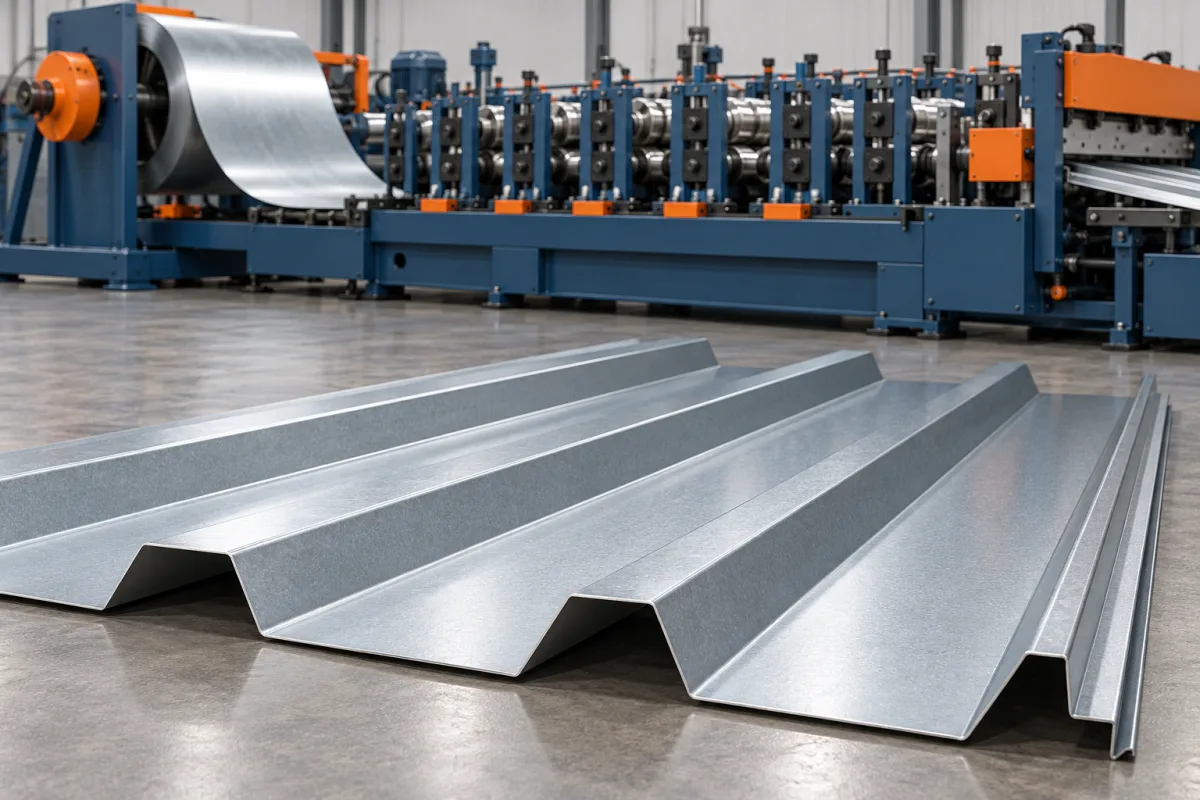
A trapezoidal wall cladding roll forming machine makes sheets with flat crests and valleys joined by angled rib walls. The profile gives the facade a repeated geometric pattern and creates the edges used to connect neighboring panels. Selecting the line means defining that complete section, including the details that become hidden in the lap.
Compared with rounded corrugated cladding, the angular profile places different demands on tools, cutoff support and accessory shapes. Compared with narrow concealed-fix siding, it may use a broader repeating sheet. The intended wall system, not the broad word cladding, should establish the actual product.
Which trapezoidal proportions matter?
Rib depth, pitch, crest width and valley width determine the basic shape. The rib-wall angle and bend radii complete the section, while smaller stiffening features may alter the visible flats. Show all of these on a controlled drawing rather than relying on a facade photograph.
Keep repeating geometry separate from terminal geometry. The outermost ribs may be modified for the overlap and should not be inferred from the center pattern. An assembled pair explains how those edges establish effective cover.
How does the facade layout influence production?
Record whether the panels will be installed vertically, horizontally or in another approved arrangement. Openings and corners can introduce short pieces, special ends or a particular package sequence. These details affect order handling even if the basic roll-formed section stays unchanged.
Where alignment of ribs across adjoining wall areas matters, agree the reference used for cutting and installation. Do not leave the production team to infer architectural alignment from nominal sheet length alone.
What information should be sent before a quotation?
- The full section and assembled side-lap drawing.
- Material grade, thickness and coating combinations.
- Visible-face direction and appearance criteria.
- Required lengths, notches or fixing features.
- Closures and important trim interfaces.
- A realistic order mix and packing arrangement.
If matching an established profile, include accepted samples and identify any dimensions that must remain interchangeable with existing stock. This is a more useful starting point than asking for a generic trapezoidal machine with a broad width range.
How does the machine create the angular ribs?
Guided strip passes through successive stages that develop the rib walls, crests, valleys and laps. The planned progression matters because the finished cross-section emerges from the whole forming sequence, not just the final roll shape. Material and strip width must match the agreed tooling envelope.
The cutting arrangement then produces the order lengths, and the takeoff supports the sheet for inspection and stacking. Review whether any feature-making, marking or protective-film operation is integrated or supplied separately.
What makes coating and appearance acceptance practical?
Use production-intent material and define how the visible face will be inspected. Wide flats and angular ribs reflect light differently, so approval should not depend on unrelated photographs. Agree support, viewing direction and lighting for the appearance comparison.
Inspect bend regions for coating condition and contact surfaces for marks. Then repeat the check after normal discharge and packaging. That sequence helps distinguish forming issues from handling damage and makes corrective work more targeted.
Can one line make several facade patterns?
A second rib pattern may need different tools even when the overall sheet width is unchanged. Ask which dimensions are adjustable and which require replacement roll sets, guides or cutoff parts. A profile matrix should identify the full changeover scope.
Evaluate the order frequency for each pattern. Shared equipment can be attractive for intermittent products, but repeated changeovers may consume time and material. Demonstrate the first accepted panel after a change, including lap fit and finish, rather than timing only the tool movement.
How should the cutoff preserve wall-panel quality?
Inspect rib shape close to the cut ends, cut squareness and the two terminal edges. A profile-supported cutting system should leave the panel usable without unplanned straightening. The acceptance method should state what burr and end condition are permitted for the product.
Short pieces may need different transfer attention from long panels. Include both in the trial and check that labels or order identifiers remain with the correct pieces. The finished package, not the cutting cycle alone, is the useful production result.
What should be demonstrated in a wall mock-up?
Use several sheets and the intended fastening or support references. Check side-lap continuity, effective cover and rib alignment. Fit relevant trims or closures so the test includes the interfaces that customers actually encounter.
- Confirm the relaxed section and finished lengths.
- Inspect the terminal ribs along the sheet.
- Assemble panels without unexpected forcing.
- Compare finish under agreed conditions.
- Verify accessory fit and any special features.
- Record accepted output after handling.
Keep the mock-up and dimensional records together. Each provides evidence the other cannot: dimensions establish the section, while the assembly shows its repeated visual and functional relationship.
Frequently asked questions
Is trapezoidal cladding always exposed-fastener?
The exact fixing arrangement comes from the selected system. Do not infer it solely from the rib shape. Include the terminal joint and attachment detail in the product specification.
Can a roof profile use the same tools?
Only if the approved roof section is covered by the tooling. Similar central ribs do not prove identical edge laps, material requirements or installation interfaces.
Will a wider coil create a wider panel?
Not safely as an assumption. Strip width, rib development and terminal geometry are linked. Any alternative width needs to be part of the engineered profile range.
Are trims made by the cladding former?
They are separate products unless their tools and process are specifically included. Folding or other roll-forming equipment may be needed for corners, openings and flashings.
Which output figure should be compared?
Compare accepted cladding orders using the same material, lengths, finish checks and handling scope. A maximum strip-speed figure does not capture the complete route's productivity.
Choose around a repeatable facade product
A useful trapezoidal-wall proposal connects angular geometry to lap fit, appearance and order handling. Define those requirements clearly, then use the trial to prove the product and not simply the machine's ability to form ribs.

Continue your research
- Wall Cladding Roll Forming Machines
- Wall Panel Roll Forming Machine
- Metal Siding Roll Forming Machine
- Box Profile Wall Panel Roll Forming Machine
- Corrugated Wall Cladding Roll Forming Machine
- Vertical Metal Siding Roll Forming Machine
- How Wall cladding roll forming machine Works
- How To Choose a Wall cladding roll forming machine
- Wall cladding roll forming machine Price: What Affects the Cost?
Configuration & specification inputs
Match the configuration to your section drawing, material and production requirements.
| Parameter | Requirement / confirmation needed |
|---|---|
| Profile geometry | Trapezoidal rib depth, pitch, crest and valley dimensions with complete terminal details. |
| Material | Production-intent coated material with defined facade appearance requirements. |
| Thickness & grade | Reviewed combinations of grade, base-metal thickness and developed strip width. |
| Process route | Controlled entry, progressive angular forming, lap completion, cutting and order handling. |
| Cutting | Lengths and end condition preserving the terminal ribs and specified special features. |
| Output | Accepted facade orders under the stated finish, length and packing conditions. |
| Electrical supply | Confirmed destination supply and auxiliaries for the selected cladding package. |
| Acceptance | Section dimensions, repeated lap and cover, accessory fit and appearance before and after stacking. |