
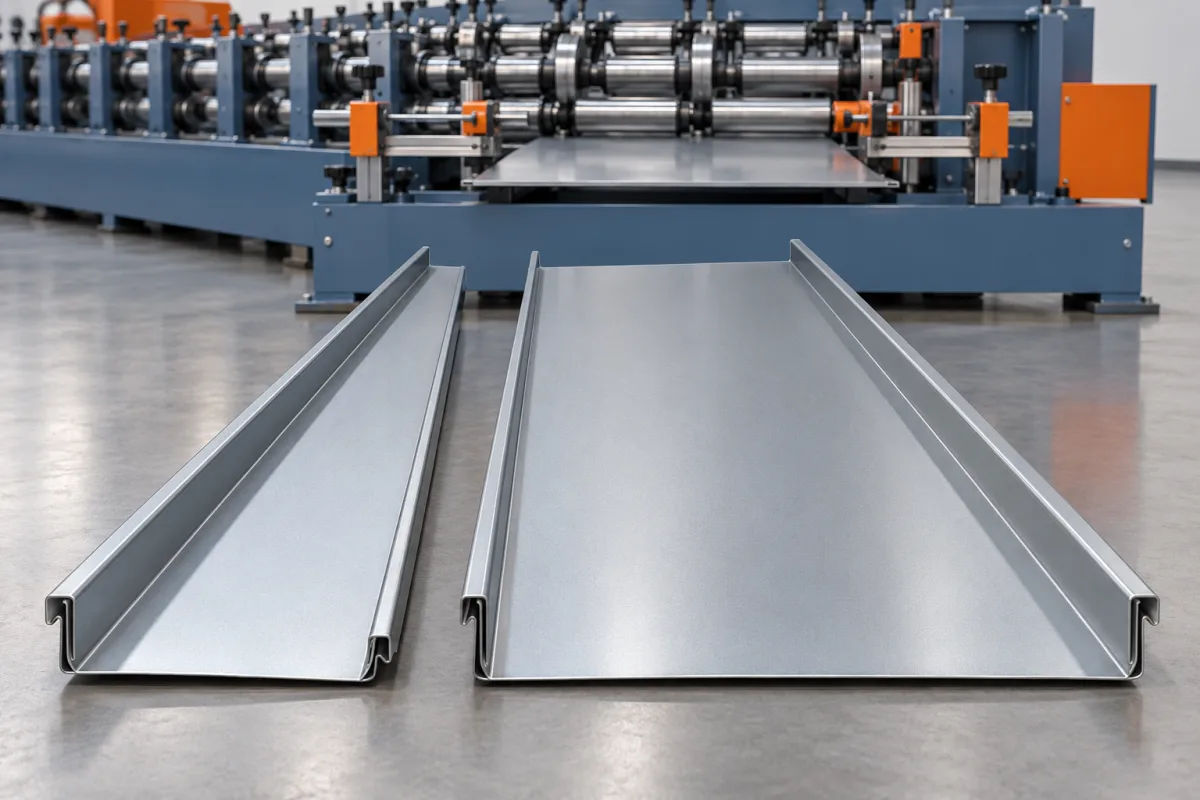
A tapered standing seam roll forming machine produces panels whose width changes along their length to suit a defined roof layout. The taper changes the plan shape while the two edges still need the correct standing-seam geometry. This makes the process different from producing parallel panels with a fixed distance between seams.
The project starts with a panel schedule derived from the roof geometry. Narrow-end width, wide-end width, length, edge orientation and panel identity must be clear. Without that schedule, a machine may produce a tapered shape that cannot be assembled in the intended position.
What does tapered mean in manufacturing terms?
A tapered panel is not simply a parallel panel cut diagonally at one end. Its longitudinal edges are not parallel, so the useful width varies along the piece. The drawing must distinguish plan dimensions from the material allowances consumed by each formed seam.
Also distinguish taper from longitudinal curvature. A panel can be tapered in plan, curved along its length, or require both. Those are separate capabilities and should be specified independently before a combined process is considered.
Which roof-layout information is needed?
- Panel identifier and intended location in the roof layout.
- Finished narrow-end and wide-end dimensions.
- Length and the reference used to measure it.
- Left and right seam identities and orientation.
- Required end angles, notches and allowances.
- Material, coating and any separate curvature requirement.
Keep the manufacturing schedule revision tied to the installation layout. A geometrically correct panel can still be unusable if its handedness or sequence is wrong. Clear identification is therefore part of the product, not merely an administrative convenience.
How are tapered blanks and seam allowances related?
The flat blank must contain enough material for the intended pan and both formed edges. Finished cover dimensions cannot be used directly as raw blank widths without accounting for the seam development. The supplier should define the blanking method for the approved profile.
Review nesting and offcut handling as part of material planning. Tapered pieces may consume coil differently from repeated parallel panels. Use the actual cutting layout and accepted yield rather than applying a generic waste percentage.
How can the edges be formed?
The proposed equipment must follow or separately process the nonparallel edges while reproducing the required seam section. Some arrangements use distinct passes or specialized tapered-panel handling. The actual method should be explained with the intended narrow and wide dimensions.
Do not assume a parallel-panel machine can accept any tapered blank. Ask for its approved working envelope and demonstrate representative shapes. The narrow end can impose a different tooling and handling constraint from the wide end.
What happens to clips and seam closing?
The finished edges still belong to a specified roof-panel system. Use the intended clips or attachments and, for a mechanical seam, compatible closing equipment. Tapered plan geometry does not remove the need for correct edge fit.
Assemble adjacent tapered pieces in their scheduled positions. A seam that fits in a short straight sample may encounter practical issues when the full panel arrangement is tested. Include the intended end treatment and any changes in attachment layout from the approved design.
How should material and appearance be reviewed?
Specify grade or alloy, thickness, coating and visible-face direction. Trial the actual material through blanking and edge forming. Inspect cut edges, seam returns and the visible pan after normal handling.
Where the panel narrows substantially, review the available pan and any face-rib requirement. A decorative rib arrangement that suits a parallel panel may not fit the tapered geometry. Treat such features as explicit options, not automatic carryovers from a standard profile.
How should tapered orders be identified and packed?
Use durable, appropriate panel identification that corresponds to the layout and does not damage the visible finish. Include orientation and revision where needed. Packages should support the changing width and protect both seams.
Consider installation sequence when grouping pieces. A collection of individually correct panels can create substantial site work if labels are missing or the required order is buried in the stack. Confirm the sorting and packing method during the production trial.
What should acceptance measure?
- Confirm panel identity against the approved schedule.
- Measure narrow and wide ends using agreed datums.
- Check length, end angles and seam allowances.
- Inspect both formed edges along the taper.
- Assemble representative neighboring panels.
- Complete the specified seam-closing check where applicable.
- Inspect finish and condition after packaging.
Report output as accepted scheduled pieces or completed sets, with blanking and handling included where required. A parallel-panel strip-speed figure is not a meaningful substitute for this more varied production route.
Frequently asked questions
Is an angled end cut enough to make a tapered panel?
No. Taper describes a width that changes along the panel. An angled end can be an additional feature, but it does not make the two longitudinal seams nonparallel.
Can tapering and curving use the same setup?
Only where the proposed equipment and profile support the combined geometry. Specify both requirements and trial the actual combination rather than assuming two separate capabilities can be combined.
Does the narrow end need a minimum width?
The allowable geometry depends on the profile and equipment. Ask the supplier to review the actual narrow-end dimensions and demonstrate the most demanding scheduled pieces.
Why does handedness matter?
The two seam edges have defined roles, and a tapered panel belongs in a specific orientation. Reversing that relationship can make a correctly sized piece incompatible with its neighbors.
What is the best enquiry document?
A controlled panel schedule linked to the roof layout, plus the complete seam drawing and material specification. Include end details, identification requirements and any curvature.
Build the production route around the panel schedule
Tapered standing-seam work combines geometric planning with accurate edge forming. Clear dimensions, handedness and identification make the equipment proposal testable and help ensure that each accepted piece fits its intended place.

Continue your research
- Standing Seam Roll Forming Machines
- Standing Seam Roll Forming Machine
- Snap Lock Standing Seam Machine
- 25mm Snap Lock Standing Seam Machine
- 38mm Snap Lock Standing Seam Machine
- 1 Inch Mechanical Lock Standing Seam Machine
- How Standing seam roll forming machine Works
- How To Choose a Standing seam roll forming machine
- Standing seam roll forming machine Price: What Affects the Cost?
Configuration & specification inputs
Match the configuration to your section drawing, material and production requirements.
| Parameter | Requirement / confirmation needed |
|---|---|
| Profile geometry | Tapered plan geometry with scheduled narrow and wide ends and separately controlled seam edges. |
| Material | Specified grade or alloy, coating and orientation for the tapered blank and edge-forming route. |
| Thickness & grade | Material-thickness combinations reviewed with the most demanding narrow-end geometry. |
| Process route | Scheduled blank preparation, compatible nonparallel-edge forming, end features and identified handling. |
| Cutting | Blank and end geometry including seam allowances, taper, angles and panel identity. |
| Output | Accepted scheduled tapered pieces or sets, including blanking, sorting and handling scope. |
| Electrical supply | Utilities for the agreed blanking, tapered-forming and auxiliary arrangement. |
| Acceptance | End widths, length, handedness, seam geometry, neighbor fit and traceable package sequence. |