
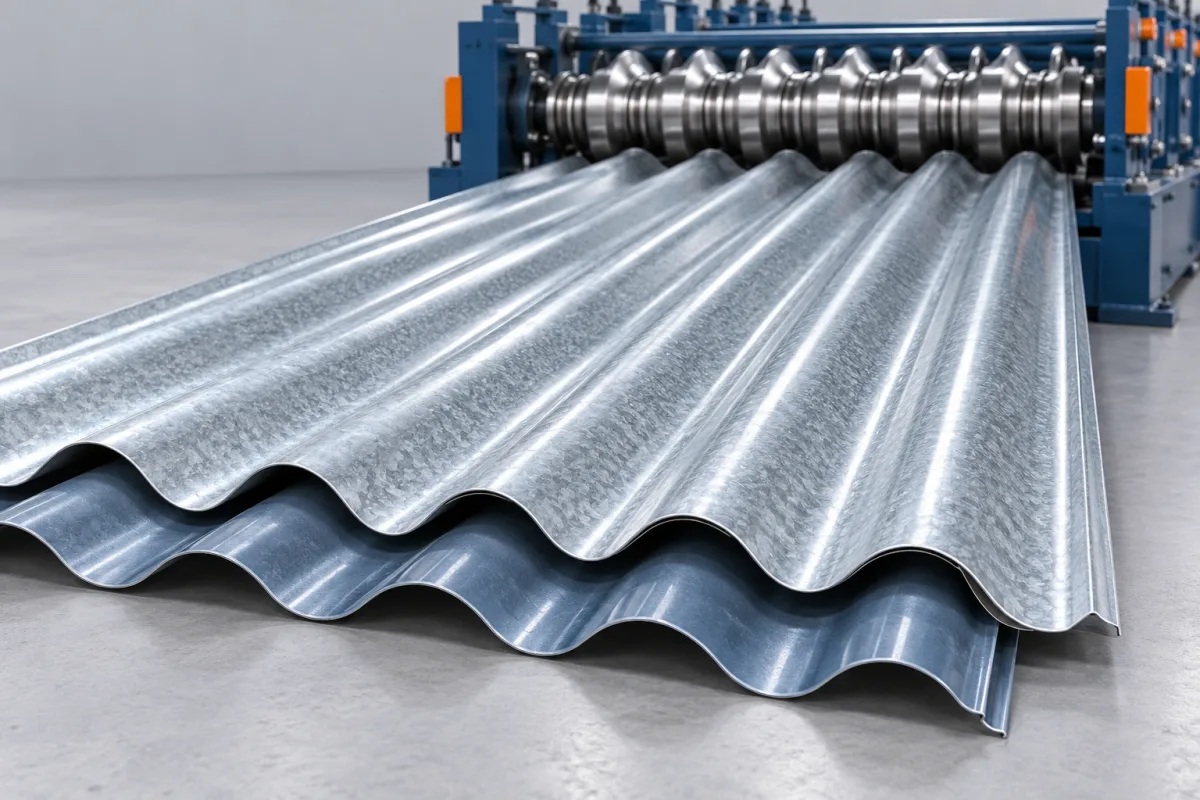
A 7/8 corrugated roofing sheet machine forms a repeating curved corrugation with a nominal 7/8-inch depth, equivalent to 22.225 mm. That depth is only one element of the section. Corrugation pitch, curve shape, edge termination and installed overlap must also be defined before a machine can be matched to an existing roof or a new panel range.
The rounded wave distinguishes this product from trapezoidal roofing with flat crests and angled sidewalls. It gives the sheet a different visual rhythm and changes the forming tools, cutoff support and closure shape. A buyer should choose the actual corrugated product first rather than ask a generic roofing former to reproduce it by adjustment.
What does the 7/8 designation establish?
It normally identifies nominal corrugation depth, but the specification must show the measurement points. It does not state pitch, cover width, material thickness or allowable roof span. Those are independent product and project inputs.
When matching an existing section, measure several corrugations rather than one potentially damaged crest. Compare the two terminal edges and the overlap arrangement. A close visual match can still produce an uneven lap if the pitch or end-wave position differs.
How does the rounded profile differ from trapezoidal sheet?
A corrugated cross-section alternates curved crests and valleys. Tool contact and material development follow those curves instead of concentrating around the corners of a trapezoid. The final contour should be evaluated as a continuous shape, not only by checking the overall depth.
This also changes accessory matching. Closures need the same wave pitch and contour, and cut-end support must suit the curved section. A closure or cutoff component from a trapezoidal product is not an interchangeable item simply because sheet widths are similar.
Which measurements belong in the tooling package?
- Nominal depth with the defined measurement convention.
- Corrugation pitch and the number of waves across the sheet.
- Approved crest and valley contours.
- Both terminal-edge positions and overlap direction.
- Overall width, assembled cover and input-strip requirement.
- Material combinations and the exposed-face orientation.
Where a physical sample defines a legacy section, create a controlled drawing from the agreed sample rather than using an unknown sheet indefinitely. Record how the sample was supported during measurement and whether any local damage was excluded.
How is the corrugation formed progressively?
The strip is guided from the coil into successive rolls that develop the waves. The forming sequence must accommodate material moving into the corrugated shape while keeping the section consistent across its width. The last stages establish the approved contour before cutting and discharge.
Ask how the proposed line supports the sheet through cutoff and transfer. Rounded crests can be dented by unsuitable local contact even when the forming itself is satisfactory. Inspect a piece immediately after cutting and again after normal handling to distinguish these effects.
How should steel and aluminum options be compared?
Record steel grade or aluminum alloy and temper with the intended thickness. Equal thickness does not mean equal forming behavior. A supplier should review the actual combinations instead of approving a broad material list from the corrugation name alone.
Include coating, finish and any film in the trial plan. The rolling contact follows repeated curved surfaces, so inspect crests and valleys for marks and coating condition. Keep the actual coil identification with the sample so a later change in material can be assessed against the approved production envelope.
What controls coverage and material yield?
The overlap consumes part of the sheet's physical width, while the developed curves consume more strip than the projected width suggests. Effective cover and input width therefore answer different questions. Confirm both for the chosen section instead of estimating coil demand from the nominal installed width.
For order planning, distinguish nominal panel coverage from roof takeoff. Openings, end laps, cutting waste and installation details can change the quantity required for a project. The forming line produces specified sheets; it does not determine those building quantities automatically.
Can the same corrugated panel serve walls?
A manufacturer may supply the approved profile for wall orders as well as roof orders, but each application needs its own fastening, support and accessory details. Architectural wall work may also place different emphasis on finish and visible alignment.
If curved architectural surfaces are planned, define any separate curving operation. A straight corrugated-sheet former should not be assumed to deliver a controlled longitudinal radius. Identify whether the installed design uses a separate process or a specifically approved installation method.
How should a trial address long panels?
Use the intended supports and normal transfer route. Long sheets should not drag over edges or be lifted in a way that permanently changes the waves. Include the package configuration because nesting and restraint can create dents that were absent at the machine exit.
Measure representative short and long pieces, check overlap across several sheets and fit the specified closures. Record accepted output after handling. A high count of cut sheets is not useful if a significant proportion cannot be shipped without repair.
Frequently asked questions
Does 7/8 inch specify the sheet thickness?
No. It describes the nominal profile depth in this product name. Base-metal thickness must be stated separately with material grade or alloy and the coating convention.
Can any corrugated roofing sheet overlap it?
Only if the relevant geometry and assembly details match. Compare pitch, depth, wave contour and terminal edges rather than relying on the general word corrugated.
Will changing coil width change the cover width?
It can also change edge termination or produce an unacceptable section. Any width variation must be part of the tooling design and approved product range, not an improvised production adjustment.
Is a curved roof included in this machine scope?
Not automatically. Specify any required longitudinal curvature and identify the equipment or approved installation process responsible for it. Straight sheet forming and controlled curving are separate requirements.
What should be checked beyond the depth?
Check pitch, contour, effective cover, mating edges, end quality and finish. An assembled multi-sheet sample is especially useful for confirming that the product behaves consistently at its overlap.
Use the full wave as the reference
A successful 7/8 corrugated project connects depth to the complete repeating contour and installed lap. That definition makes tooling, accessory compatibility and handling requirements much clearer than a nominal size alone.

Continue your research
- Roofing Sheet Roll Forming Machines
- Corrugated Roof Sheet Roll Forming Machine
- Trapezoidal Roof Sheet Roll Forming Machine
- R Panel Roll Forming Machine
- PBR Panel Roll Forming Machine
- IBR 686 Roofing Sheet Machine
- How Roofing sheet roll forming machine Works
- How To Choose a Roofing sheet roll forming machine
- Roofing sheet roll forming machine Price: What Affects the Cost?
Configuration & specification inputs
Match the configuration to your section drawing, material and production requirements.
| Parameter | Requirement / confirmation needed |
|---|---|
| Profile geometry | Nominal 7/8-inch corrugation depth with separately approved pitch, contour, edges and cover. |
| Material | Specified steel grade or aluminum alloy and temper, including coating and exposed face. |
| Thickness & grade | Base-metal thickness independent of the 7/8-inch profile-depth designation. |
| Process route | Guided coil entry, progressive curved-wave forming, supported cutoff and protected stacking. |
| Cutting | Usable corrugated ends with no unacceptable crest crushing or terminal-wave distortion. |
| Output | Accepted sheets or coverage after overlap, finish and handling checks. |
| Electrical supply | Utilities matched to the corrugating mill, cutoff and chosen takeoff equipment. |
| Acceptance | Wave depth and pitch, continuous contour, joined-sheet cover, closure fit and package condition. |