
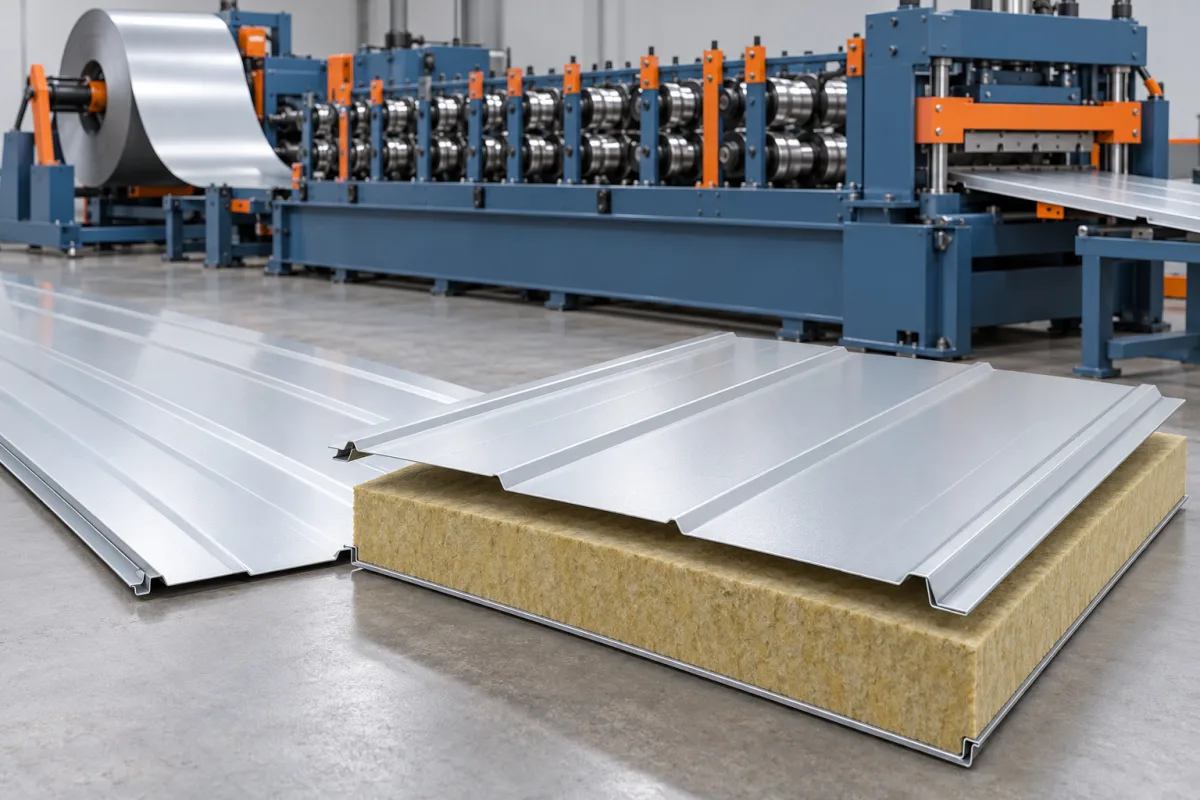
An insulated wall panel skin roll forming machine produces the metal facing used in a sandwich-panel manufacturing route. It shapes the visible surface and the edge details that contribute to the finished panel joint. The facing is an intermediate component: core preparation, bonding or foaming, pressing and final finishing remain additional operations in the complete panel process.
This distinction is important when comparing equipment. A skin former can be a standalone source of prepared facings or an integrated section of a continuous line. Its specification must match the downstream process rather than treating the metal sheet as a finished single-skin wall panel.
What is different about a sandwich-panel facing?
The skin has two functional sides. One becomes the visible surface, while the other interfaces with the core or bonding system. Its edge geometry also needs to fit the complete panel joint, including the relationship between the inner and outer facings.
A sheet that looks correct from outside can still be unsuitable if its hidden return interferes with core placement or downstream tooling. Review the complete panel cross-section, not only a detached drawing of the metal face.
Which panel information should guide the tooling?
Define the finished wall-panel thickness range, joint design, inner and outer facing shapes and chosen core route. Identify whether panel-width or thickness changes alter either metal edge. The facing supplier needs those interfaces to establish a meaningful product matrix.
- Outer and inner facing drawings with clear identities.
- Visible texture, ribs or microribs where specified.
- Edge returns and the completed panel joint.
- Material and coating on both sides of each skin.
- Downstream guides, press or lamination interfaces.
- Required width and variant-change arrangements.
Keep the two skins from being confused in programs and inspection records. They may share material thickness while having different geometry, coating or process requirements.
How does a standalone facing route differ from integration?
A standalone route may cut and stack prepared facings for later use. It therefore needs a length schedule, intermediate handling and protection that preserve edge geometry and bonding-surface condition. Inventory identification becomes part of the process.
An integrated route feeds facing material directly into the next manufacturing stages. Its speed control, strip alignment and changeover behavior must coordinate with those stages. The correct configuration depends on how the complete sandwich panel is made, not just on the skin former's own output.
What forming and surface operations may be required?
The facing may need leveling, embossing, shallow ribs, edge forming or protective-film application, depending on the product. List each required operation and its place in the route. A smooth face and an embossed face should not be assumed to use the same equipment package.
Specify which surface is protected for appearance and which surface needs to remain suitable for bonding. Any treatment intended to support adhesion belongs in the agreed complete process, with responsibilities defined between the facing and panel-line suppliers.
How should material and coating be reviewed?
State grade, base-metal thickness and coatings on both sides. The visible coating and the backing surface can have different purposes. Include the actual production material in trials so forming and downstream compatibility are assessed together.
Do not replace process qualification with a generic statement that coated steel is suitable. The selected adhesive or core route, surface condition and manufacturing conditions need their own review. The skin-forming specification should identify these interfaces without inventing a universal bonding recipe.
What changes when panel thickness or joint style changes?
Some variations may change only downstream equipment, while others require different facing-edge geometry. Compare the complete panel sections and ask which guides, rolls and other tools must move or be replaced. A nominal thickness adjustment does not automatically leave the skin unchanged.
Demonstrate the change through a finished panel sample where practical. A facing may pass its own width check but produce an unsatisfactory joint after core assembly. Acceptance should connect the intermediate component to its intended use.
How should handling protect the hidden surface?
For cut facings, define support, separation and storage so edges are not crushed and the bonding surface is not contaminated. Mark orientation and variant identity clearly. Handling instructions should follow the qualified downstream process and material requirements.
For continuous feeding, review strip tracking and the transfer interface between forming and panel assembly. The facing should arrive in the required position without being forced into alignment by the next machine. Observe the interface during a coordinated trial.
What should a complete acceptance plan include?
- Verify inner and outer skin identity and material.
- Measure face features, edge returns and width.
- Inspect coating, film and relevant hidden surfaces.
- Check transfer or stacked-facing condition.
- Demonstrate required product changes.
- Produce representative assembled-panel samples.
- Inspect final joint fit and the agreed downstream quality results.
Separate facing dimensional acceptance from bonding, thermal, fire or other finished-panel assessments. Those are different requirements with different test methods and responsibilities. Keeping them distinct makes the equipment scope clearer rather than less complete.
Frequently asked questions
Does this machine make a finished insulated wall panel?
It makes the metal facing unless the proposal explicitly includes the complete core and assembly route. List core processing, bonding, pressing, cutting and packaging separately when a complete line is required.
Can both skins use identical tools?
Only if their approved geometry is identical. Compare the complete joint and visible-face requirements; inner and outer skins often have different roles even when their material is similar.
Is embossing always necessary?
No. It is a product-specific surface requirement. Specify the intended texture or smooth finish and identify the equipment needed to reproduce it.
Can a single-skin wall former supply these facings?
Only after the edge geometry, surface condition and downstream interfaces are reviewed. A familiar wall-sheet profile does not automatically fit a sandwich-panel manufacturing process.
How should output be compared?
For integration, compare the coordinated route's accepted panel output. For standalone facings, include cutting, handling and supply to the next process. Isolated strip speed can be misleading in either case.
Engineer the skin as part of the panel
The most useful facing-machine brief begins with the finished sandwich-panel section and works back to each metal skin. That connects forming, surfaces and changeovers to the product the complete line must deliver.

Continue your research
- Wall Cladding Roll Forming Machines
- Wall Panel Roll Forming Machine
- Metal Siding Roll Forming Machine
- Box Profile Wall Panel Roll Forming Machine
- Corrugated Wall Cladding Roll Forming Machine
- Trapezoidal Wall Cladding Roll Forming Machine
- How Wall cladding roll forming machine Works
- How To Choose a Wall cladding roll forming machine
- Wall cladding roll forming machine Price: What Affects the Cost?
Configuration & specification inputs
Match the configuration to your section drawing, material and production requirements.
| Parameter | Requirement / confirmation needed |
|---|---|
| Profile geometry | Inner and outer facing geometry tied to the complete insulated-wall panel joint. |
| Material | Specified facing grade, two-sided coating and surface requirements for the chosen core process. |
| Thickness & grade | Base-metal thickness combinations matched to each facing and panel configuration. |
| Process route | Coil preparation, specified texture or film, facing-edge forming and transfer to the defined core route. |
| Cutting | Standalone facing lengths or coordinated continuous transfer as required by the complete panel process. |
| Output | Accepted prepared facings or coordinated finished-panel output according to integration scope. |
| Electrical supply | Utilities coordinated with facing preparation, forming and downstream panel equipment. |
| Acceptance | Skin identity, edges, surface condition, transfer alignment and representative completed-panel joint. |