
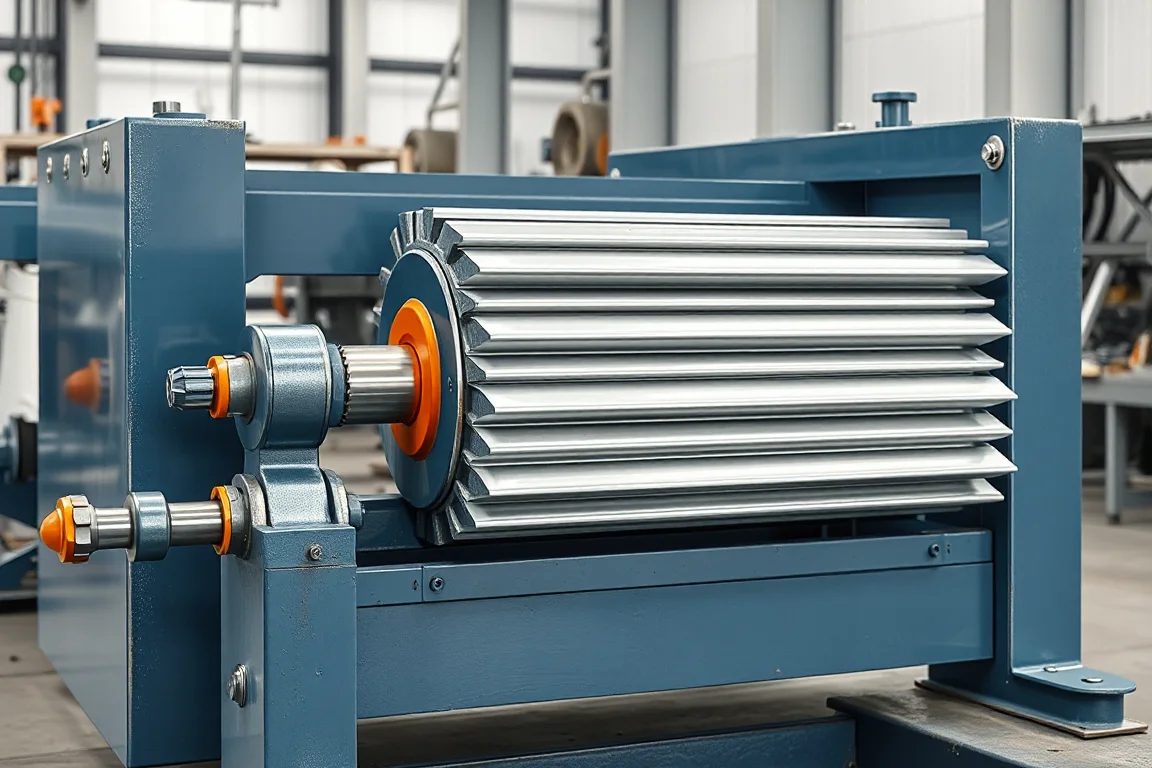
What defines a flat roller shutter slat forming machine
A flat roller shutter slat roll forming machine produces slats with a visually flat exposed face, as distinct from a curved or profiled face. The flat face is the part the building occupant sees. It is not the feature that determines whether the assembled curtain will coil correctly. Each slat still has articulated edge hooks, and those hooks, not the flat face, control how adjacent slats engage and rotate through the winding arrangement. The machine therefore has to form both the visible face and the interlock geometry. A line that produces a flat strip without matched edge hooks is not producing a shutter slat; it is producing trim.
Why the flat face is only one part of the requirement
Face flatness is easy to check on a bench. It is also easy to achieve while the hook geometry is wrong. A slat can look perfectly flat and still bind when several lengths are assembled into a curtain. The reason is that the curtain is a chain of hinges. Each hook must pick up the adjacent slat and allow rotation through the intended winding arc. If the hook opening is too tight, the curtain will be stiff; if it is too loose, slats may separate or rattle. The flat face does not compensate for either condition. When evaluating a machine, the profile drawing should show the hook form, the face form, and the end-lock detail as one continuous section.
Component interfaces: interlock, guide and end treatment
The interlock is the interface between adjacent slats. It is formed by a pair of hooks: typically one on each edge. The geometry of these hooks must match the intended guide clearance, because the curtain sits in vertical guides. If the slat is too wide for the guide, it will jam; if it is too narrow, it will rattle. The ends of each slat require an end treatment, often an end lock or cap, which prevents lateral movement and can provide a mounting point. These three interfaces—interlock, guide clearance and end treatment—are not independent. Changing the hook form can alter the effective slat width, which then affects guide fit. For that reason, the profile drawing and the guide drawing should be reviewed together, not as separate documents.
Choosing a production route for flat slats
The basic route for a flat slat is forming, interlock development, optional insulation or perforation, cut-off, and then curtain assembly. Forming is not a single pass; it is a sequence of stations that progressively bend the strip into the hook and face geometry. Interlock development is the part of the line that sets the hook opening and the face transition. If the slat is perforated or insulated, that step is added before cut-off. Cut-off then separates the continuous strip into lengths. Curtain assembly is a separate operation that may happen in the same workshop or elsewhere. A machine that only performs the forming and cut-off steps is a component producer. A line that also handles insulation and assembly is a curtain producer. Those are different business scopes, and the equipment quote should make clear which scope is being offered.
Coated steel, aluminium and the effect on forming
Flat roller shutter slats are typically made from coated steel or aluminium. These materials behave differently in forming. Coated steel has a higher yield strength than aluminium for a given thickness, and it tends to spring back more after bending. That spring-back affects hook closure. Aluminium is softer and may mark more easily at the forming rolls. Neither material is universally better; the choice depends on the required stiffness, weight and corrosion environment. When the material changes, the hook geometry and the roll settings may need to change as well. A machine that is set up for one material may not produce a correct hook in another without adjustment. Insulated constructions require additional processing, such as inserting foam or a thermal break, and that step can affect the slat's stiffness and edge distortion.
Cut-off requirements and end quality
The cut-off is often treated as a simple shear, but for a shutter slat it is a profile-supported operation. The cut must not crush the hook or leave a burr that interferes with the interlock. A cut-off that is not supported by the profile can deform the slat ends, and that deformation may be visible only when the slat is assembled. The cut length must also be consistent, because variation accumulates across a curtain. If the line includes secondary operations such as end notching or hole punching, those operations need to be sequenced so that they do not distort the formed hooks. The cut-off and any secondary operations should be inspected as part of the first-off approval, not just as a length measurement.
Perforation and insulation as separate decisions
Perforation is sometimes added to a flat slat for ventilation or appearance. It changes the slat's stiffness and can cause edge distortion if the perforating tool is not matched to the profile. A perforated slat may behave differently in the interlock, because the holes reduce the material available to carry bending stress. Insulation is a different addition, typically used for thermal or acoustic performance. It may involve inserting a core, applying a foam layer, or forming a double-wall section. Both perforation and insulation are optional, and each one changes the production route. They should be quoted as separate operations so that the buyer can compare the cost and complexity of each. A machine that forms a plain flat slat is not the same as a line that produces an insulated flat slat, and the two should not be compared on a per-metre basis alone.
Assembly boundaries: slat, guides, bottom bar and curtain
The roll forming machine produces slats, but a finished roller shutter is a curtain assembly. The curtain includes the slats, the guides, the bottom bar and the end locks. The assembly operation may involve threading slats into guides, attaching the bottom bar and fixing the end locks. These operations are not part of the roll forming machine unless the line is specified to include them. When reviewing a quotation, the scope should list each of these items separately. A complete shutter workshop cannot be inferred from a slat-machine price. The buyer should ask which operations are performed by the proposed line and which are performed manually or by separate equipment. That distinction affects labor, floor space and the definition of a finished part.
Output definitions that reflect finished-curtain production
Output for a flat slat line is often quoted as a line speed or a number of slats per shift. Those figures can be misleading if they refer only to the bare forming process. The relevant output is the number of accepted curtain lengths per shift, after accounting for changeover, setup scrap, cut-off time and any secondary operations. If insulation or perforation is included, those steps add time and may become the bottleneck. The buyer should define output in terms of the actual profile and material, and should include the assembly operations if the finished curtain is the product. A line that produces slats quickly but requires extensive manual assembly may not deliver the expected curtain throughput.
Electrical supply and power scope
The buyer should state the available voltage, frequency and phase. These are site conditions, not machine ratings. The installed power of the line depends on the number and size of motors, the cut-off type, and any auxiliary equipment such as uncoilers, perforators or insulation inserters. A confirmed equipment schedule is needed before the installed power can be determined. Quoting a single power figure without that schedule can lead to site electrical work that is not included in the project. The buyer should also confirm whether the line requires a transformer or a specific earthing arrangement, because those are separate from the machine's internal electrical design.
Acceptance checks for flat slat assemblies
Acceptance should go beyond a visual check of a single slat. Assemble multiple slats with the intended guides and end locks, then check articulation through the intended winding arrangement. Inspect the hook engagement and the face marking after handling. Pay attention to the interlock coating: if the coating is damaged during forming or assembly, corrosion may start at the hinge. Check the cut ends for burrs or deformation. A slat that looks flat on the table can still bind when several lengths are assembled into a curtain, so the assembled test is essential. If the line includes perforation or insulation, those features should be inspected in the assembled state as well, because they can affect how the curtain coils.
Practical checklist for specifying a flat slat line
- Provide a profile drawing that shows hook geometry, face form and end-lock detail.
- State the base-metal thickness and grade, and note any coating or insulation requirement.
- Define the production route, including whether perforation or insulation is in scope.
- Confirm cut-off requirements: cut length, end quality and any secondary operations.
- Separate the slat production scope from the curtain assembly scope in the quotation.
- Define output per shift using the actual profile and material, not a demonstration substitute.
- State the site electrical supply and request a confirmed equipment schedule.
- Plan an acceptance test that assembles multiple slats with guides and end locks.
- Inspect the interlock coating and cut ends after handling and assembly.
- Record changeover steps, setup scrap and unloading time during the trial.
Comparing alternatives: flat, curved, perforated and insulated
A flat slat line is not interchangeable with a curved slat line or an insulated slat line. A curved slat has a different face geometry, which changes the roll forming stations and the way the slat behaves in the guide. A perforated slat adds a punching operation that can affect stiffness and edge condition. An insulated slat adds a material insertion or foaming step and may require a different cut-off approach. These are separate product families, and the equipment scopes differ. When comparing quotations, the buyer should compare completed components and operations, not just bare strip speed. A lower-cost line that omits a needed secondary operation may end up requiring manual work or a second machine. The comparison should be based on the finished part and the agreed acceptance criteria.
Frequently asked questions
Can a flat slat line also produce curved slats?
Not without changing the forming rolls and possibly the cut-off. The curved face requires a different sequence of bends, and the hook geometry may also change. A line set up for flat slats is a dedicated configuration. Some machines are designed for changeable tooling, but that capability must be confirmed in the equipment scope. Without the correct rolls, a flat line cannot produce a curved profile.
How do I know if the interlock will work in the guide?
The interlock and the guide clearance must be checked as an assembly. The profile drawing should show the slat's overall width and the hook form, and the guide drawing should show the internal clearance. When the slats are assembled into the guide, the curtain should move smoothly without binding or excessive play. If the slat is too wide, it will jam; if it is too narrow, it will rattle. This is why the acceptance test should include the intended guides.
Does the cut-off need to be different for coated material?
The cut-off should be designed to support the profile and to avoid damaging the coating at the cut edge. A shear that crushes the hook or leaves a heavy burr can cause coating damage that leads to corrosion. The cut edge should be inspected for burrs and deformation. The cut-off type and tooling should be matched to the profile and material, and this should be part of the machine specification.
What is the difference between a slat machine and a complete production line?
A slat machine forms and cuts the slat. A complete production line may also include an uncoiler, a perforator, an insulation inserter, and sometimes assembly stations for guides and bottom bars. The two are different scopes. A quotation for a slat machine does not include the operations needed to produce a finished curtain. The buyer should request a written scope that lists every operation included.
How should output be measured for a flat slat line?
Output should be measured in accepted curtain lengths per shift, using the actual profile and material. The measurement should include changeover time, setup scrap, cut-off time and any secondary operations. If the line includes insulation or perforation, those steps may reduce the effective output. A bare forming speed is not a reliable indicator of curtain production.
What should be inspected on the first-off sample?
The first-off sample should be inspected for face flatness, hook geometry, cut length and end condition. It should also be assembled with adjacent slats and the intended end locks to check articulation. The interlock coating should be examined for damage. If perforation or insulation is included, those features should be checked as well. The first-off is a chance to verify that the machine settings match the profile drawing before steady production begins.

Continue your research
- Roller Shutter Door Roll Forming Machines
- Roller Shutter Slat Roll Forming Machine
- Rolling Shutter Guide Rail Roll Forming Machine
- Curved Roller Shutter Slat Roll Forming Machine
- Perforated Roller Shutter Slat Machine
- Insulated Roller Shutter Slat Machine
- How Roller shutter roll forming machine Works
- How To Choose a Roller shutter roll forming machine
- Roller shutter roll forming machine Price: What Affects the Cost?
Configuration & specification inputs
Match the configuration to your section drawing, material and production requirements.
| Parameter | Requirement / confirmation needed |
|---|---|
| Profile geometry | A flat-faced shutter slat still has articulated edge hooks. Inspect the visible face and the assembled curtain; face flatness alone does not show that the shutter will coil correctly. |
| Material | Specified coated steel or aluminum; insulated constructions require additional processing |
| Thickness & grade | Buyer to specify base-metal thickness and grade; operating range requires supplier verification. |
| Process route | Forming → interlock development → optional insulation/perforation → cutoff → curtain assembly |
| Cutting | Confirm profile-supported cutoff, cut lengths, end quality and any secondary operations. |
| Output | Define accepted output per shift with the actual profile and material. |
| Electrical supply | Buyer to state voltage / frequency / phase. Installed power requires a confirmed equipment schedule. |
| Acceptance | Check articulation through the intended winding arrangement. Inspect hook engagement and face marking after handling. A slat that looks flat on the table can still bind when several lengths are assembled into a curtain. |