
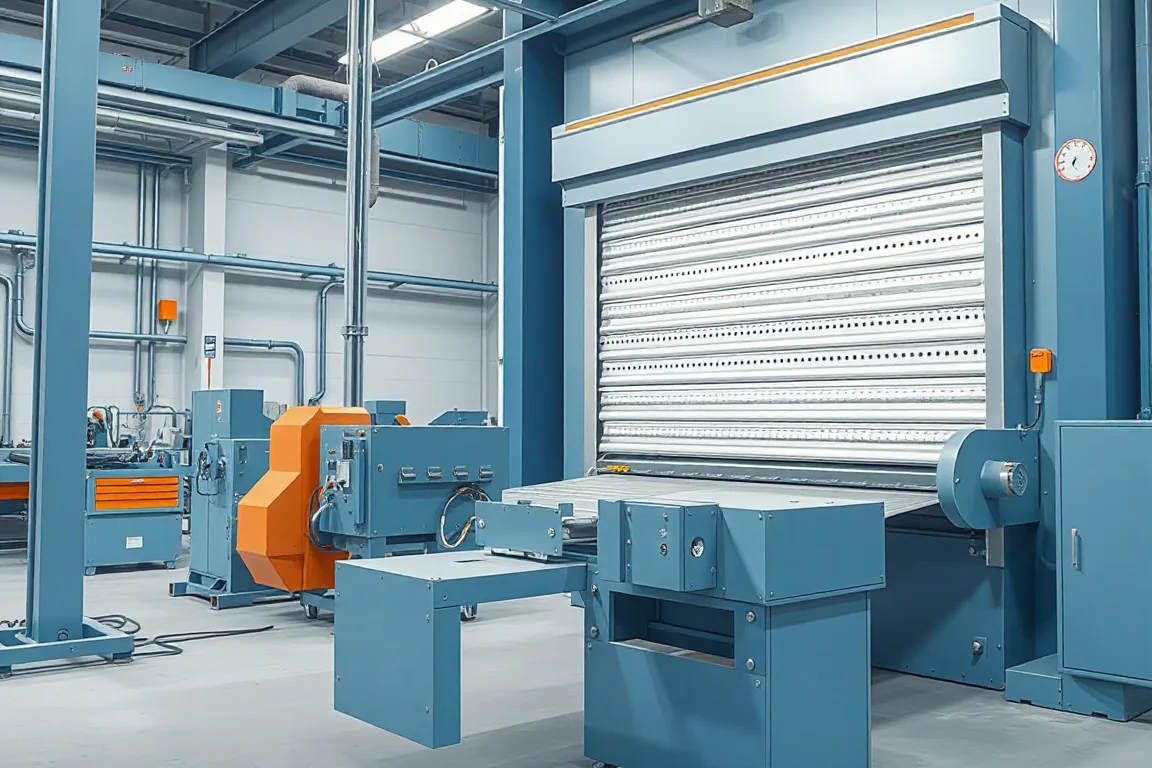
A perforated roller shutter slat machine is a roll forming line configured to produce interlocking shutter slats that contain a defined pattern of holes. The machine does more than punch holes in a formed profile. It must coordinate strip feed, hole creation or verification, progressive forming of the slat face and interlocking edges, and cutoff so that each finished slat can articulate, coil and connect to adjacent slats in a curtain.
What the application actually covers
The application is the production of individual slats that assemble into a roller shutter curtain. Each slat has a face, often curved or flat, with interlocking hooks along the longitudinal edges. End locks or end treatment constrain lateral movement when the curtain is assembled. A perforated slat adds a hole pattern across the face, which affects how the strip deforms during forming and how the finished curtain behaves.
The machine is therefore not a generic roll former. It is a profile-specific line whose tooling, pass sequence and cutoff are built around one slat interlock, one face geometry, one hole pattern and one material family. Changing any of those inputs can require changes to forming stations, perforation tooling or cutoff support.
How perforation changes the forming problem
Holes interrupt the continuous material that would otherwise carry tensile and compressive strains through the forming passes. A strip with a dense hole pattern behaves differently from solid strip. The remaining bridges between holes, the edge margin, and the material around each hole all influence how the section develops.
The practical consequences are uneven strain distribution, a greater tendency for the face to distort, and a higher risk of hole deformation if perforation is performed before or during forming. The interlocking hooks are especially sensitive because they rely on controlled material flow to close to the intended geometry. If the hole pattern removes material near a bend line, the hook may not form consistently.
Perforation also affects stiffness. A perforated slat is generally less stiff than an equivalent solid slat, but the magnitude depends on hole size, spacing, pattern orientation and the remaining edge material. The machine alone does not determine this; the combination of profile, perforation layout and material does.
Production routes: perforate before, during or after forming
There are three broad routes, and they are not interchangeable.
Pre-perforated coil or strip
The material arrives already perforated. The roll forming line then forms the slat from perforated strip. This route simplifies the line because perforation is outside the machine, but it places the hole pattern under the control of the coil supplier and makes pattern changes a material procurement issue. Forming perforated strip requires tooling that tolerates the interrupted material and maintains interlock quality.
In-line perforation before or between forming passes
A punching or perforating station is integrated into the line, typically before the forming stations or at an early pass. The line controls both pattern and forming in one sequence. This route offers more control over registration between holes and profile features, but it requires careful synchronization and scrap removal. Punched slugs or slugs from the perforation station must be managed so they do not interfere with forming rolls or finished slats.
Perforation after forming
The slat is formed first and then perforated. This can preserve interlock forming because the hooks are produced from solid material, but perforating a formed section is more difficult. Access to the face, support of the profile during punching, and the risk of distorting the formed section all become significant. This route is less common for slats with curved faces or closely spaced hooks.
The correct route depends on the hole pattern, the face geometry, the material and the required interlock quality. A route that works for a sparse pattern on a flat face may not work for a dense pattern on a curved face.
Component production versus curtain assembly
A perforated slat machine produces slats. It does not produce a finished shutter. The boundary between component production and curtain assembly should be clear in any quotation or project plan.
The machine scope typically includes forming, interlock development, perforation if integrated, and cutoff. It may include end-lock forming or notching if the profile requires it, but that should be confirmed. Curtain assembly involves adding end locks, assembling multiple slats, fitting guides, bottom bars and any operating hardware. Insulated constructions require additional processing and are a different production problem.
Secondary operations such as deburring, hole cleaning, end treatment or coating repair may be needed. These operations can govern the practical output of a finished curtain even if the roll forming line itself runs quickly. Comparing bare strip speed between machines without accounting for secondary operations can mislead the buyer.
Cutoff and end quality for perforated slats
Cutoff must suit the profile, not just the strip. For a perforated slat, the cutoff station needs to support the section so that the cut does not collapse the face or deform holes near the cut end. The cut length must be repeatable, and the cut end should be clean enough for the intended end-lock or assembly method.
If the hole pattern crosses the cut line, the end condition may include partial holes. That can affect appearance and edge treatment. The buyer should confirm how the pattern is registered to cut length and whether partial holes are acceptable. Any secondary operations needed to finish the cut end should be identified before the line is approved.
Inspection and acceptance for perforated slats
Acceptance should be based on assembled components and representative production samples, not on a single demonstration piece. The following checks are practical and directly related to the application.
- Measure hole pattern position and size on first-off and steady-production samples using agreed gauges.
- Check burr direction and visible finish on the perforated face and cut ends.
- Assemble multiple slats with the intended guides and end locks, then check movement, clearances and interlock engagement.
- Inspect the interlock coating for damage and confirm that forming did not crack or flake the coating.
- Confirm scrap removal is effective and that punched slugs do not remain in the line or in finished slats.
- Record changeover steps, setup scrap, punching time and unloading time for the agreed profile and material.
The presence of holes does not by itself establish a shutter's ventilation, security or wind performance. Those are system-level properties that depend on the complete curtain, guides, fixings and installation.
Material and profile inputs that must be specified
The machine cannot be evaluated without a defined profile, material, thickness and grade. The slat interlock, curved or flat face, end-lock detail and guide clearance should all be provided in a drawing. The intended face finish and any coating or foam compatibility requirements matter because perforation and forming can damage coatings.
Coated steel and aluminium are common, but they behave differently. Insulated constructions require additional processing and should be treated as a separate application. Thickness and grade are buyer responsibilities; the operating range requires supplier verification against the actual profile and hole pattern. Electrical supply is also a buyer input, and installed power requires a confirmed equipment schedule rather than an estimate.
How to compare alternative production routes
When comparing pre-perforated material, in-line perforation and post-forming perforation, consider the following decision factors.
- Pattern flexibility: in-line perforation usually allows more control over pattern changes than pre-perforated coil.
- Interlock quality: forming solid material before perforation can protect hook development, but perforating a formed section is harder.
- Scrap and slug management: in-line perforation creates slugs that must be removed; pre-perforated material may arrive with its own edge condition.
- Line complexity: integrated perforation adds stations, synchronization and maintenance requirements.
- Material sourcing: pre-perforated coil ties the buyer to a supplier's pattern and lead time.
- Finished-part scope: the route that produces the best slat may still require secondary operations before curtain assembly.
A complete shutter workshop cannot be inferred from a slat-machine price. Guides, bottom bars, end locks and assembly operations should be quoted separately so the buyer can see the true scope.
Practical checklist before approving a line
- Run the agreed material and profile, not an easier demonstration substitute.
- Inspect first-off pieces and a representative steady-production sample with the agreed gauges.
- Record changeover steps, setup scrap, punching and unloading time.
- Confirm that the written equipment scope includes all secondary operations needed for a finished part.
- Assemble multiple slats with the intended guide and end locks and check movement and clearances.
- Inspect the interlock coating and cut ends for damage.
- Confirm scrap removal is included in the line layout.
Frequently asked questions
Can a standard roller shutter slat machine be converted to produce perforated slats?
Conversion depends on the existing line. Adding a perforation station may be possible if there is space in the pass sequence and the forming stations can tolerate the interrupted material. If the original line was designed for solid strip, the interlock tooling may need modification. The better question is whether the existing line can produce acceptable interlock quality and hole registration with the intended pattern. That requires a trial with the actual profile and material.
Does perforation reduce slat stiffness, and how should that be assessed?
Perforation generally reduces stiffness because material is removed, but the amount depends on hole size, spacing, pattern orientation and remaining edge material. Stiffness should be assessed on the assembled curtain, not on the slat alone, because the interlock and guides contribute to the overall behaviour. A curtain with more slats may behave differently from a single slat test. The machine supplier and the curtain designer should agree on the relevant check.
Should holes be punched before or after roll forming?
Punching before or during forming is common because it allows registration between the hole pattern and the profile features. Punching after forming can preserve interlock development but is more difficult because the formed section must be supported and the punching operation may distort the face. The choice depends on the hole pattern, the face geometry and the required interlock quality. There is no universal answer.
What should be inspected on finished perforated slats?
Inspect hole position and size, burr direction, visible finish, interlock engagement and coating condition. Assemble several slats with the intended guides and end locks and check movement and clearances. Check cut ends for damage and confirm that partial holes at the ends are acceptable for the assembly method. Scrap removal should also be verified so that slugs do not remain in the line or in finished slats.
How does a perforated slat machine differ from an insulated slat machine?
An insulated slat machine produces slats that include insulation or foam-filled constructions. That requires additional processing and different tooling, and the profile is usually different. A perforated slat machine focuses on hole creation and forming the interlock. The two applications should be quoted and evaluated separately because their production routes, cutoff requirements and acceptance checks differ.
What should be included in a quotation for a perforated slat production line?
A quotation should state the profile, material, thickness and grade assumptions, the perforation route, cutoff requirements and the boundary between slat production and curtain assembly. It should list secondary operations needed for a finished part. Output should be defined as accepted output per shift with the actual profile and material, not as a bare strip speed. Electrical supply and installed power should be confirmed through an equipment schedule.

Continue your research
- Roller Shutter Door Roll Forming Machines
- Roller Shutter Slat Roll Forming Machine
- Rolling Shutter Guide Rail Roll Forming Machine
- Flat Roller Shutter Slat Roll Forming Machine
- Curved Roller Shutter Slat Roll Forming Machine
- Insulated Roller Shutter Slat Machine
- How Roller shutter roll forming machine Works
- How To Choose a Roller shutter roll forming machine
- Roller shutter roll forming machine Price: What Affects the Cost?
Configuration & specification inputs
Match the configuration to your section drawing, material and production requirements.
| Parameter | Requirement / confirmation needed |
|---|---|
| Profile geometry | Perforated shutter slats need a specified hole pattern and remaining edge material. Evaluate how perforation affects forming, stiffness and curtain assembly. |
| Material | Specified coated steel or aluminum; insulated constructions require additional processing |
| Thickness & grade | Buyer to specify base-metal thickness and grade; operating range requires supplier verification. |
| Process route | Forming → interlock development → optional insulation/perforation → cutoff → curtain assembly |
| Cutting | Confirm profile-supported cutoff, cut lengths, end quality and any secondary operations. |
| Output | Define accepted output per shift with the actual profile and material. |
| Electrical supply | Buyer to state voltage / frequency / phase. Installed power requires a confirmed equipment schedule. |
| Acceptance | Check burr direction, visible finish and interlock operation on finished slats. Include scrap removal in the line layout. The presence of holes does not alone establish a shutter's ventilation, security or wind performance. |