
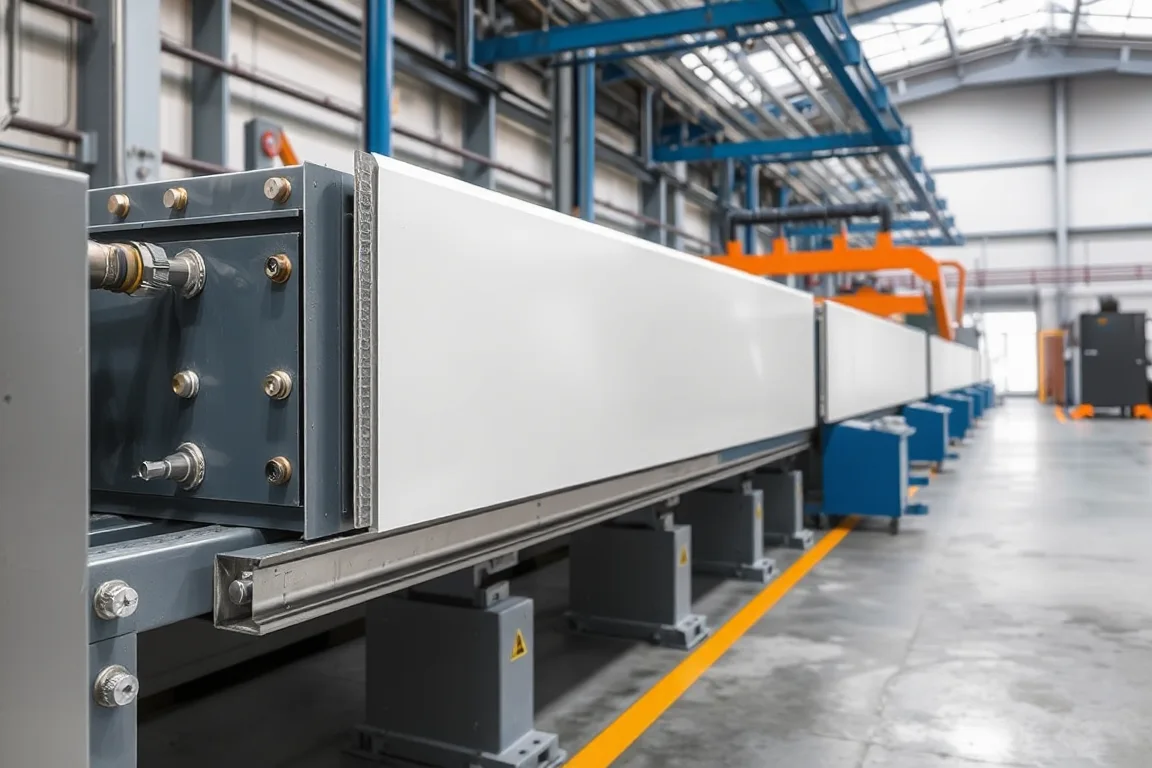
An EPS roof sandwich panel production line is not a single machine but a coordinated sequence that turns coated steel coils, expanded polystyrene (EPS) core material and adhesive or bonding chemistry into finished roof panels. This page focuses on the roof-panel application: a profiled metal facing with a defined overlap or joint, bonded to an EPS core, cut to length and prepared for roof fastening. It distinguishes component production from panel assembly, because a line may fabricate facings, dispense or place core, press and cure, but the finished roof panel performance also depends on joint design, fixings and site installation. The EPS roof line differs from wall-panel or cold-room lines because roof profiles carry different rib patterns, drainage and overlap details, and because roof panels are often specified for weather exposure, spanning and thermal continuity across joints.
What the line actually produces
The output is a finished roof sandwich panel, usually a factory-bonded composite with two metal facings and an EPS core. The line must accept the specified facing material, profile and base-metal thickness, place or form the core, apply the bonding system, maintain panel geometry during curing and cut the panel to the ordered length. The precise panel construction is defined by the buyer’s drawing: facing profile, joint design, core thickness and finished thickness. The line’s role is to reproduce that construction consistently. It does not by itself establish thermal, fire or structural classification; those apply to a verified panel assembly, including joints and fixings, not to the equipment label.
Component interfaces: facings, core and bonding
The first interface is between the coil and the roll-former. The coil width, coating, base-metal grade and thickness must suit the profile rolls. If the facing arrives pre-profiled, the line’s decoiler and feed section must handle the delivered shape without marking or distortion. The second interface is between the facing and the EPS core. EPS boards can be placed as pre-expanded blocks or sheets, or the line may receive EPS in a form that is further shaped. The bonding system—often a formulated adhesive, or a reactive chemistry for other core types—must be compatible with the facing coating and the EPS surface. The third interface is between the panel and the cutoff: the cut must follow the profile, produce clean ends and avoid crushing the core or delaminating the facings. Each interface has its own tolerance and handling requirement, which is why the equipment schedule and process specification should be read together.
EPS roof versus other core materials
EPS is a pre-formed, low-density core. It is typically supplied as boards or blocks and does not require the same reactive dispensing, foaming or curing control as polyurethane or polyisocyanurate systems. That difference changes the line layout. An EPS roof line usually needs a core placement or lamination station and a bonding process that wets and adheres to the EPS surface. Mineral wool roof lines must handle a denser, fibrous board with different compression and dust characteristics. Reactive foam lines need metering, mixing and dispensing equipment with chemical safety controls. A line sold for one core type is not automatically suitable for another. When comparing quotes, ask which core form the feed and bonding sections are configured to accept, and how the line maintains core alignment and thickness.
Production routes: continuous, discontinuous and lamination
Continuous pressing suits long runs of a stable profile, where the facings and core move through a heated or unheated press section and cure under controlled pressure. Discontinuous pressing uses a stationary press cycle, which can be more flexible for shorter runs or thicker panels but introduces cycle time into the output. Core-board lamination is another route: pre-formed EPS boards are bonded to facings, often with a pressing or vacuum-bag stage rather than a continuous line. These are different layouts with different floor space, utilities and curing requirements. The correct route depends on the panel construction, the expected order pattern and the accept criteria for bond quality. A continuous line may be preferable for one profile and one adhesive system, while a discontinuous or lamination route may suit a wider mix of thicknesses or panel types.
Roof joint and overlap design in the line review
A roof panel is not just a flat sandwich. The profile includes ribs, troughs and a joint—often an overlap, a standing seam or a concealed-fix detail. The line’s forming section must produce the joint geometry within tolerance, because the joint controls weathertightness and how panels engage. The cutoff must not deform the joint or leave burrs that interfere with the overlap. The finished panel’s roof performance also depends on fasteners, sealants, clips and the substrate. Those are assembly and installation considerations, not line outputs. During the design review, include a section of the intended roof build-up and confirm that the line scope covers the profile’s joint features. If the joint is formed after bonding, the line sequence must show how the profile is protected during core placement and pressing.
Facing preparation and adhesive selection
Facing preparation may include uncoiling, levelling, cleaning, pre-treatment or forming. Coated steel surfaces vary in how they accept adhesives; some coatings need a specified preparation or primer, while others are designed for direct bonding. The adhesive or bonding system must match the facing, the EPS and the service conditions. For EPS, solvent-based adhesives can affect the core, so the chosen chemistry should be confirmed for compatibility. The line must provide consistent adhesive application—coverage, bead pattern or film thickness—because bond performance depends on it. The process specification should state the adhesive system, mix ratio if two-component, open time and the pressing or curing window. Chemical handling, ventilation and extraction form part of the equipment scope.
Bonding, pressing and curing control
After core placement and adhesive application, the panel enters a pressing or laminating stage. Pressure distribution matters: uneven pressure can starve the bond in some areas and over-compress the core in others. For EPS, the core can recover from moderate compression, but excessive pressure can crush the board or distort the facing profile. Curing may be ambient or heated, depending on the adhesive system and the required handling strength. The line’s speed is often set by the curing or bonding stage rather than by the roll-former. This is why output should be discussed as accepted panels per shift after the process is stable, not as a single machine speed. The curing section should be designed around the adhesive’s specified conditions, and the line’s control system should record or indicate the relevant process parameters if the quality plan requires traceability.
Cutoff, length control and secondary operations
The cutoff must produce the ordered panel length with acceptable end quality. For roof profiles, a flying or stationary cut may be required depending on line speed and profile. The cut should follow the profile without collapsing the core or deforming the joint. After cutoff, secondary operations may include punching, notching, stacking, wrapping or labelling. These operations are often specified separately from the main line, so the quotation should list them explicitly. Length control should be measured on the finished panel, not only on the facings before bonding, because curing and handling can affect final dimensions. If the panel requires end caps or joint accessories, the line scope should say whether those are produced on the same line or sourced separately.
Utilities, safety and chemical handling scope
The electrical supply—voltage, frequency and phase—must be stated by the buyer and matched to the equipment schedule. Installed power is not a single number; it depends on the motors, heaters, dispensers and extraction included in the confirmed scope. Compressed air, water, drainage and ventilation may also be required, especially if reactive chemistries or solvent-based adhesives are used. Chemical processing needs specialist safety controls: containment, extraction, personal protective equipment and emergency provisions according to the material safety data and local regulations. The line supplier should clarify which utilities and safety provisions are included in the equipment scope and which remain the buyer’s responsibility. This is a significant part of project cost and should not be left to assumption.
Acceptance checks for EPS roof panels
Acceptance should be based on the agreed test plan and the actual panel construction. Inspect facing geometry and profile dimensions, joint fit and overlap, cut length and end quality, and bond quality between facings and core. For roof panels, also check that the profile and joint are consistent along the length and that any sealant or fastener provisions are correctly positioned. Core properties such as density and thickness should be verified against the specification. Thermal or fire classifications apply to a verified panel assembly, not to a line or a material label, so they should be checked through the appropriate assembly testing route. First-off pieces and a representative steady-production sample should both be inspected, and changeover steps, setup scrap and secondary operation times should be recorded.
Practical checklist before approving a line
- Define the panel construction: facing profile, joint design, core type and finished thickness.
- State the facing material, base-metal thickness and grade, and any coating or pre-treatment requirements.
- Confirm the EPS form and density to be accepted by the line, and the bonding system.
- Review the production route: continuous pressing, discontinuous pressing or core-board lamination.
- Check the cutoff method against the profile and the required end quality.
- List all secondary operations needed for a finished roof panel, such as punching, notching and stacking.
- Verify the equipment scope includes adhesive handling, extraction and curing controls where required.
- Ask for a run with the agreed profile and materials, not a demonstration substitute.
- Inspect first-off and steady-production samples with agreed gauges and a written test plan.
- Record changeover steps, setup scrap and unloading time as part of the output discussion.
- Separate roof-system weathering and installation requirements from production dimensional checks.
Comparing production routes and supplier scopes
Continuous lines tend to suit high-volume, stable profiles, but they demand consistent coil and core inputs and a carefully controlled curing stage. Discontinuous lines can offer more flexibility for thicker panels or mixed orders, at the cost of cycle time and press utilization. Lamination routes can be attractive when the core arrives pre-formed and the facing is produced separately, but they add handling and pressing steps that affect labor and floor space. The supplier scope also varies: some quote only the roll-former and cutoff, while others include core feeding, adhesive application, pressing, curing, extraction and quality-control equipment. Because these differences change both the achievable output and the project cost, compare line layouts and included equipment rather than a single headline figure. The right route is the one that matches the panel construction, the order pattern and the acceptance criteria, with clear boundaries between line production and panel assembly.
Frequently asked questions
Can an EPS roof sandwich panel production line also run mineral wool or polyurethane cores?
Usually not without significant changes. Mineral wool is denser and requires different core feeding, compression and cutting behavior. Reactive polyurethane or polyisocyanurate systems require metering, mixing and dispensing equipment with specialized safety controls. The facing feed and bonding sections are configured for a specific core form and chemistry. If you need multiple core types, discuss a line layout that can be reconfigured, and confirm which sections are shared and which are dedicated.
How is the joint formed on a roof panel—during forming or after bonding?
The joint is typically formed into the metal facing by the roll-former before bonding, or partially formed and finished after. The exact sequence depends on the profile and joint design. What matters is that the joint geometry is maintained through core placement, pressing and cutoff without deformation. The design review should include a cross-section of the joint and a clear statement of which operations are performed before and after bonding.
What determines the achievable output of the line?
Achievable output is set by the slowest necessary stage in the process, often curing or bonding rather than the roll-former. Accepted panels per shift should be defined with the actual profile and material, after changeover and setup scrap are accounted for. Because curing conditions, adhesive system and panel thickness all influence cycle time, output figures should be tied to a specific panel construction and process specification.
What should be inspected on a finished EPS roof panel?
Inspect the facing profile and joint fit, cut length and end quality, bond quality and core dimensions. For roof panels, check that the overlap or joint detail is consistent and that any sealant or fixing provisions are correctly positioned. Core density and thickness should match the specification. Thermal and fire performance are properties of a verified panel assembly, so they are checked through the appropriate assembly testing route rather than by inspecting the line.
Are thermal and fire classifications established by the production line?
No. Thermal and fire classifications apply to the finished panel assembly, including joints, fixings and the complete roof build-up. They are not established by a ribbed facing, an EPS label or the production line itself. The production line must reproduce the specified construction consistently, but the performance evidence comes from testing or assessment of the assembly under the relevant criteria.
What utilities and safety provisions should be included in the line scope?
The electrical supply—voltage, frequency and phase—must be stated by the buyer and matched to a confirmed equipment schedule. Compressed air, ventilation, extraction and chemical containment may be required, especially for solvent-based adhesives or reactive chemistries. Chemical handling needs specialist safety controls according to the material safety data and local regulations. The quotation should clearly separate what the supplier provides from what the buyer must provide, because these provisions can materially change the project scope.

Continue your research
- Sandwich Panel Production Lines
- EPS Sandwich Panel Production Line
- Rockwool Sandwich Panel Production Line
- EPS Wall Sandwich Panel Production Line
- Rockwool Wall Sandwich Panel Production Line
- Rockwool Roof Sandwich Panel Production Line
- How Sandwich panel production line Works
- How To Choose a Sandwich panel production line
- Sandwich panel production line Price: What Affects the Cost?
Configuration & specification inputs
Match the configuration to your section drawing, material and production requirements.
| Parameter | Requirement / confirmation needed |
|---|---|
| Profile geometry | An EPS roof panel combines a roofing-facing profile with core bonding and roof joints. Include overlaps, fasteners and the complete roof-panel assembly in the design review. |
| Material | Specified metal facings with EPS, mineral wool or formulated foam core as applicable |
| Thickness & grade | Buyer to specify base-metal thickness and grade; operating range requires supplier verification. |
| Process route | Facing preparation/forming → core preparation or dispensing → bonding/pressing → curing → cutoff |
| Cutting | Confirm profile-supported cutoff, cut lengths, end quality and any secondary operations. |
| Output | Define accepted output per shift with the actual profile and material. |
| Electrical supply | Buyer to state voltage / frequency / phase. Installed power requires a confirmed equipment schedule. |
| Acceptance | Inspect joints, cut ends and bond quality after the agreed process. Separate roof-system weathering requirements from production dimensional checks. A ribbed facing and EPS label do not by themselves establish thermal or fire classification. |