
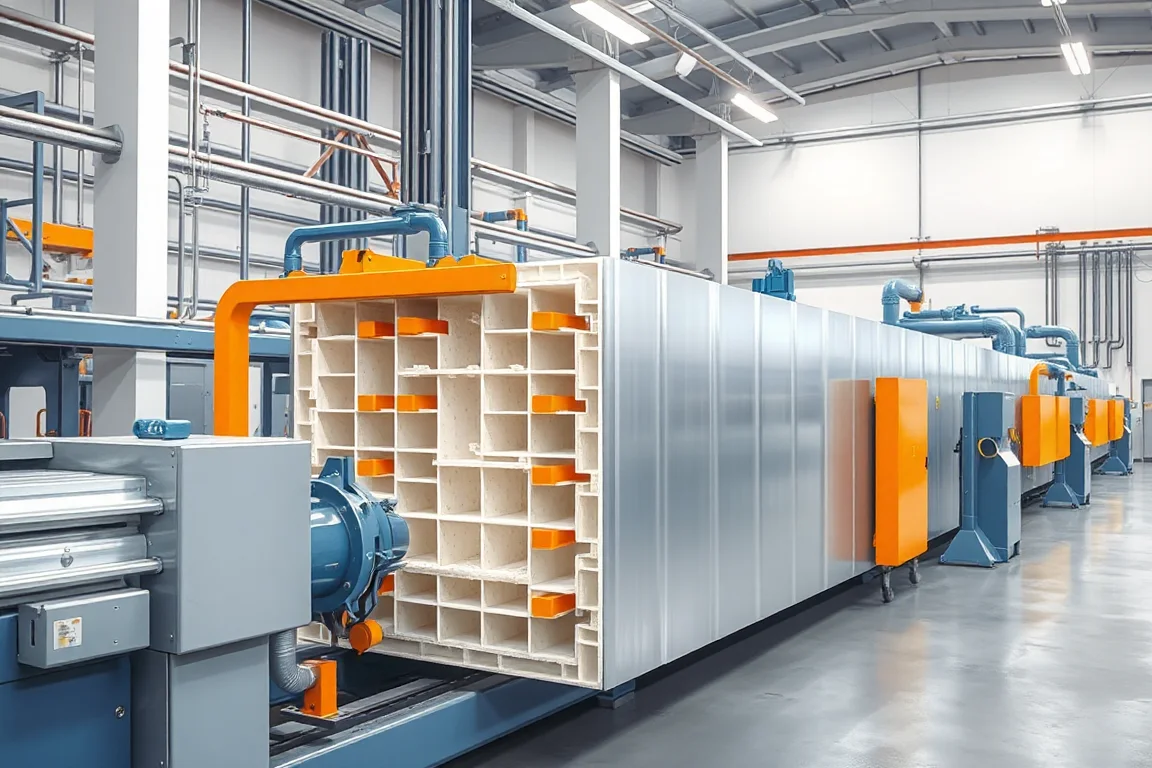
An EPS wall sandwich panel production line is not simply a roll former with a foam feeder behind it. A wall panel is a bonded composite: two prepared metal facings, a shaped EPS core, and a joint detail that lets adjacent panels lock, seal and carry load as an assembly. The line exists to reproduce that composite consistently, panel after panel, at the width and thickness the building project requires. The practical question is therefore not which machine is largest, but which configuration holds the specified facing geometry, core fit and bond while producing saleable wall panels rather than roof panels or flat laminate.
What makes a wall panel different from a roof panel
Wall and roof panels share a family resemblance but rarely share a joint. Roof panels typically rely on a raised rib, a lap that sheds water, and a profile that tolerates foot traffic and ponding considerations. Wall panels more often use a tongue-and-groove, concealed-fix or interlocking edge that presents a flat or lightly profiled face, closes tightly against weather and accommodates vertical or horizontal installation. The joint is formed by the facing geometry, and the EPS core must fill behind that geometry without voids or crush.
That distinction drives the roll-former design, the core shaping method and the cutoff. A line tooled for a roof rib may produce a panel that is dimensionally correct but architecturally wrong for a wall facade, and a wall joint cannot be improvised at installation. The drawing, joint detail and finished thickness should be fixed before the equipment scope is agreed, because the facing profile and the core profile are mutually dependent.
Facing preparation and why it precedes core work
Metal facings arrive as coils. They are decoiled, levelled or tensioned, and formed into the specified edge and face geometry. Surface condition matters because the bond depends on it: contamination, excess lubricant, oxidation or handling damage can all reduce adhesion, and the facing preparation stage is where those conditions are either managed or carried downstream. Some constructions use a primer or adhesive-promoting treatment; whether that is required belongs in the process specification, not in a generic description.
Facing preparation also sets the reference for everything after it. If the formed edge is inconsistent, the core cannot seat correctly, the joint will not close, and cutoff will produce variable end quality. For this reason, inspection of the first formed facings is more informative than watching the line run at speed.
The EPS core interface: shaping, density and fit
Expanded polystyrene for panels is typically supplied as blocks or boards that are cut, profiled or sliced to the required core geometry, or it is produced in a continuous expansion and shaping route depending on the plant. What matters at the line interface is that the core matches the internal cavity formed by the two facings, including any edge return, tongue or rebate. Core that is undersized leaves gaps that weaken the bond and the joint; core that is oversized or crushed distorts the facing and opens the panel edges.
Density, bead quality and ageing affect how the core behaves during pressing and cutting. EPS is not a single commodity — the specified grade and its condition on delivery belong in the material input list, and the line settings and handling provisions should follow that specification. Core storage conditions, including moisture exposure, can change how the material performs at the bonding stage.
Bonding and pressing routes: continuous versus discontinuous
Three broad production routes appear in EPS wall sandwich panel work, and they are not interchangeable.
- Continuous pressing: facings and core are brought together and consolidated through a moving press or double-belt section, then cured and cut to length. This suits long runs of one profile and tends to give consistent bonding and flatness when the process is stable.
- Discontinuous pressing: panels are assembled on a bed and pressed in batches, often with a curing period before release. This can suit thicker or more varied constructions and lower volumes, but the cycle includes loading, pressing, curing and unloading time that affects achievable output.
- Core-board lamination: a pre-formed EPS board is laminated between facings, sometimes with separate bonding and forming steps. This route can simplify core handling but shifts the difficulty to lamination consistency and edge finishing.
The choice should follow the panel construction, the required joint fidelity and the production target, not a preference for one layout in isolation. Curing or bonding requirements often set the achievable rate more than the speed of the facing roll former.
Cutoff, joint ends and secondary operations
Wall panels are cut to ordered lengths, and the cut end is part of the product. A profile-supported cutoff must handle the facing geometry without crushing the edge or tearing the core, and it must produce ends that fit the joint and any end closure. Beyond cutoff, many wall systems need notching, punching, edge sealing, protective film application or label positioning. These secondary operations are frequently quoted as separate items, so the written equipment scope should be compared against every operation needed to hand over a finished, installable panel.
Length control and end quality deserve their own acceptance check. A panel that is dimensionally correct along its face may still have a skewed or crushed end that fails at the first joint on site.
Output, curing and what a credible production target looks like
Quoted output figures are only useful when tied to a defined panel, thickness, material and process route. Curing, bonding and press cycles can dominate the cycle time, so comparing roll-former speed between proposals can be misleading. A credible target is stated as accepted panels per shift using the actual profile and material, after the process has stabilised, with setup and changeover losses recognised. No verified model rating applies across all configurations, so the target should be built from the intended product mix rather than assumed.
Utilities, chemistry and safe handling boundaries
An EPS panel line may involve adhesive or chemical systems depending on the chosen bonding route. Chemical processing requires specialist safety controls, and the handling, storage, extraction and disposal provisions belong in the project scope rather than being treated as an afterthought. Electrical supply is a buyer-defined input: voltage, frequency and phase should be stated, and installed power should be confirmed from a complete equipment schedule rather than estimated from a single sub-assembly. Compressed air, extraction and thermal provisions also affect layout and cost.
Inspection and acceptance: panel assembly versus line label
Acceptance should separate three things: the equipment as delivered, the panels it produces, and the building performance claimed for those panels. Inspect facing geometry and joint fit against the drawing; check bond quality using the specified method; and verify the relevant core properties. Assemble a representative joint sample, because a panel that passes a bond test may still fail to close properly. Include facing protection and panel cutoff in the review.
Thermal and fire classifications concern a verified panel assembly, not a label attached to a production line. Those classifications depend on the full construction — facings, core, bond, joints, fixings and tested assembly — and must be supported by the defined construction and relevant testing. A production line can make a panel; it cannot confer a classification on one.
Comparing line proposals: a practical checklist
- Does the proposal reference the actual wall panel drawing, joint detail and finished thickness?
- Is the core route matched to the specified EPS and the panel cavity geometry?
- Is the pressing and curing method stated, with its effect on achievable output?
- Does the cutoff support the profile, ordered lengths and end quality, and are secondary operations listed?
- Are facings, core, adhesive or chemical systems and storage conditions defined in the process specification?
- Does the acceptance plan cover facing geometry, joint fit, bond quality and core properties with an agreed method?
- Are utilities, extraction, chemical handling and installed power confirmed from a complete equipment schedule?
- Can the builder demonstrate the agreed material and profile, with first-off and steady-production samples available for inspection?
How changeover and scrap shape the real cost of ownership
Wall panel producers often run more than one profile, thickness or length. Changeover steps, setup scrap and the time required to return to stable production are part of the operating cost and should be recorded and compared, not treated as an operator skill question alone. A line that is efficient on one long run but slow to change over may be a poor fit for a varied order book, while a more flexible layout may trade some throughput for responsiveness. The decision should follow the realistic product mix rather than a single idealised panel.
Distinguishing this page from nearby panel types
EPS roof, rock wool wall and roof, PU/PIR, cold room and garage door panels each have their own joint, core and process implications. Rock wool cores need different handling and density control; reactive foams involve dispensing and curing behaviour that EPS does not share; cold room and garage door panels impose their own edge and surface requirements. Treating all sandwich panels as one universal route obscures the decisions that actually determine whether a wall line will produce compliant, installable panels.
Frequently asked questions
Can one line produce both EPS wall panels and EPS roof panels?
Sometimes, if the roll former tooling and cutoff are designed for both profiles and the operator can change over reliably. However, roof and wall joints differ, and a line optimised for one may produce the other with compromises in joint fit or end quality. The honest answer depends on the specific drawings and the tooling scope, not on the core material alone.
Does the EPS grade affect the production line design?
Yes. Core strength, bead quality and dimensional stability influence how the core seats, presses and cuts. A line configured around one core grade may not handle a denser or more brittle grade without adjustment to handling and cutting provisions. The specified grade should be stated as a material input so the equipment scope can respond to it.
Why is curing often the limiting factor rather than roll-forming speed?
Bonding and curing set the minimum time before a panel can be handled or cut without disturbing the bond. A fast roll former feeding a process that must wait for cure does not create faster output. Accepted panels per shift after stabilisation is a more meaningful measure than the speed of any single sub-assembly.
What should be inspected on a first-off wall panel?
Check the formed facing geometry against the drawing, the joint fit when two panels are assembled, the bond quality using the agreed method, core condition, and the cut end. First-off pieces reveal setup errors before they become scrap, and the same checks should be repeated on a steady-production sample.
Do thermal or fire classifications come with the production line?
No. Classifications apply to a verified panel assembly, including facings, core, bond, joints, fixings and the tested build-up. The production line is a means of manufacture. The evidence must come from the defined construction and relevant testing of that assembly.
What electrical information does the buyer need to provide?
Voltage, frequency and phase should be stated by the buyer as site conditions. Installed power should then be confirmed from a complete equipment schedule covering all sub-assemblies, because a partial list can understate the real supply and distribution requirements. Utility provisions are part of project scope, not an afterthought.

Continue your research
- Sandwich Panel Production Lines
- EPS Sandwich Panel Production Line
- Rockwool Sandwich Panel Production Line
- EPS Roof Sandwich Panel Production Line
- Rockwool Wall Sandwich Panel Production Line
- Rockwool Roof Sandwich Panel Production Line
- How Sandwich panel production line Works
- How To Choose a Sandwich panel production line
- Sandwich panel production line Price: What Affects the Cost?
Configuration & specification inputs
Match the configuration to your section drawing, material and production requirements.
| Parameter | Requirement / confirmation needed |
|---|---|
| Profile geometry | An EPS wall panel needs a wall-specific joint and facing design. Verify the supplied core, bond process and intended building-performance evidence rather than relying on core terminology. |
| Material | Specified metal facings with EPS, mineral wool or formulated foam core as applicable |
| Thickness & grade | Buyer to specify base-metal thickness and grade; operating range requires supplier verification. |
| Process route | Facing preparation/forming → core preparation or dispensing → bonding/pressing → curing → cutoff |
| Cutting | Confirm profile-supported cutoff, cut lengths, end quality and any secondary operations. |
| Output | Define accepted output per shift with the actual profile and material. |
| Electrical supply | Buyer to state voltage / frequency / phase. Installed power requires a confirmed equipment schedule. |
| Acceptance | Check the specified bond-quality criteria and assemble a representative joint. Include facing protection and panel cutoff in the process review. Finished-panel performance must be supported by the defined construction and relevant testing. |