
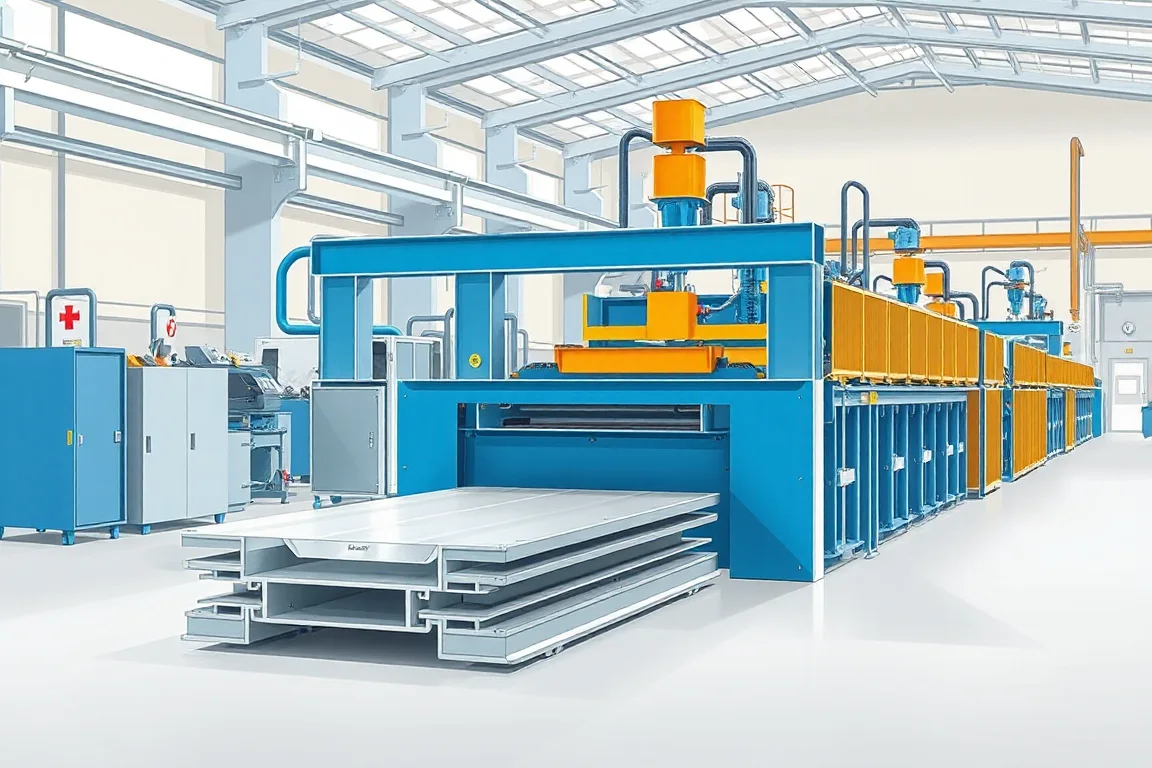
An EPS sandwich panel production line is not a single machine but a configured sequence that turns coil or sheet facings and expanded polystyrene core material into a finished building panel with a defined joint. The line must be specified around the panel drawing: width, facing profile, joint design, core type, finished thickness and the performance evidence the completed assembly is expected to support. This article explains how the finished profile is defined, how the production route is structured, where tooling choices matter, which operations sit outside the line, and how to assess changeovers and accepted output without relying on a supplier's headline speed.
What the finished EPS panel actually is
The finished product is a composite panel: two metal facings separated by an EPS core, bonded so the facings and core act together in handling and service. The visible geometry is set by the facing profile — the shape rolled or formed into the metal — and the joint design that lets adjacent panels engage. Common joint families include tongue-and-groove, concealed-fix and overlapping arrangements, but the exact geometry must come from the buyer's drawing or the supplier's confirmed profile set. The core establishes thickness and contributes insulation and stiffness; the facings carry bending and surface requirements. The interface between core and facing is a bonded joint, and its quality is a production variable, not a given.
A production line can only reproduce a panel that has been defined as a drawing. If the drawing is incomplete — for example, if the joint is described only as 'standard' — the line builder must guess, and the resulting panel may not fit the intended fixing system. The finished profile should therefore be fixed before equipment selection, including the exact panel width, the joint cross-section, the finished thickness and the expected facing material grade.
Drawing and material inputs the line must receive
The line specification begins with inputs that are often treated as commercial details rather than engineering data. These include the facing material specification — metal type, base-metal thickness and coating, if any — and the EPS core specification, such as density or grade. The process also needs to know whether the core arrives as purchased board or is produced from bead. That choice changes the upstream equipment and the storage and handling provisions. Adhesive or bonding system selection belongs in the process specification, along with the conditions under which it is applied and cured. Chemical processing of reactive systems requires specialist safety controls and should not be treated as a generic add-on.
Material storage conditions can influence bond performance and dimensional stability. A line that is configured around one set of inputs may behave differently if the facing thickness changes or the core surface is not as expected. The buyer should therefore state the intended product range, not only the flagship panel, and confirm which variations the line must support. For EPS specifically, the core is typically supplied as pre-expanded board, so the line's job is usually to feed, align and bond rather than to expand beads on the same machine.
Production route: from facing to cutoff
A representative route for an EPS sandwich panel line runs: facing preparation and forming, core preparation or feeding, bonding or pressing, curing, and cutoff. Each stage has a distinct purpose. Facing preparation may include uncoiling, levelling, cleaning or treating the surface so the adhesive can develop a reliable bond. Forming rolls the facing into the required profile, including the joint geometry. Core preparation, where board is used, involves feeding and aligning boards to the facing; where the core is produced inline, it involves different equipment and controls. Bonding and pressing bring the layers together under controlled pressure and time so the adhesive wets and holds. Curing allows the bond to develop enough strength for handling and cutting. Cutoff produces the finished length, and the method must suit the profile — cutting through a formed joint is different from cutting a flat sheet.
The sequence matters because curing or bonding requirements can set the achievable production rate. A fast facing former does not compensate for a press or curing section that cannot keep pace. When comparing proposals, ask how the line behaves between stages: where panels accumulate, how they are transferred, and how the cutoff is synchronized with the forming and pressing sections. The route should be described as a process flow with the actual profile and material, not as a list of stand-alone machines.
Tooling alternatives: rolls, dies and cutoff
For a given profile, the forming tooling can take different forms. Roll forming is common for continuous production; it uses a series of rolls that progressively bend the metal. The number of stations and the roll design depend on the profile complexity and material. Alternative forming methods may be used for simpler or shorter runs, but they change the line's flexibility and the surface quality that can be expected. The joint shape may be formed into the facing or created by separate edge pieces; each approach affects tooling cost, changeover time and the precision of the joint fit.
Cutoff tooling is another decision point. A shear or saw that suits a flat panel may not suit a formed joint without deformation. The buyer should confirm that the cutoff supports the profile, the required cut lengths and the end quality needed for the next operation. If the joint must be cut cleanly for a gasket or a concealed fixing, the cutoff method and its support tooling matter. Tooling is profile-specific; a line built for one joint design may not produce another without new rolls or dies. This is a normal constraint, not a defect, but it should be planned rather than discovered at changeover.
Operations that are separate from the line
An EPS sandwich panel production line does not necessarily deliver a finished, installable panel. Several operations sit outside its scope and are often omitted from quotations. These can include trimming, end sealing, gasket or sealant application, protective film, stacking or packaging, and any secondary machining such as notching or hole punching. Core board production is a separate activity if the core is purchased rather than made inline. Adhesive or chemical handling, extraction and safety equipment may be included or excluded depending on the supplier's scope. Utilities and site works are separate. The buyer should compare the written equipment scope against all operations needed for the finished part and identify what the line does not do.
Thermal or fire classifications concern a verified panel assembly, not a label on the production line. A line may be capable of producing a panel that passes a given test, but the classification belongs to the tested assembly, including facings, core and joint details. Keep that distinction when reviewing performance claims.
Changeovers and production flexibility
Changeover is the transition between products: a different panel thickness, joint type, facing material or length. On an EPS sandwich panel line, changeover may involve adjusting the core feed, repositioning forming rolls, changing cutoff settings and revising adhesive application. The effort depends on how the line is designed: some adjustments are manual and some are motorized, and the difference shows up in setup time and scrap. A line that is intended to run one product can be simpler and less expensive; a line expected to switch frequently needs deliberate changeover provisions. Ask for the changeover steps to be recorded and the setup scrap to be measured with the actual profile, not with an easier demonstration substitute. The objective is not the fastest changeover in isolation but the one that preserves joint fit and bond quality after the switch.
Inspection and accepted output
Inspection should follow an agreed test plan. Start with first-off pieces: check facing geometry, joint fit, bond quality and the relevant core properties. Then take a representative sample from steady production after the process has stabilized. Visual checks of the joint and facing surface are useful, but bond quality needs a defined method — for example, a peel or pull test on a sample — and acceptance criteria should be written before the run. Length and squareness should be checked against the drawing. Core properties such as density or thickness should be verified as they affect the composite. The purpose is to confirm that the line produces accepted panels, not merely panels.
Production targets should be defined as accepted output per shift with the actual profile and material. This accounts for changeover, setup scrap, curing time and any secondary operations. Comparing only the speed of the facing former can be misleading because the line's throughput is set by its slowest necessary stage. A rate without a quality definition is not a production rate.
How to compare equipment alternatives
When comparing EPS sandwich panel production line proposals, look beyond the machine list. Compare how each proposal handles the joint, the core feed, the bonding method and the cutoff, and how these choices affect changeover and accepted output. Continuous pressing, discontinuous pressing and core-board lamination are different layouts with different implications for curing and length control. A continuous line may suit long runs of one profile; a discontinuous layout may suit heavier panels or different core types. Confirm whether the core is fed as purchased board or produced inline, because that changes the upstream scope. Compare quotations on the same basis: included utilities, chemical handling, extraction, cutting, inspection equipment and downstream operations. Also compare the evidence each supplier offers for the profile and material you intend to run — a demonstration on a different profile or an easier material does not prove the line will meet your requirements.
Practical checklist before approving a line
- Fix the panel drawing: width, facing profile, joint design, core type and finished thickness.
- State the product range the line must support, not only the flagship panel.
- Confirm whether core boards are purchased or produced inline.
- Verify the production route stage by stage, including curing and cutoff.
- Check that cutoff tooling suits the formed joint and required cut lengths.
- Identify operations outside the line: sealing, gaskets, packing, secondary machining.
- Record changeover steps and expected setup scrap with the actual profile.
- Agree the inspection plan, including first-off and steady-production samples.
- Define accepted output per shift with the actual profile and material.
- Confirm the electrical supply requirements from a confirmed equipment schedule.
- Compare the written scope against all secondary operations needed for a finished part.
FAQ: EPS sandwich panel production lines
What profile details must be fixed before choosing a line?
Fix the panel width, facing profile, joint design, core type and finished thickness. Also state the facing material grade and any coating, and whether the core is purchased board or produced inline. These details determine the forming rolls, core feed, bonding method and cutoff tooling. Without them, the line cannot be configured to reproduce the intended panel reliably.
Is the EPS core made on the line or bought separately?
Both arrangements exist. Many EPS sandwich panel lines are designed to feed purchased EPS board, aligning and bonding it between facings. Inline core production is a separate process with its own equipment and controls. The choice affects upstream scope, storage and handling, so it should be decided before the line specification is finalized.
How should bond quality be checked?
Use a defined test method agreed before production. A visual check of the joint and facing surfaces is useful, but bond strength is usually assessed by a peel or pull test on a sample. The acceptance criteria should be written in the test plan, and samples should come from first-off pieces and from steady production after the process stabilizes.
What limits the achievable production rate?
The slowest necessary stage usually limits the line, and curing or bonding requirements often set that limit. A fast facing former does not compensate for a press or curing section that cannot keep pace. Define the target as accepted panels per shift with the actual profile and material, including changeover and setup scrap, rather than as a single machine speed.
Can one line make different joint designs?
Typically, forming rolls and cutoff tooling are profile-specific. Changing the joint design may require new rolls or dies and revised cutoff support. A line can be designed for changeover between some profiles, but the feasible range should be confirmed against the drawing and the changeover provisions. Do not assume that one line will make any joint without tooling changes.
What performance evidence belongs to the panel, not the line?
Thermal and fire classifications belong to a verified panel assembly, including facings, core and joint details. A production line may be capable of making a panel that passes a given test, but the classification is not a property of the line itself. Keep that distinction when reviewing claims and when specifying the test plan for the finished product.

Continue your research
- Sandwich Panel Production Lines
- Rockwool Sandwich Panel Production Line
- PU Sandwich Panel Production Line
- EPS Wall Sandwich Panel Production Line
- EPS Roof Sandwich Panel Production Line
- Rockwool Wall Sandwich Panel Production Line
- How Sandwich panel production line Works
- How To Choose a Sandwich panel production line
- Sandwich panel production line Price: What Affects the Cost?
Configuration & specification inputs
Match the configuration to your section drawing, material and production requirements.
| Parameter | Requirement / confirmation needed |
|---|---|
| Profile geometry | An EPS sandwich-panel line combines metal facings with a specified EPS core and bonding process. Confirm whether core boards are fed as purchased material and how joint formation and bond inspection are performed. |
| Material | Specified metal facings with EPS, mineral wool or formulated foam core as applicable |
| Thickness & grade | Buyer to specify base-metal thickness and grade; operating range requires supplier verification. |
| Process route | Facing preparation/forming → core preparation or dispensing → bonding/pressing → curing → cutoff |
| Cutting | Confirm profile-supported cutoff, cut lengths, end quality and any secondary operations. |
| Output | Define accepted output per shift with the actual profile and material. |
| Electrical supply | Buyer to state voltage / frequency / phase. Installed power requires a confirmed equipment schedule. |
| Acceptance | Include core handling, facings, joining, curing where required, cutoff and stacking. Identify excluded utilities or downstream work. Compare accepted panels over a representative product mix rather than only the speed of a facing former. |