
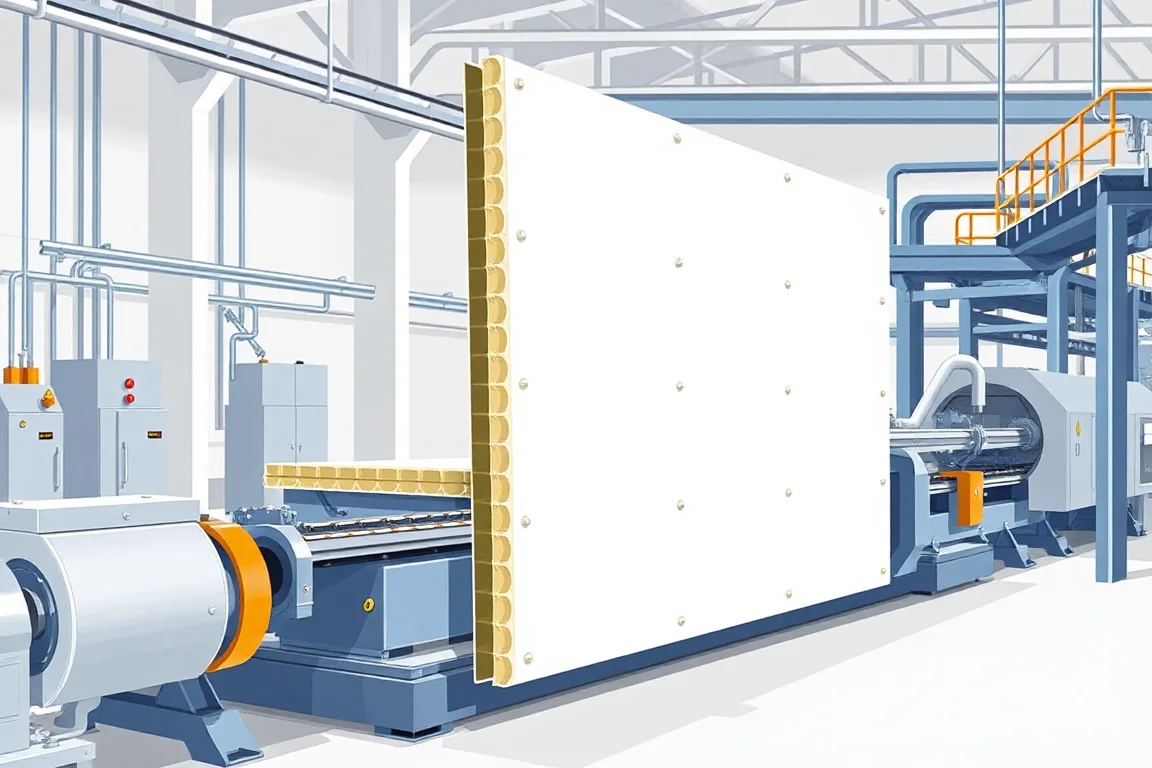
The term PU PIR sandwich panel production line covers equipment for making insulated panels in which the core is a reactive polyurethane-family foam. A PU (polyurethane) foam system and a PIR (polyisocyanurate) foam system are related but not interchangeable: they use different formulations, react differently, and call for different metering, temperature and curing conditions. A production line built for one does not automatically suit the other without reviewing the chemical system, the dispensing equipment, the press or laminator, and the extraction and safety provisions. This article explains the component interfaces, shows how the main production routes differ, and sets out inspection points that belong to the panel rather than to a label on the machine.
What a PU PIR line actually produces
The finished article is a sandwich panel: two metal facings separated by a rigid, insulating foam core, bonded so the facings and core act together. The joint design at the panel edge, the facing profile and the panel thickness are set by the building application. A wall panel, roof panel, cold-store panel or door panel each impose different demands on flatness, edge straightness and joint fit. Because of that, the line specification should start from the panel drawing and the intended use, and only then move to machine layout. PU PIR foam is not the same as expanded polystyrene beads or mineral wool; those cores have their own production routes and cannot be run on a reactive-foam line as if the process were the same.
Facing preparation and forming as a separate scope
The metal facings are uncoiled, levelled and, where required, roll-formed to the panel's edge profile. Decorative or protective coatings may need a film or a primer, and the facing surface condition affects adhesion. This stage is often sold or scoped as a distinct module: decoiler, leveller, roll-former, and sometimes a pre-heater. It should be treated as its own acceptance boundary. Check that the formed profile matches the joint drawing, that the facing is not marked or oiled in a way that harms bonding, and that the profile is consistent along the coil. A line can produce excellent foam and still deliver a poor panel if the facing geometry is wrong, so facing inspection is not a formality.
Core preparation and reactive dispensing
In a PU PIR line the core is created by dispensing or injecting the reactive foam system onto a facing or into a cavity, then letting it expand and cure. The chemical system is supplied with its own processing window: component temperatures, mixing ratio, pour pattern and throughput matter. Metering and mixing equipment, temperature control of the tanks and lines, and the dispensing head or traverse belong to this module, and so do the extraction and safe-handling provisions that the chemical system requires. These are specialist design matters. The formulation supplier's instructions and local safety requirements govern; the production line supplier and the chemical supplier need to agree the interface. The names PU and PIR describe chemistry, not a fire classification, and the choice of chemistry on its own does not establish any particular reaction-to-fire result for a finished panel.
Bonding, pressing and curing: three different layouts
The foam must bond to both facings and reach the intended density and cell structure while the panel is held to thickness. There are three broad approaches, and they are genuinely different production routes rather than options on one machine:
- Continuous double-belt pressing. The facings and dispensed foam travel continuously through a heated double-belt press that controls thickness while the foam rises and cures. Suited to long runs of a stable profile.
- Discontinuous pressing. Facings are placed in a press, foam is dispensed, and the panel cures under pressure in a batch. More flexible across thicknesses and short runs, but with a different rhythm and handling pattern.
- Core-board lamination. Foam is produced as a separate board, then bonded to facings with adhesive in a laminating step. This separates foam manufacture from panel assembly and changes which equipment is needed.
The route determines the achievable production rate far more than the speed of the facing roll-former. Curing and bonding time set the ceiling, so output figures should be discussed as accepted panels per shift for the actual profile and material, not as a raw line speed.
Why cutting and end quality are their own specification
After curing, the panel is cut to length. The cutoff must suit the profile and the core: it should produce clean ends, without crushing the foam or deforming the facing, and it should hold the cut length the drawing requires. Where the joint needs machining, rebating or edge trimming, those are secondary operations that belong in the line scope or in a clearly defined separate scope. End quality drives joint fit and sealing on site, so it deserves its own acceptance check rather than being treated as a by-product of the main process.
Assembly boundaries versus component production
It is useful to draw a line between producing components and assembling a deliverable panel. A supplier may offer only the facing former, or only the dispensing and press module, or a combined line. Certification, thermal performance evidence and fire classifications belong to the verified panel assembly, not to a module or a chemistry name. When comparing quotations, map each item to a stage: facing preparation, core preparation, bonding and pressing, curing, cutoff, and any secondary operation. Then mark which stages are in scope and which are not. This prevents a low quotation that omits extraction, chemical handling, or quality-control equipment from being compared unfairly against a complete one.
How to compare continuous, discontinuous and lamination routes
Continuous pressing rewards a stable, repeating profile and long runs, and it tends to integrate the process into one controlled line. Discontinuous pressing accepts more variation in thickness and shorter batches, but depends on disciplined manual handling and batch records. Core-board lamination separates foam production from panel bonding; it can simplify foam control but adds an adhesive step and its own bonding controls. None is universally better. The right choice follows from the range of panel types, the run lengths, the thickness spread, and the performance evidence the market requires. Writing those inputs down before comparing layouts is more useful than comparing headline speeds.
Utilities, safe handling and site provisions
Items that are easy to underestimate include the electrical supply, compressed air, extraction and ventilation, chemical storage and temperature control, and cleaning arrangements between runs. The buyer should state voltage, frequency and phase, and the installed power should come from a confirmed equipment schedule rather than an assumption. Reactive foam systems require specialist design and safe-handling provisions; this is a matter for the chemical system supplier and the equipment designer together, and it should be visible in the scope of supply rather than assumed. Where the panel is intended for a regulated application, the evidence route for that application should be agreed before the line is ordered, because it affects sampling and documentation.
Application-specific inspection and acceptance
Acceptance should be built around the defined panel, not around the machine. A practical plan includes:
- First-off inspection against the drawing: panel width, thickness and edge profile.
- Joint fit, checked with the mating part or a gauge representing it.
- Bond quality between foam and facings, assessed under the agreed method.
- Core properties relevant to the application, tested to an agreed plan.
- A steady-production sample taken after the process has stabilised.
- Cut length and end quality, including any secondary machining.
Run the agreed facing material and profile during acceptance, not an easier substitute. Record changeover steps, setup scrap, and the time taken for punching or unloading, because these shape real output. Where thermal or fire evidence is needed, it should come from a verified assembly tested for that purpose; no label on the line or chemistry term substitutes for it.
Practical project checklist
- Panel drawing, joint design, thickness range and intended application written down.
- Facing material, grade and coating confirmed, with base-metal thickness to be verified by the supplier.
- Foam system identified as PU or PIR, with the chemical supplier's processing window available.
- Production route chosen: continuous press, discontinuous press or core-board lamination.
- Scope mapped stage by stage, including extraction, chemical handling and quality-control equipment.
- Electrical supply stated, with installed power taken from an equipment schedule.
- Acceptance plan agreed for facing geometry, joint fit, bond quality and relevant core properties, using the real profile and material.
- Changeover, setup scrap and secondary operations accounted for in output expectations.
Frequently asked questions
Can one line run both PU and PIR foam systems?
The two systems react and cure differently and may need different component temperatures, ratios and dispensing arrangements. Whether a specific line can run both depends on the metering and temperature-control capability and on the chemical supplier's guidance. Treat it as a question to answer from the foam system requirements, not as an assumption based on the machine name.
Is the facing roll-former the main determinant of output?
Usually not. Curing and bonding govern how quickly panels can be produced and handled, so accepted panels per shift for the real profile and material are a more honest measure. Forming speed only tells you how fast one stage can run in isolation.
How is a PU PIR line different from an EPS or mineral wool line?
EPS panels use pre-expanded bead and a different bonding route; mineral wool panels use a fibre core with its own handling and adhesion requirements. A reactive PU PIR line adds metering, dispensing, temperature control and extraction for the foam system, and it cannot simply substitute a different core without changing the process.
Where do fire and thermal claims come from?
From testing of a defined, verified panel assembly, including facings, core and joint. Chemistry names such as PIR or PU describe formulation families and do not on their own establish a classification. The required evidence should be agreed with the specification before ordering equipment.
What should be checked before releasing a line from acceptance?
First-off pieces and a stabilised production sample, inspected against the drawing for width, thickness, profile, joint fit and bond quality, with core properties tested to the agreed plan. Changeover records and setup scrap should also be documented, because they affect the usable output the line will deliver.
Can a line be scoped as components only?
Yes. Facing preparation, dispensing, pressing, curing and cutoff can be supplied and accepted as separate modules. If they are split, the interfaces, the transfer of panels between stages, and the responsibility for the finished panel's performance need to be assigned explicitly in the project documents.

Continue your research
- Sandwich Panel Production Lines
- EPS Sandwich Panel Production Line
- Rockwool Sandwich Panel Production Line
- EPS Wall Sandwich Panel Production Line
- EPS Roof Sandwich Panel Production Line
- Rockwool Wall Sandwich Panel Production Line
- How Sandwich panel production line Works
- How To Choose a Sandwich panel production line
- Sandwich panel production line Price: What Affects the Cost?
Configuration & specification inputs
Match the configuration to your section drawing, material and production requirements.
| Parameter | Requirement / confirmation needed |
|---|---|
| Profile geometry | PU and PIR refer to different foam-system formulations and processing requirements. Chemical metering, curing and safety controls require specialist design; the labels do not establish a fire classification. |
| Material | Specified metal facings with EPS, mineral wool or formulated foam core as applicable |
| Thickness & grade | Buyer to specify base-metal thickness and grade; operating range requires supplier verification. |
| Process route | Facing preparation/forming → core preparation or dispensing → bonding/pressing → curing → cutoff |
| Cutting | Confirm profile-supported cutoff, cut lengths, end quality and any secondary operations. |
| Output | Define accepted output per shift with the actual profile and material. |
| Electrical supply | Buyer to state voltage / frequency / phase. Installed power requires a confirmed equipment schedule. |
| Acceptance | Review material storage, metering, extraction, cleaning and other required provisions with the system suppliers. Establish an acceptance plan for the defined panel. Avoid deriving fire or thermal claims from chemistry terminology alone. |