
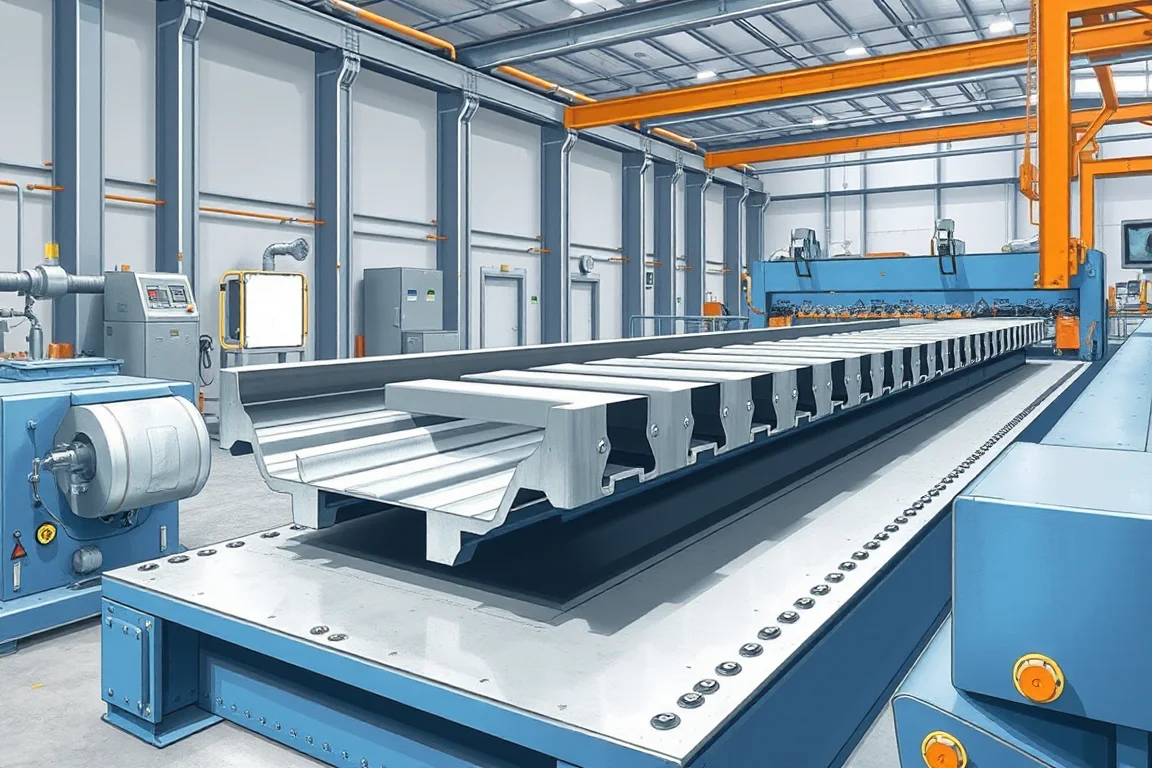
A dovetail metal deck roll forming machine produces a specified re-entrant deck section whose rib geometry includes a narrower opening and wider region beneath it. That undercut shape distinguishes dovetail deck from ordinary open trapezoidal ribs. The complete section, side laps and material need to be defined before tools or production rates are discussed.
Dovetail deck can belong to different engineered floor or roof systems, sometimes with additional underside or attachment functions. Those applications must follow the actual product design. A recognizable dovetail shape alone does not establish structural capacity, fire classification or compatibility with a hanging accessory.
Which re-entrant dimensions control the product?
Show rib depth, opening width, wider internal region, web angles, flats and bend radii. Identify both terminal edges and the assembled cover. The drawing should provide measurement references for features that cannot be checked conveniently with a simple outside-width reading.
Include the actual intended application and product revision. If a proprietary or established profile is being matched, use the approved geometry and rights or supply arrangements appropriate to that product rather than copying a name or appearance.
Why does re-entrant geometry change forming?
The tools must develop the section progressively while maintaining access as the opening becomes narrower. The final contour depends on the sequence, material and tool contact. It is not equivalent to folding an open trapezoid and merely squeezing the top at the end.
Ask the supplier to review the actual section and material combinations. Any special feature or embossment must remain correct through the complete forming route. Trial the final geometry rather than approving intermediate shapes.
What should side-lap requirements include?
Provide loose-edge and joined-edge drawings, the effective-cover reference and any required joining method. Dovetail rib geometry does not determine the terminal lap automatically. The edge may have its own engineered form and acceptance requirements.
- Define both terminal profiles separately.
- Show assembly direction and contact areas.
- Identify required joining tools or mating samples.
- Check end condition near the lap.
- Retain a multi-sheet assembly reference.
Assemble trial sheets without forcing them into an artificial position. Unexpected resistance or gaps should be recorded and investigated.
How should floor-system features be handled?
If the deck is intended for a composite floor system, use the approved rib and feature design and the relevant qualification process. Do not assume that the undercut shape alone establishes all composite behavior for every material and slab arrangement.
Similarly, underside attachments need their own compatible design. A hanging accessory should not be selected simply because it appears to fit the dovetail opening. The manufacturing specification should reproduce the approved interface and leave load suitability to the complete designed system.
Which material combinations need trials?
Pair steel grade, base-metal thickness, coating and strip width with each target profile. Tight or re-entrant bends make it especially important to inspect the actual material after the full forming sequence. Keep the coil identity with the results.
Check coating condition and local shape around the narrow opening and lower corners. Choose normal and demanding combinations from the proposed matrix. Independent maximum statements should not be combined into an untested envelope.
What should cutoff and discharge preserve?
The cutting arrangement must suit the re-entrant section and leave acceptable ribs and laps near the ends. Inspect for local crushing, opening changes and burr condition. Compare end measurements with an interior section to separate cutoff effects from general forming deviations.
Review how the sheet is supported during transfer and stacking. The package should not deform the opening or terminal edges. Where the underside is visible in the intended product, appearance after handling also needs an agreed reference.
Can a standard deck line be adapted?
Only after reviewing the complete re-entrant geometry, material and equipment. Tool access, forming progression, cutoff and handling may differ substantially from an open-rib profile. Request a defined conversion scope rather than assuming a final-roll change is sufficient.
If multiple dovetail variants are planned, compare their openings, depths, laps and feature patterns. Demonstrate first-good-sheet recovery after a change with both dimensional and joined-lap checks.
What should acceptance document?
- The approved re-entrant profile and material combination.
- Opening, internal rib geometry, depth and cover.
- Required embossments or other features.
- Cut-end condition and joined side laps.
- Any specified accessory-interface fit.
- Condition after normal stacking.
- Accepted output and changeover results.
Keep manufacturing evidence separate from structural and assembly-level qualification. The line trial proves that the defined steel component is reproduced, not that every use of a dovetail-shaped deck is approved.
Frequently asked questions
Is dovetail deck just a trapezoidal profile?
No. Its re-entrant geometry changes the opening and internal rib relationship. That affects forming, inspection and potential interfaces.
Does the shape automatically make it composite deck?
No. Composite use depends on the specified product and deck-slab system with its engineering and qualification. Shape alone is not sufficient.
Can any hanger fit the underside groove?
Use only the accessory and interface defined for the selected system. A visual fit does not establish load suitability or compatibility.
Why inspect the opening after stacking?
Local pressure can alter the re-entrant shape or lap. The delivered sheet should retain the geometry approved at the machine exit.
What is the best quotation package?
Provide the full re-entrant drawing, material matrix, side laps, features, lengths and intended application. Include accessory references and other variants only where they are genuinely part of the required product.
Control the hidden geometry as well as the visible ribs
Dovetail-deck manufacture depends on accurate re-entrant features and compatible side laps. A clear drawing and complete-route trial make those requirements measurable and keep the equipment scope aligned with the engineered product.

Continue your research
- Floor Deck Roll Forming Machines
- Floor Deck Roll Forming Machine
- Roof Deck Roll Forming Machine
- B Deck Roll Forming Machine
- N Deck Roll Forming Machine
- H Deck Roll Forming Machine
- How Floor deck roll forming machine Works
- How To Choose a Floor deck roll forming machine
- Floor deck roll forming machine Price: What Affects the Cost?
Configuration & specification inputs
Match the configuration to your section drawing, material and production requirements.
| Parameter | Requirement / confirmation needed |
|---|---|
| Profile geometry | Approved dovetail re-entrant rib with controlled opening, internal width, depth and terminal laps. |
| Material | Specified deck steel grade and coating for the actual engineered dovetail product. |
| Thickness & grade | Material-thickness combinations assessed through re-entrant forming and required features. |
| Process route | Coil preparation, controlled progressive re-entrant forming, specified features, supported cutting and stacking. |
| Cutting | Lengths and end condition preserving the narrow opening, ribs and lap geometry. |
| Output | Accepted dovetail sheets after internal-geometry, joined-lap and handling checks. |
| Electrical supply | Utilities for specialized profile forming, feature operations, cutoff and discharge. |
| Acceptance | Opening and internal contour, depth, cover, features, accessory interface where specified and package condition. |