
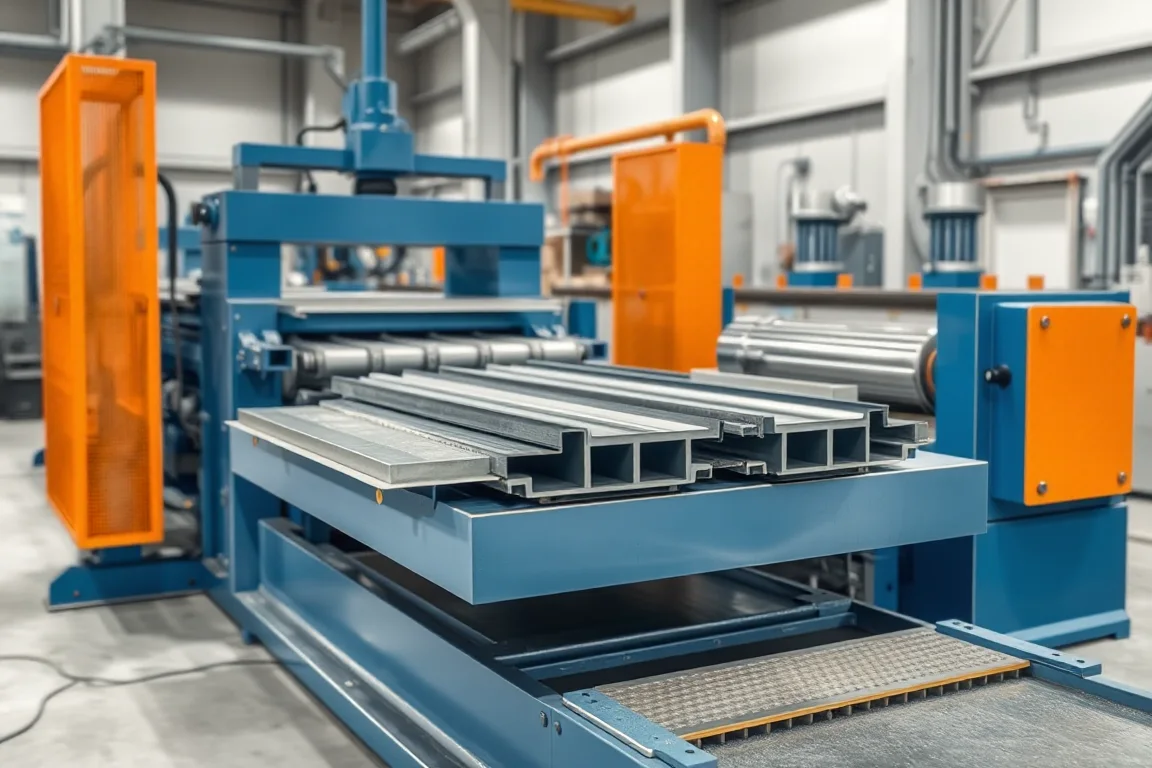
A scaffold toe board is an edge-retention component. It sits at the perimeter of a working platform and keeps loose objects from sliding or being kicked off the edge. It is not a load-bearing walking plank, and its production route reflects that different duty. This article explains what a scaffold toe board roll forming machine does, where roll forming fits, where it does not, and how to specify a line that delivers finished, inspected toe boards rather than a stack of formed strips.
What a Toe Board Actually Does on a Scaffold
A toe board forms a barrier at the platform edge. Its job is to retain objects, not to carry foot traffic. That single functional distinction drives every downstream decision about the profile. A walking plank must resist bending under people, tools and materials, and it must provide a walkable surface with friction characteristics suited to the application. A toe board must stand up at the edge, stay attached under expected contact, and resist being knocked out of position.
Because of this, the profile geometry of a toe board is dominated by retention, attachment and edge treatment rather than by span stiffness. The attachment method — hooks, brackets, clips or fasteners that interface with the platform or frame — is as important as the formed shape itself. A toe board that forms cleanly but does not attach positively to the intended platform system is not a finished product.
From Scaffold Drawing to Component Specification
The starting point should be the approved scaffold-system drawing, not a generic machine category. The drawing defines the platform edge, the available attachment features, the required overall height and the interfaces with standards, ledgers or frames. From that, the toe board profile is derived: material grade and base-metal thickness, the upstand or channel shape, the anti-slip or stiffening pattern where specified, and the end configuration.
The profile drawing should state the finished component requirements, including any coating or finish and the joining method. Where galvanizing or another coating follows welding, the process plan must account for the full finished component, not just the formed strip. The finished part definition should distinguish the formed section from the joined assembly, because inspection and acceptance apply to the complete item.
Where Roll Forming Fits — and Where It Does Not
Roll forming is well suited to long, uniform sheet sections produced in continuous lengths. A toe board profile that consists of a folded or ribbed strip, an upstand or a simple channel can be produced efficiently by passing coil or strip through a series of contoured rolls. Punching or embossing for anti-slip texture and attachment features can be integrated into the line, and cutoff can produce fixed lengths.
Roll forming is not automatically the right process for every scaffold component. A conventional tubular ledger or standard, for example, is more likely produced by tube making with welded end fittings. Those neighbouring categories — ringlock and cuplock ledger lines, or frame profile lines — address different components with different interfaces. A toe board line should not be presented as a complete scaffold manufacturing plant; it produces one family of edge-retention components, and joining, finishing and inspection remain separate operations.
Profile Interfaces: Ribs, Patterns, Hooks and End Treatments
Toe board profiles commonly incorporate several interacting features. Ribs or swages stiffen the section and can help locate it against the platform. An anti-slip pattern, where specified, is usually produced by punching or embossing, and its position relative to the forming sequence matters because deforming a formed profile can distort the section. Hooks, end plates, brackets and support interfaces are attachment features that may be formed, punched, or manufactured separately and joined afterwards.
Each interface has to be considered as a system. The hook or bracket that engages the scaffold platform must match the platform feature it engages with. The end treatment — whether a folded return, a cap, a punched hole pattern or a welded plate — affects both handling safety and attachment. A formed sample that looks correct may still fail to attach properly if the end treatment is not controlled.
Production Route: Forming, Cutoff and Joining Are Separate Boundaries
A practical production route for a toe board component is: punch or emboss, form the plank or channel section, cut to length, fit and join the end attachments, then inspect. These are genuinely separate production stages with different equipment, different skill requirements and different quality risks. Roll forming covers the forming stage; it does not perform joining or final inspection.
The cutoff step deserves specific attention. The cutoff method must be compatible with the formed profile so that it does not crush or twist the section. Cut length control affects the finished component, and the quality of the cut end affects how easily end fittings can be joined and how cleanly the finished part presents at the platform edge. Where secondary operations such as hole punching, notching or end forming are needed, they should be listed explicitly in the equipment scope.
Material and Finish Decisions Belong Together
The toe board material is typically a specified structural steel, but the grade, base-metal thickness and finish need to be defined as a set. The base-metal thickness and grade are buyer-specified inputs; the operating range a given machine can handle requires supplier verification and should not be assumed from a generic description. Coating choice interacts with the joining method: if the finished part is to be galvanized after welding, the welding procedure, the fit-up and the drain path all have to suit that sequence.
It is rarely useful to treat material, thickness and finish as independent choices. A change in one often forces a change in another, and the production route must be planned around the finished component requirement, not the formed strip alone.
Electrical Supply and Installed Power
The buyer should state the required voltage, frequency and phase for the destination site. Installed power is a derived figure that comes from a confirmed equipment schedule covering the forming line, any integrated punching or embossing units, the cutoff, and any separate joining equipment. It should not be estimated from a category description. A confirmed schedule is also the basis for planning site distribution and any local supply works.
Output Planning Around the Real Constraint
Output for a toe board line should be defined as accepted finished pieces per shift, counted after inspection and including end attachments. A high forming speed does not help if joining and inspection are the production constraint. In practice, the joining of hooks or end plates, the handling of long components and the inspection of walking surfaces and attachment interfaces often determine real throughput more than the roll former does.
When comparing options, record changeover steps, setup scrap, punching time and unloading time. These are the practical elements that determine how well a line matches a production plan. A line that forms quickly but creates a bottleneck at the joining bench has not solved the production problem.
Inspection and Acceptance of Finished Toe Boards
Acceptance should be applied to the finished component and, where relevant, to its behaviour in the system. Inspectors should examine the walking surface or exposure face, the ribs and stiffening features, and the attachment interfaces. Ends should be checked after cutting and after any fastening preparation, because cut quality and hole position affect fit-up and attachment.
Load and slip requirements apply to the finished component and the platform system. They cannot be inferred from a formed sample alone or from profile shape. A sample trial with the intended deck and retainers is more informative than a dimensional check in isolation. Keep platform-system performance requirements separate from any claim based solely on the formed profile.
What to Compare When Evaluating Production Options
At a basic level, the alternatives are: a dedicated roll forming line with integrated punching and cutoff, a roll forming line plus separate joining equipment, or a different primary process such as press braking or tube-based fabrication where the component shape suits it. Each has different implications for setup, changeover, distortion control and the number of times the part is handled.
An integrated line can reduce handling between forming and cutoff, but the joining of hooks and end plates usually remains a separate operation regardless. A line that claims to deliver finished toe boards should be assessed on whether the written equipment scope includes all secondary operations needed for a finished part: end fitting equipment, joining fixtures, handling provisions and verification requirements. Comparing only the forming section misses the stages that most often determine cost and output.
Practical Checklist Before Approving a Production Line
- Confirm the approved scaffold-system drawing and the interfaces the toe board must attach to.
- Define the profile: upstand or channel shape, ribs, anti-slip pattern and end treatment.
- State material grade, base-metal thickness and required finish as a single set, and ask the supplier to confirm the achievable operating range.
- Confirm the process route and where punching or embossing occurs relative to forming.
- Confirm the cutoff method is profile-compatible and that cut length and end quality are controlled.
- List all end fittings, hooks, brackets and joining operations, and identify which equipment performs each one.
- State voltage, frequency and phase, and request a confirmed equipment schedule for installed power.
- Define output as accepted finished pieces per shift, counted after joining and inspection.
- Run the agreed material and profile, not an easier demonstration substitute.
- Inspect first-off pieces and a representative steady-production sample with the agreed gauges.
- Record changeover steps, setup scrap, joining time and unloading time.
- Trial finished toe boards with the intended deck and retainers before accepting the line.
Frequently Asked Questions
Is a scaffold toe board roll forming machine the same as a scaffold plank line?
No. A plank is a load-bearing walking surface; a toe board is an edge-retention component. The profile, attachment interfaces and inspection criteria differ. A roll forming line configured for planks is not automatically suitable for toe boards, and vice versa, because the required section geometry, stiffening and end treatments are different.
Can one machine produce both toe boards and other scaffold profiles?
Only if the roll set, punching and cutoff are compatible with each profile, and that is a profile-by-profile question rather than a general capability. Changing between significantly different sections usually requires roll changes, setup work and re-verification. Treat each profile as its own production case and confirm compatibility rather than assuming a shared line covers everything.
Why is the joining step treated separately from roll forming?
Roll forming shapes a continuous strip. Joining hooks, end plates or brackets typically requires separate equipment, fixtures and skilled labour. Because joining often constrains throughput more than forming does, and because it affects the final attachment behaviour, it should be planned as its own stage with its own acceptance checks.
How should the finished toe board be inspected?
Inspect the exposure face, ribs and attachment interfaces, and check ends after cutting and fastening preparation. Then trial the finished toe board with the intended deck and retainers. Load and slip behaviour belongs to the finished component and system, so it cannot be judged from a formed sample alone or from profile shape.
What should be included in an enquiry for a toe board production line?
Include the approved drawing or a clear profile definition, material grade and thickness, required finish and joining method, cut lengths, end treatment, electrical supply, accepted finished output per shift, and the intended acceptance checks. Also state which joining operations are expected to be in scope, so the equipment schedule can be assessed against the finished component, not just the formed strip.
How is output measured for a toe board line?
Count accepted finished pieces per shift after joining and inspection, not formed strip metres. Defining output this way exposes the real constraint — whether it is forming speed, joining time, handling or inspection — and gives a more honest basis for comparing options.

Continue your research
- Scaffolding Roll Forming Machines
- Scaffold Plank Roll Forming Machine
- Scaffolding Deck Roll Forming Machine
- Ringlock Scaffold Ledger Roll Forming Machine
- Cuplock Scaffold Ledger Roll Forming Machine
- Scaffold Frame Profile Roll Forming Machine
- How Scaffolding roll forming machine Works
- How To Choose a Scaffolding roll forming machine
- Scaffolding roll forming machine Price: What Affects the Cost?
Configuration & specification inputs
Match the configuration to your section drawing, material and production requirements.
| Parameter | Requirement / confirmation needed |
|---|---|
| Profile geometry | A toe board retains objects at a platform edge. Specify its attachment and edge treatment and distinguish it from a load-bearing walking plank. |
| Material | Specified structural steel with the required finish and joining procedure |
| Thickness & grade | Buyer to specify base-metal thickness and grade; operating range requires supplier verification. |
| Process route | Punch/emboss → plank or channel forming → cutoff → end fitting/joining → inspection |
| Cutting | Confirm profile-supported cutoff, cut lengths, end quality and any secondary operations. |
| Output | Define accepted output per shift with the actual profile and material. |
| Electrical supply | Buyer to state voltage / frequency / phase. Installed power requires a confirmed equipment schedule. |
| Acceptance | Trial the finished toe board with the intended deck and retainers. Inspect ends after cutting and fastening preparations. Keep the platform-system requirements separate from a claim based solely on profile shape. |