
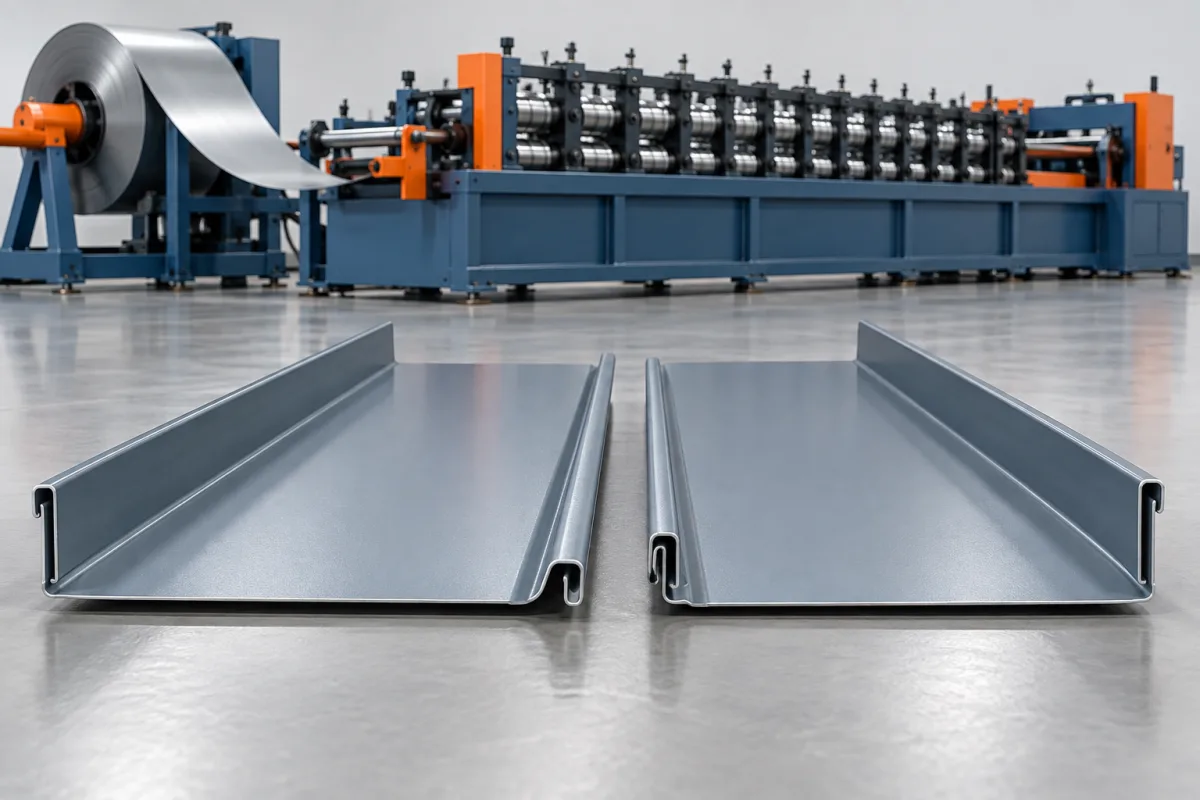
A 1.5 inch mechanical lock standing seam machine forms panels with a nominal 38.1 mm raised seam prepared for mechanical closing. The finished roof joint depends on the two formed edges, the specified clip and the compatible seaming process. A machine enquiry should define all of those elements rather than treating seam height as the complete product.
This profile sits within a wider mechanical-seam family, but shared naming does not make one-inch, one-and-a-half-inch and two-inch sections interchangeable. Each has its own geometry and equipment interfaces. The practical comparison begins with the exact roof-panel system planned for production.
What should be defined before selecting tools?
Show both panel edges before closing and the completed joint after the intended seaming sequence. Include seam-height datums, return dimensions, clip engagement and pan geometry. The drawing should identify any face ribs or striations and the required effective cover.
Where existing seaming equipment will be used, provide its compatibility requirements and representative approved samples. The forming tools should be designed to that interface instead of leaving the installer to discover whether the resulting edge can be closed.
Why is mechanical closing part of machine acceptance?
A loose panel is an intermediate product in this route. Its edge must assemble around the intended clip and pass through the specified closing operation. Measuring only outside height can miss a return or clearance problem that appears during seaming.
Include a closed joint in the trial and inspect its geometry and coating. If the product uses a particular multi-stage closing sequence, that sequence should be represented. Do not approve an alternative improvised fold merely because it looks closed.
How does this profile differ from 38 mm snap lock?
The nominal heights are similar, but the joining methods and edge shapes differ. Snap-lock profiles are designed for their prescribed engagement method, while mechanical-lock profiles are prepared for additional closing. Their clips and cutoff details may differ as well.
Keep separate drawings, programs and sample references for the two families. A production team should not have to identify the correct product from a height measurement alone when the hidden returns determine its function.
What is the production sequence?
Coil entry and guidance establish the strip path. Progressive forming develops the pan and the two mechanical-seam edges. Specified holes or notches are made by the agreed process, and length cutting produces panels for supported takeoff.
The downstream assembly uses the intended clips and compatible closing equipment. Define which operations are included in the machine package and which belong to site installation or another workshop process. This makes the equipment boundary clear without leaving essential interfaces unaddressed.
How should material variants be assessed?
Pair grade or alloy and temper with base-metal thickness, coating and any protective layer. The approved range should be demonstrated through both forming and closing. A material that produces an acceptable open edge may behave differently during the final fold.
Inspect coating at tight bends and the completed seam. Assess pan appearance under agreed support and lighting conditions. Retain material identification and samples so future changes can be reviewed against a stable reference.
What changes when panel width or seam family changes?
Pan-width adjustment within one seam family is different from changing seam height or lock design. Ask for a matrix showing approved width, material and tooling combinations. Include cutoff supports and any feature-making programs in that matrix.
For a profile change, measure recovery through an accepted closed joint. A tool exchange that produces the right loose dimensions but fails the intended seaming process is not a completed production changeover.
How should panel ends and long lengths be handled?
Define any notches or end allowances required by the roof system. Check that the cutoff leaves the raised edges usable and that handling does not bend them before assembly. Long panels need a supported transfer path appropriate to the chosen factory or jobsite arrangement.
Demonstrate representative lengths and inspect the start and finish of the closed seam. The middle of a sample can look satisfactory while an end-preparation issue prevents proper completion of the actual panel.
Which results should the trial record?
- Loose-edge dimensions and pan geometry.
- Clip identity and assembly condition.
- End preparation and cutoff quality.
- Completed seam after the specified closing sequence.
- Coating and visible-face condition.
- First accepted product after required changes.
- Accepted panel output under stated handling conditions.
Record deviations separately from nominal output. Comparing complete accepted products gives a more useful equipment assessment than reporting a high strip speed without the necessary seam and finish checks.
Frequently asked questions
Is 1.5 inch exactly 38 mm?
It equals 38.1 mm. Use the actual profile drawing and tolerance rather than exchanging nominal labels. More importantly, confirm the entire mechanical-lock geometry.
Can a snap-lock seamer close this profile?
Use only closing equipment confirmed for the specified mechanical seam. A similar height or visual fit does not establish the correct forming sequence or final joint.
Are clips included with the roll former?
They are part of the roof-panel system and should be identified separately in scope. Provide the intended clip samples for machine trials even if another supplier manufactures them.
Can the machine make curved panels?
Controlled longitudinal curving requires its own compatible process and specification. A straight-panel forming capability does not automatically include the required radius or curved-joint behavior.
What is a useful quotation package?
Include open and closed seam drawings, clip details, materials, panel widths and lengths, end features and the intended production location. Identify existing seaming equipment if compatibility is required.
Approve the joint as a complete route
The 1.5-inch mechanical-lock decision should connect forming, handling and seam closing. That produces a testable equipment brief and keeps the finished roof-panel connection at the center of acceptance.

Continue your research
- Standing Seam Roll Forming Machines
- Standing Seam Roll Forming Machine
- Snap Lock Standing Seam Machine
- 25mm Snap Lock Standing Seam Machine
- 38mm Snap Lock Standing Seam Machine
- 1 Inch Mechanical Lock Standing Seam Machine
- How Standing seam roll forming machine Works
- How To Choose a Standing seam roll forming machine
- Standing seam roll forming machine Price: What Affects the Cost?
Configuration & specification inputs
Match the configuration to your section drawing, material and production requirements.
| Parameter | Requirement / confirmation needed |
|---|---|
| Profile geometry | Nominal 38.1 mm mechanical seam with approved open edges, clip relationship and final fold. |
| Material | Production-intent grade or alloy, coating and protective layers for the complete forming-and-closing route. |
| Thickness & grade | Reviewed thickness combinations verified in both loose and closed samples. |
| Process route | Guided forming, defined feature operations, supported cutting, attachment assembly and compatible seaming. |
| Cutting | Specified lengths and end details with undamaged mechanical-lock returns. |
| Output | Accepted panel orders including stated changeovers, handling and joint checks. |
| Electrical supply | Site supply and auxiliary requirements for the forming package and separately scoped seaming process. |
| Acceptance | Pan and edges, clip identity, end preparation, completed seam geometry and coating condition. |