
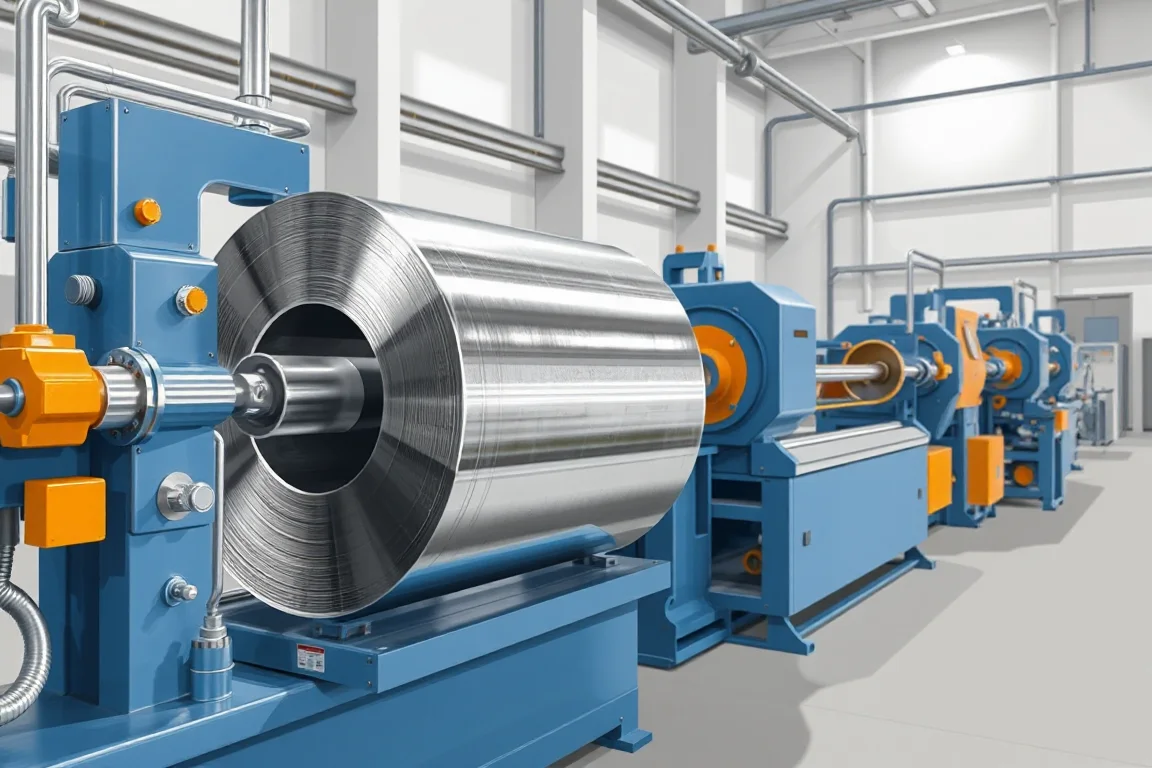
What a narrow strip steel coil slitting line actually produces
A narrow strip steel coil slitting line is a coil processing system arranged to convert a wide master coil into multiple narrower strands, typically recoiled as separate coils or spools. The term narrow here is relative to the incoming coil width and the intended finished strip width; the defining output is not a single slit coil but a set of parallel strips that must maintain width consistency, edge condition and orderly coil build. This application sits between general coil slitting and downstream operations such as tube forming, roll forming, stamping or edge conditioning. It is not a cut-to-length line, although some lines combine slitting and cut-to-length functions; the primary separation method and inspection criteria differ.
The line's purpose is to create value by matching a mill-width coil to a narrower finished width without introducing edge damage, camber or coil build problems that disrupt the next process. Because narrow strips are more sensitive to tension variation and guidance errors, the design of the slitting head, strip separation, tension control and recoiling equipment matters more than raw line speed. The buyer should treat the line as a system: the payoff, slitting, separation, tension and recoiling stages must work together for the specific strip pattern.
Coil and material inputs that define the line's boundaries
Every slitting line is bounded by the coil it can accept and the strip it can produce. The profile requirements should state coil width, thickness, mass, inside and outside diameter, and the required strip or blank. These are not independent: a coil that is wide and heavy may require different payoff and coil car capacity than a narrow, light coil, and the slitting head must be sized for the strip width pattern. Material grade and surface condition also matter. Higher-strength steels increase the force needed to slit and can affect edge quality and knife wear. Surface-sensitive material, such as pre-painted, coated or polished stock, may require special contact surfaces, handling precautions and strip separation methods that avoid scratching.
The thickness field is a buyer-specified input: base-metal thickness and grade must be stated, and the operating range requires supplier verification. No generic range should be assumed. The line's capability envelope is a combination of width, thickness, grade and coil geometry, and each combination can change the achievable strip quality. A line that performs well on one grade and thickness may need different knife setup, tension or recoiling adjustments for another. Buyers should define the production mix and identify which combinations are routine, occasional and never intended.
Component interfaces from payoff to recoiling
The main components of a narrow strip slitting line include coil loading, payoff or decoiler, entry equipment such as a peeler or flattener, the slitting head with knife arbors, strip separation and threading devices, tension control, recoilers, and handling equipment for finished coils and scrap. Each interface has a specific job.
- Coil loading and payoff: A coil car and mandrel support the master coil and allow controlled unwinding. The payoff must handle the coil's mass and diameter without marking the strip. For narrow strip, consistent payoff tension is important because variation propagates into strip width and coil build.
- Entry processing: Some lines include a leveler or flattener before slitting; others rely on good incoming flatness. A leveler changes flatness and can help with crossbow or coil set, but it also adds contact points and must be compatible with the surface. The entry section should be judged by how it prepares the strip for the slitting head, not as a substitute for slitting accuracy.
- Slitting head: Knife setup determines strip width and edge condition. The number of cuts, knife spacing, overlap and clearance are set in controlled procedures. The operator should not adjust moving machinery; knife setup and changes must follow the equipment manufacturer's controlled procedures. The head's arbor stiffness and knife positioning system affect width consistency and burr formation.
- Strip separation and threading: After slitting, the strands must be separated and guided to individual recoilers or a shared recoiler with dividers. For narrow strips, separation is critical because strands can interleave, cross or telescope if not controlled. Threading devices, guide plates and strip separators should be designed for the intended slit pattern.
- Tension and recoiling: Tension control determines coil tightness and build. Too little tension can produce loose, telescoped coils; too much can stretch or narrow the strip. Each recoiler should have tension regulation appropriate to the strip cross-section. For multiple narrow strands, individual tensioning or a coordinated tension system may be needed.
- Handling and scrap: Finished coils must be removed without damage, and edge trim scrap must be collected continuously. Scrap handling can become a bottleneck if it is not matched to the line's cutting rate.
Production routes: slitting versus cut-to-length and leveling
Narrow strip production can follow different routes, and they are not interchangeable. A slitting line separates a wide coil into narrower strips. A cut-to-length line produces flat sheets of a specified length. A leveling line improves flatness without necessarily changing width. Some lines combine functions, but the buyer should understand which operation dominates the quality requirements.
If the final product is a narrow coil or spool, slitting is the core process. The line must include slitting, separation and recoiling. If the final product is a narrow blank or sheet, the route may involve slitting followed by cut-to-length, or a blanking line. In that case, the cutoff requirements become primary: cut lengths, end quality, squareness and any secondary operations. The selection requirements mention confirming profile-supported cutoff, cut lengths, end quality and any secondary operations. That means the line's cutting method must suit the strip profile and the intended part.
Leveling is sometimes included before slitting to correct coil set or crossbow. It can improve slit strip flatness, but it adds rolls that contact the strip and may not suit surface-sensitive material. The buyer should decide whether leveling is necessary for the incoming coil quality and the finished strip requirements, or whether it is an unnecessary process step that adds cost and potential surface damage.
Assembly boundaries: what the line supplier provides and what stays with the buyer
It is useful to separate component production, assembly, certification and in-service performance. The line supplier may manufacture or integrate components such as the slitting head, recoilers, controls and handling equipment. Assembly is the physical integration of these components into a working line, including alignment, wiring, piping and commissioning. Certification and acceptance testing are separate: they involve verifying that the assembled line meets agreed criteria under specified conditions. In-service performance depends on operation, maintenance, material variation and production demands.
Buyers should clarify the boundaries. Does the supplier provide the complete line from coil car to finished coil handling, or are some items buyer-supplied? Are foundations, pits, compressed air, electrical supply and safety guarding included? Is training and documentation part of the scope? The selection requirements note that power supply voltage, frequency and phase are buyer to state, and installed power requires a confirmed equipment schedule. That means the buyer must provide electrical data, and the supplier must confirm the connected load and distribution. Omitted material-handling equipment can make an apparently low quotation incomplete.
Application-specific inspection for narrow strip
Inspection should reflect the intended output. For slitting, inspect width, edge burr and recoiling quality. For cut-to-length, inspect length, squareness and flatness. The method should be agreed before production. For narrow strip, width consistency is often the first check; each strand should be measured at several points along its length using the agreed gauge. Edge burr inspection may involve visual or tactile checks, and the acceptance criteria should be defined because burr height and type can affect downstream forming or coating.
Recoiling quality includes coil build, tightness, telescoping and edge alignment. A coil that is wound too loosely may collapse or tangle during unwinding. A coil with poor edge alignment may have interleaved strands. The buyer should ask how individual strands are guided and recoiled within the verified equipment envelope. That question reveals whether the line design addresses the specific narrow strip challenge. It is also important to define how incoming coil defects are distinguished from process-induced damage. If a defect appears after slitting, the team needs a procedure to determine whether it came from the master coil or the slitting process.
Practical checklist for specifying a narrow strip slitting line
- Define the incoming coil envelope: width, thickness, mass, inside and outside diameter, and grade.
- State the intended slit pattern: number of strips, widths, tolerances and whether strands are recoiled individually or together.
- Describe finished coil requirements: coil weight, inner diameter, outer diameter, winding tension and packaging.
- Specify material surface condition and any handling restrictions that affect contact surfaces.
- Clarify the production route: slitting only, slitting plus leveling, slitting plus cut-to-length, or integrated blanking.
- Ask for a layout showing all operations included and the direction of material flow.
- Confirm which equipment is in scope: coil car, payoff, peeler, flattener, slitting head, strip separator, tension system, recoilers, scrap handling and finished coil handling.
- State electrical supply details and request a confirmed equipment schedule for installed power.
- Agree on acceptance checks for width, burr, coil build and any cut-to-length characteristics.
- Plan for changeover: knife setup procedures, setup scrap and time between patterns.
- Define maintenance access and safety provisions for threading, knife changes and coil handling.
- Review the quotation for omitted items such as foundations, pits, air supply, guarding or training.
Alternatives to a dedicated narrow strip slitting line
Buyers sometimes consider alternatives when volumes are low or the product mix is broad. One alternative is to purchase pre-slit narrow coil from a service center instead of investing in a line. That avoids capital cost and maintenance but adds dependence on supplier lead time and may not suit just-in-time production or special edge requirements. Another alternative is a combination line that performs slitting and cut-to-length; it can offer flexibility but may compromise the optimization of each function. A third option is a lighter-duty slitting line for occasional narrow strip work; it may be adequate for low volumes but could lack the tension control and separation features needed for consistent narrow strip quality.
The comparison should consider total cost of ownership, not just purchase price. A dedicated narrow strip line may offer better width consistency and coil build, but it requires sufficient volume to justify. A general-purpose slitting line may handle wider coils and heavier gauges but may not excel at narrow, multiple-strand patterns. For surface-sensitive material, a line with minimal contact points and careful handling may be preferable even if it is slower. The selection requirements note that a maximum strip speed does not describe the full operating cycle; coil loading, threading, recoiling and bundle movement can dominate real production. Therefore, the buyer should compare lines on the basis of complete cycle time and yield, not just a single speed figure.
Frequently asked questions
How do I determine the right number of recoilers for my slit pattern?
The number of recoilers depends on how many separate coils or spools you need and whether strands can be wound together with dividers. If each narrow strip must be a separate coil, you may need one recoiler per strand or a system that routes strands to individual recoilers. If strands can be wound together, a single recoiler with proper separation may be sufficient. The decision should consider coil weight, handling, downstream unwinding and tension control. Ask how individual strands are guided and recoiled within the verified equipment envelope.
What causes width variation in narrow strip slitting?
Width variation can come from knife setup, arbor deflection, strip tension, incoming coil camber or hardness variation. If the knives are not properly spaced or if the arbor lacks stiffness, the strip can shift during slitting. Inconsistent tension can also cause the strip to narrow or widen elastically. Incoming coil defects such as camber or thickness variation can propagate into width variation. The buyer should define incoming coil quality and agree on inspection methods that separate incoming defects from process-induced variation.
How should I specify edge quality for narrow strips?
Edge quality is often described by burr height, edge condition and the presence of cracks or tears. The specification should state the acceptable burr type and size for the intended downstream process. For example, a strip destined for roll forming may tolerate a different edge than one for a coated product. Inspection methods may include visual, tactile or measurement with agreed gauges. Because edge quality depends on knife condition, clearance and material, the buyer should ask how knife setup and changes are controlled and documented.
Can a narrow strip slitting line also handle cut-to-length?
Some lines combine slitting and cut-to-length, but the two functions have different quality priorities. Slitting focuses on width, edge burr and coil build; cut-to-length focuses on length, squareness and flatness. A combination line can offer flexibility for mixed production, but the buyer should confirm that the cutoff method suits the narrow strip profile and that changeover between modes is practical. If cut-to-length is a primary requirement, a dedicated line may provide better length accuracy and end quality.
What should I include in a factory acceptance test for a narrow strip line?
A factory acceptance test should run the agreed material and profile, not an easier demonstration substitute. It should include first-off pieces and a representative steady-production sample, inspected with the agreed gauges for width, burr and coil build. The test should also record changeover steps, setup scrap and handling time. For cut-to-length, length, squareness and flatness should be checked. The buyer should ensure that the test conditions match the intended production conditions as closely as practical.
How do I distinguish incoming coil defects from slitting damage?
Establish a baseline inspection of the master coil before slitting, noting any edge defects and flatness issues. After slitting, inspect the strands and compare. If a defect appears in the same position relative to the original coil edge, it may be incoming. If it appears along the slit edge or varies with line setup, it is likely process-induced. Documenting coil identification and line settings helps trace the source. A clear procedure should be agreed before production so that disputes can be resolved with evidence.

Continue your research
- Coil Processing & Auxiliary Equipment
- Steel Coil Slitting Line
- Cut To Length Line
- High Speed Steel Coil Slitting Line
- Heavy Gauge Steel Coil Slitting Line
- Steel Coil Blanking Line
- How Coil processing line Works
- How To Choose a Coil processing line
- Coil processing line Price: What Affects the Cost?
Configuration & specification inputs
Match the configuration to your section drawing, material and production requirements.
| Parameter | Requirement / confirmation needed |
|---|---|
| Profile geometry | Narrow-strip slitting emphasizes strip-width accuracy, edge quality and orderly recoiling. State the intended slit pattern and finished-coil requirements, including how narrow strands are separated and tensioned. |
| Material | Defined coil grades and surface conditions within a verified capacity envelope |
| Thickness & grade | Buyer to specify base-metal thickness and grade; operating range requires supplier verification. |
| Process route | Safe coil loading → payoff → leveling or slitting → length control/recoiling → handling |
| Cutting | Confirm profile-supported cutoff, cut lengths, end quality and any secondary operations. |
| Output | Define accepted output per shift with the actual profile and material. |
| Electrical supply | Buyer to state voltage / frequency / phase. Installed power requires a confirmed equipment schedule. |
| Acceptance | Ask how individual strands are guided and recoiled within the verified equipment envelope. Inspect width, burr and coil build using the agreed method. Knife setup and changes must follow the equipment manufacturer's controlled procedures. |