
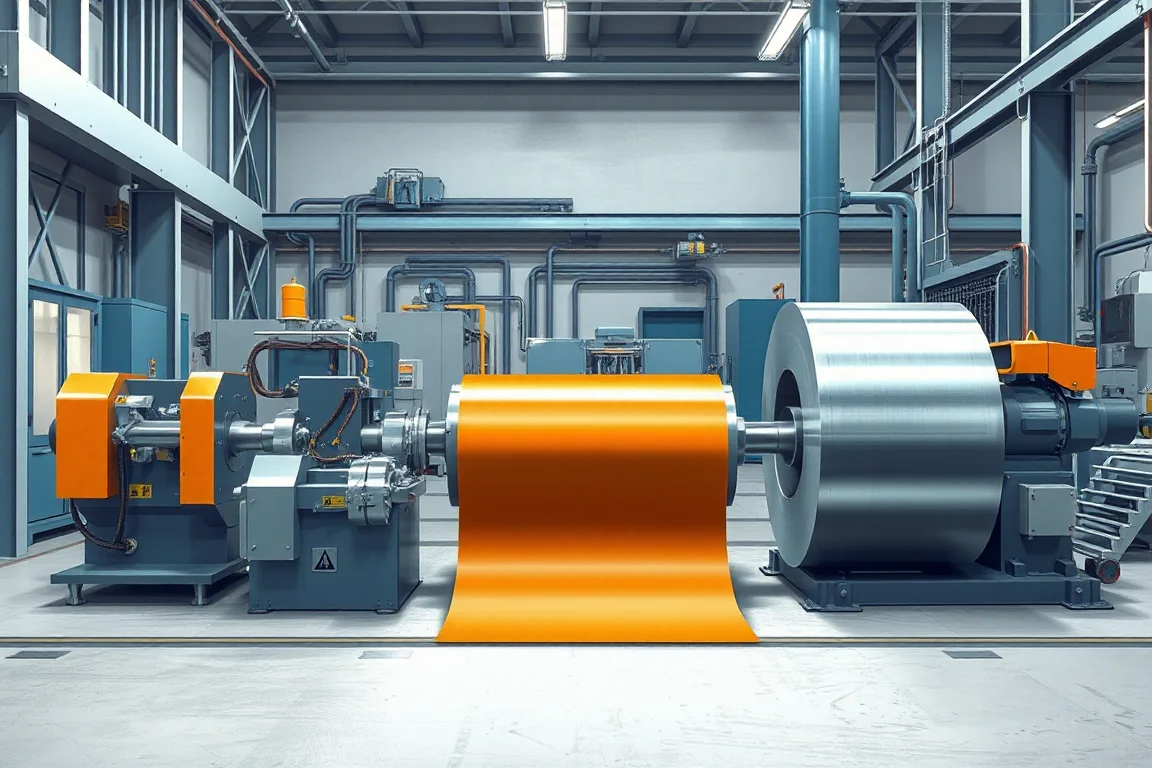
What the high speed designation actually measures
In coil slitting, speed is not a single property of the machine. It is an outcome of the material being processed, the slit pattern being produced, the tension being maintained and the coil handling that precedes and follows the slitter. A line may run a narrow, soft strip pattern quickly and slow considerably when processing a wide, higher-strength coil into many narrow strands, because each additional strand multiplies the demands on separation, tension and recoiling.
For a high speed steel coil slitting line, the relevant comparison is accepted output over a full coil: from loading the coil, threading the strip, slitting, separating scrap, recoiling the finished strips, removing them and preparing for the next coil. A brief no-load speed display does not describe this cycle. Buyers should request a production evaluation that uses the intended material and slit pattern and reports output across a complete coil-handling sequence, including setup and removal time.
Component interfaces from uncoiler to recoiler
A slitting line is a sequence of interfaces, each of which can constrain the others. The uncoiler or payoff holds the incoming coil and pays off strip. The strip then passes through a leveler or straightener that addresses coil set and crossbow. Entry guides and a side trimmer or edge preparation stage may follow. The slitter itself carries the knife arbors and tooling that determine slit width and edge condition. After slitting, a scrap winder or chopper handles the trimmed edge. A tension section, often a bridle or a pad, controls strip tension into the recoiler. The recoiler winds each strip into a finished coil, and a coil car or turnstile removes it.
Every interface carries a requirement: surface-sensitive material may need non-marking rolls and careful strip support; multiple narrow strips may need separation discs or a strand separator to prevent interleaving; heavier coils may require a mandrel and bearing arrangement matched to the coil mass and inside diameter. The layout should show which of these operations are physically included, because a slitting line without adequate tension or scrap handling is not a complete production route.
Coil data and slit pattern as the starting point
Selection begins with the incoming coil: width, thickness, mass, inside diameter, outside diameter, grade and surface condition. These are not optional background details. They determine whether a payoff mandrel can accept the coil, whether the slitter arbor length and knife diameter can reach across the width, whether the recoiler can pull the strip at the required tension, and whether handling equipment can move the finished coils safely.
The slit pattern adds further constraints. A pattern that produces many narrow strands places more knives on the arbor, more edges to separate and more individual recoiled coils to remove. A pattern with fewer, wider strips is generally more tolerant of tension variation. The required strip width and edge quality should be stated explicitly, because slitting to width is a different objective from trimming an edge or cutting to length.
Production routes: slitting, cut-to-length and leveling are not interchangeable
Coil processing covers several distinct outputs. Slitting creates narrower strips from a wider coil. Cut-to-length creates flat sheets of a defined length. Leveling changes flatness and removes coil set but does not necessarily change width or length. A decoiler and feeder may feed a press rather than produce a finished coil.
A high speed steel coil slitting line belongs to the slitting route: payoff, slitting, tension control, recoiling and handling. A blanking line or cut-to-length line is a different route with different inspection criteria. Buyers should not assume that a line advertised for high speed slitting will also deliver sheet length and squareness, because those functions require different cutoff and stacking equipment. If both strip and sheet are needed, the production route should show how the changeover is accomplished and what equipment is added or removed.
Where assembly ends and application performance begins
The line is assembled from mechanical, electrical and control subsystems. Assembly covers the physical arrangement of uncoiler, slitter, tension section, recoiler and handling equipment, together with the drives, controls and safety provisions that link them. This is distinct from production performance, which depends on the specific material, slit pattern and operating cycle.
A line can be assembled correctly and still underperform on a particular application if the tension range, knife setup or recoiling geometry is not suited to the material. Conversely, a well-matched line can produce acceptable strip even if individual components are not the highest specification available. The practical boundary is this: assembly and commissioning confirm that the equipment functions as arranged, while application trials confirm that the intended material and pattern can be processed to the agreed quality and output.
Why tension control and scrap handling dominate quality
Tension control determines whether the slit strips wind tightly and evenly, whether camber is held within acceptable limits and whether the recoiled coil is stable for later handling. If tension is too low, strips may telescope or interleave; if it is uneven across the width, some strands may be tighter than others, causing wavy edges or uneven coil diameter. The tension system should be evaluated as part of the line, not as an isolated component.
Scrap handling is equally important. Edge trim and rejected material must be removed continuously so that it does not wrap around an arbor, jam the slitter or contaminate the finished strips. The scrap route should be defined for the intended slit pattern: a chopper, a winder or another arrangement may be appropriate depending on the material and the volume of trim.
Inspection and acceptance for slitting
For a slitting line, acceptance should focus on width, edge burr and recoiling quality. Width should be measured against the required strip dimension, with a clear method for distinguishing incoming coil width variation from process-induced variation. Edge burr should be assessed for the intended use, because different downstream operations tolerate different edge conditions. Recoiling quality includes coil tightness, edge alignment and freedom from interleaving.
Incoming coil defects such as rust, scratches, edge damage or thickness variation should be identified before processing so that they are not attributed to the slitting line. The acceptance plan should state how these pre-existing conditions are separated from defects introduced by slitting, leveling or recoiling. Surface quality should be included in the trial, especially for material that will be visible or coated later.
Alternatives to a dedicated high speed slitting line
A dedicated high speed slitting line is one option among several. A conventional slitting line with a lower operating rate may be adequate when the required output is modest and changeover flexibility matters more than continuous throughput. A cut-to-length line produces sheets rather than strips and is appropriate when the downstream operation needs flat blanks. A service center or toll processor may be more economical when volumes are low or the slit pattern changes frequently, because the buyer avoids capital and maintenance costs.
The comparison should consider the full production route, not just the slitting head. A dedicated line may offer better control over tension, scrap handling and recoiling for a consistent product mix. A shared or outsourced route may offer lower capital exposure and easier changes. The decision depends on annual volume, pattern stability, surface requirements and the cost of handling finished coils.
Practical checklist before approving a line
- Confirm that the intended coil width, thickness, mass and inside/outside diameter are within the arrangement described by the supplier, without treating any published figure as a verified capacity for your material.
- Review a layout that shows uncoiler, leveler or straightener, slitter, scrap handling, tension section, recoiler and coil removal as a connected sequence.
- Define the slit pattern and the required strip width, edge condition and recoiling quality in writing.
- Agree in advance how incoming coil defects will be distinguished from process-induced defects.
- Ask for a production trial using the intended material and pattern, with first-off pieces and a steady-production sample inspected with agreed gauges.
- Record changeover steps, setup scrap and the time required to load, thread, slit, recoil and remove a full coil.
- Compare the written equipment scope with any secondary operations needed to deliver a finished part.
- Confirm the electrical supply requirements for the intended installation, including voltage, frequency and phase.
FAQ
Is a high speed slitting line defined by its maximum strip speed?
No. Maximum strip speed is only one indication and is often measured under favorable conditions. The meaningful measure is accepted output over a full coil cycle, including loading, threading, slitting, recoiling and removal. Buyers should ask for that cycle to be evaluated with the intended material and slit pattern.
Why is the slit pattern important when comparing lines?
A pattern with many narrow strands places more knives on the arbor and creates more individual strips to separate, tension and recoil. That pattern generally requires more careful tension control and handling than a pattern with fewer, wider strips. Two lines may perform very differently on the same material simply because the slit pattern differs.
How should edge burr be assessed?
Edge burr should be assessed against the requirements of the downstream operation. Some uses tolerate a modest burr; others require a cleaner edge. The assessment should use a defined method and a representative sample, and it should note whether the burr is consistent along the strip and across all slit strands.
What is the difference between a slitting line and a cut-to-length line?
A slitting line produces narrower strips from a wider coil. A cut-to-length line produces flat sheets of a specified length. Leveling may be included in either route, but it changes flatness rather than width or length. The inspection criteria and the equipment arrangement are different, so the two should not be treated as interchangeable.
Can a single line produce both slit strips and cut sheets?
Some arrangements combine functions, but the changeover and added equipment must be clearly described. The production route should show how the line is reconfigured, what is removed or added, and how quality is maintained in each mode. Without that detail, a combined claim is difficult to evaluate.
How should incoming coil defects be handled during acceptance?
Incoming defects such as rust, scratches, edge damage or thickness variation should be documented before processing. The acceptance plan should state how these are distinguished from defects introduced by slitting, leveling or recoiling. If the distinction is not defined, disagreements about quality can arise without a clear basis for resolution.
What role does scrap handling play in line performance?
Scrap handling removes edge trim and rejected material continuously. If it is inadequate, trim can wrap around an arbor, jam the slitter or contaminate the finished strips. The scrap route should be matched to the intended slit pattern and material, and it should be included in the production evaluation rather than treated as an accessory.

Continue your research
- Coil Processing & Auxiliary Equipment
- Steel Coil Slitting Line
- Cut To Length Line
- Narrow Strip Steel Coil Slitting Line
- Heavy Gauge Steel Coil Slitting Line
- Steel Coil Blanking Line
- How Coil processing line Works
- How To Choose a Coil processing line
- Coil processing line Price: What Affects the Cost?
Configuration & specification inputs
Match the configuration to your section drawing, material and production requirements.
| Parameter | Requirement / confirmation needed |
|---|---|
| Profile geometry | High speed is meaningful only for a defined material, slit pattern and coil-handling cycle. Compare accepted output over a full coil, not a brief speed display. |
| Material | Defined coil grades and surface conditions within a verified capacity envelope |
| Thickness & grade | Buyer to specify base-metal thickness and grade; operating range requires supplier verification. |
| Process route | Safe coil loading → payoff → leveling or slitting → length control/recoiling → handling |
| Cutting | Confirm profile-supported cutoff, cut lengths, end quality and any secondary operations. |
| Output | Define accepted output per shift with the actual profile and material. |
| Electrical supply | Buyer to state voltage / frequency / phase. Installed power requires a confirmed equipment schedule. |
| Acceptance | Review tension control, scrap handling, recoiling and coil removal as a system. Include surface quality and edge acceptance in the trial. Do not compare lines using no-load or unusually favorable conditions alone. |