
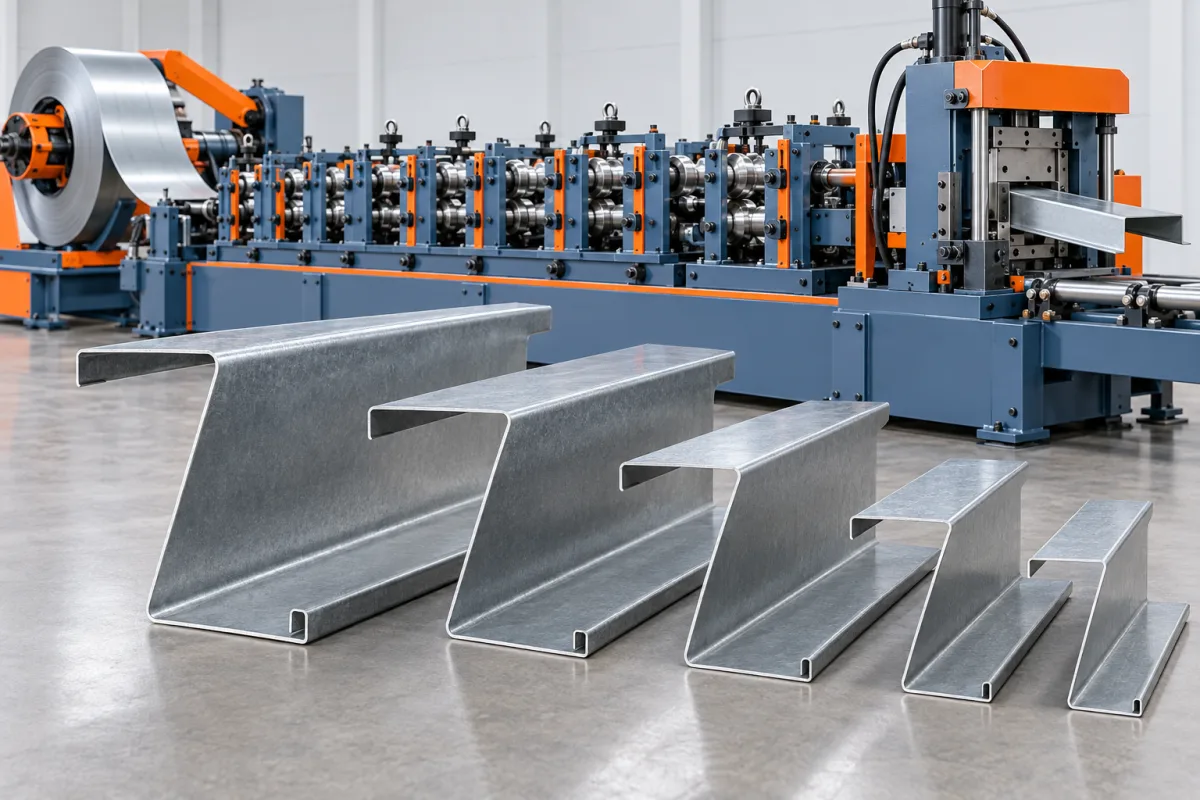
A quick change Z purlin roll forming machine supports transitions between approved Z-section members while preserving their opposite-facing flange geometry and connection features. The useful changeover result is a correctly formed, correctly punched member that fits the specified purlin system. Moving the web setting quickly is only part of that result.
Z products deserve a dedicated review because flange proportions, handedness and lapping arrangements can be important to assembly. A generic symmetrical sketch does not describe every Z member. The machine should be evaluated against the actual product drawings and order sequence.
What must the Z-section matrix contain?
List web depth, both flange dimensions, lips, radii and material combinations. Identify whether flanges differ and how the product is oriented in its intended assembly. Include any special returns or nonstandard connection features.
Keep each section tied to an approved drawing revision. When a business sells several closely related Z members, informal names can make it difficult to distinguish variants at the machine and in finished bundles.
Why does lapping or nesting need its own check?
Where the purlin system uses lapped Z members, the mating geometry must fit as designed. Flange proportions, lip clearance and connection holes all contribute. Do not assume that any two Z shapes nest simply because their nominal web depths match.
Use representative mating members in the trial and inspect the assembled relationship. Record any forcing or local alteration needed to make them fit. Manufacturing acceptance should reproduce the intended connection rather than rely on improvised correction.
How should quick change be specified?
Separate adjustments to web depth, flanges and lips from changes in hole patterns or material. Ask which tasks are automatic, which are manual and which need exchanged parts. Guides and cutoff support belong in the list alongside the forming tools.
Measure from the last accepted old Z member to the first accepted new one. Include verification of handedness, hole positions and any lapping interface. This captures the practical transition instead of a partial tooling demonstration.
How does the production route establish orientation?
Coil preparation, punching and forming need a consistent relationship to the finished member drawing. As the strip becomes a Z, features must remain associated with the correct web and flange references. The production record should make this orientation unambiguous.
After cutting, identification should distinguish the intended product and order. This is especially important where similar members have different hole patterns or asymmetric flanges. A correct section without reliable identity can still cause assembly errors.
What material combinations should be reviewed?
Pair grade, base-metal thickness and coating with each section. The forming result can change with material properties, so the same nominal size should not be treated as one universal setup across unspecified coil supplies.
Trial representative demanding combinations and keep material identification with measurements. Confirm incoming-strip requirements. That gives production a reference for separating a tool or recipe problem from variation in the feedstock.
How should holes and cut ends be inspected?
Measure features from the finished member datums and cut ends. Where holes connect lapped members or cleats, use the relevant mating reference. Check that a size change has not shifted the connection relationship while preserving an apparently correct section.
Inspect local end flare, flange distortion and burr condition. Measure both near the ends and at an interior section. The comparison helps distinguish cutoff effects from a general forming deviation.
What handling issues accompany mixed Z orders?
Z members can nest in particular ways depending on the section, but packaging should follow the approved product geometry. Define bundle supports and restraints so lips and flanges are not bent. Test actual stacking arrangements rather than assuming all variants behave alike.
For frequent small batches, agree how bundles are separated and labeled. The fastest size change is not useful if two nearly identical orders become mixed downstream. Include this order-control step in the production trial.
How should the complete change system be accepted?
- Approve the Z-section, material and connection matrix.
- Select representative changes from the real order book.
- Record every adjustment and exchanged component.
- Inspect section, orientation, holes and cut ends.
- Check required lapping or mating relationships.
- Verify identification and normal stacking.
- Measure accepted output and startup scrap across the schedule.
Structural design remains separate from manufacturing acceptance. A well-made Z section does not establish its allowable span or connection capacity without the relevant design for the purlin system.
Frequently asked questions
Are both Z flanges always the same width?
No. Follow the actual section drawing. Some systems use unequal flanges or other details to achieve their intended assembly, and the machine must reproduce those dimensions.
Can every Z purlin be lapped?
Do not assume that. Lip shape, flange proportions and the system design determine the intended connection. Check representative members and the approved lap detail.
Does quick change include punching?
Only if the equipment scope says so. Punch positions, programs or tools may need separate changes. Include them when measuring first-good-member recovery.
Can the same line produce C members?
That requires an explicit C/Z conversion capability and review of both section families. A variable-size Z line is not automatically a combined CZ machine.
What should a buyer send for comparison?
Provide the complete Z matrix, lapping or connection details, materials, hole patterns and batch sequence. Add bundle requirements so proposals address the full accepted-order route.
Keep the connection in the changeover test
Z-purlin flexibility is useful when the next member emerges with the correct geometry, orientation and connection features. Testing those together makes quick change a measurable production benefit rather than a broad sales description.

Continue your research
- Purlin Roll Forming Machines
- C Purlin Roll Forming Machine
- Z Purlin Roll Forming Machine
- 80-300mm CZ Purlin Roll Forming Machine
- 100-400mm CZ Purlin Roll Forming Machine
- Automatic Size Change CZ Purlin Machine
- How Purlin roll forming machine Works
- How To Choose a Purlin roll forming machine
- Purlin roll forming machine Price: What Affects the Cost?
Configuration & specification inputs
Match the configuration to your section drawing, material and production requirements.
| Parameter | Requirement / confirmation needed |
|---|---|
| Profile geometry | Approved Z matrix with opposite-facing flanges, any asymmetry, lips and lapping references. |
| Material | Specified steel grade and coating assigned to each Z-section drawing. |
| Thickness & grade | Reviewed thickness, grade and strip-width combinations across the required variants. |
| Process route | Registered punching, Z forming, complete size-change tasks, cutting and identified bundle transfer. |
| Cutting | Member lengths and end quality preserving the specified Z connection relationships. |
| Output | Accepted Z orders including mating checks, manual change tasks and startup scrap. |
| Electrical supply | Site supply and auxiliaries for the defined Z forming and feature-making route. |
| Acceptance | Flange proportions, orientation, holes, local end condition, required lap fit and packaging identity. |