
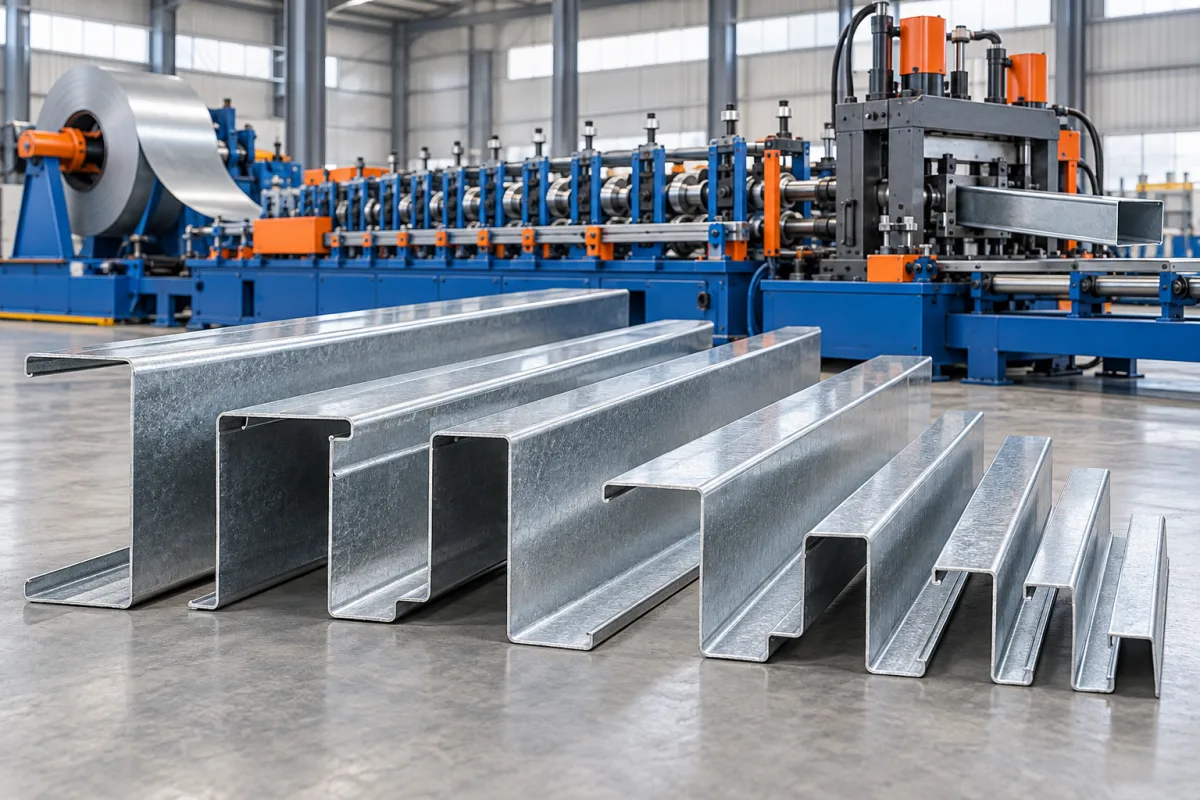
A 100–400 mm CZ purlin roll forming machine enquiry describes a relatively broad requested web-depth family for C and Z members. The range must be converted into actual section drawings and material combinations before equipment can be compared. A 400 mm web requirement says nothing by itself about flange width, lip shape, thickness or punching duty.
The key purchasing question is whether one proposed route can make the required large and small sections with acceptable changeover, straightness and connection accuracy. This calls for a production matrix and representative trials rather than a single demonstration near the middle of the range.
How should the requested range be defined?
Identify web-depth measurement datums and list the actual sizes to be sold. For every size, state C or Z shape, flange dimensions, lips, bend radii and material. Include unequal Z flanges or special returns where the purlin system requires them.
Distinguish a desired range from an approved machine envelope. The supplier should confirm each relevant combination, especially large webs paired with demanding material or wide flanges. Independent maximum values should not be combined without review.
What additional questions arise at the larger end?
A deeper section changes the developed strip width and the physical envelope moving through forming, cutting and discharge. Coil handling, guides, tool clearances and finished-member support should be reviewed with the actual largest section.
Inspection also needs appropriate supports and datums. A long deep member measured while poorly supported can give misleading results. Define how straightness, twist and cross-section dimensions will be assessed for both large and small products.
How should C and Z conversion be specified?
The C section's flanges extend to the same side of the web; the Z section's extend to opposite sides. The conversion must reproduce the intended flanges and lips, not only reverse one visible bend. Punching and cutting references may need to change too.
Ask for a task list showing automatic movements, manual adjustments and exchanged tools. Include guide settings, punch programs, cutoff parts and final inspection. This gives a realistic basis for comparing a combined CZ arrangement with separate dedicated lines.
Which material cases should be demonstrated?
Pair grade and base-metal thickness with each target section. Coating and incoming-strip condition should be identified. A successful trial using the easiest material at the largest web does not establish every other combination in the catalogue.
Select trials representing normal demand and the difficult corners of the proposed matrix. Keep material certificates or identification with the results, and record the agreed incoming-strip requirements. That provides a usable reference for future production variation.
How should punching relate to the formed member?
Define web and flange features from finished-section datums and cut ends. Identify hole sizes, slot directions, patterns and any special connection requirements. The proposed equipment should show how those features remain registered when sizes change.
Trial actual connection patterns and mating references. Avoid approving a broad purlin line using only blank members if normal orders contain many holes. Feature operations can govern both production rate and first-good-part recovery.
What does cutoff need to preserve?
Check end squareness, local flare and distortion in the web, flanges and lips. The chosen cutting sequence and support should work for the complete approved range. A tool arrangement suitable for one section may need changes for another.
Include short members as well as long structural pieces. Their transfer and support behavior can differ. Inspect dimensions near the cut ends and farther along the member to distinguish local cutting effects from general forming condition.
How should the layout and stacking be reviewed?
Map coil loading, strip entry, tool access, finished lengths and bundle movement. The largest purlin envelope and longest order should fit the planned handling route. Leave equipment-access and safety arrangements to the approved installation design.
For mixed C and Z orders, define identification and bundle separation. Nesting behavior can differ between sections, particularly where flanges are unequal or special lips are used. Test the intended packaging rather than assuming all members stack alike.
What makes the trial representative?
- Approve the full 100–400 request matrix and selected trial cases.
- Run actual material and connection patterns.
- Measure web, flanges, lips, angles and hole positions.
- Assess straightness, twist and cut-end condition.
- Demonstrate C/Z conversion and meaningful size changes.
- Verify member identification and stacking.
- Record accepted output, changeover work and startup scrap.
Use accepted members from the agreed order schedule as the output measure. Isolated forming speed does not capture punching density, cutting frequency or the time needed to recover a new section.
Frequently asked questions
Does the range guarantee every intermediate size?
No. The actual approved matrix should identify supported dimensions and combinations. A nominal web range is not a substitute for a complete section and material schedule.
Can the maximum thickness be used at 400 mm?
Only if that particular grade, width and profile combination is confirmed. Separate maximum values should not be combined into an assumed machine capability.
Why test a smaller section on a large-range line?
Small sections can present different clearance, lip-forming and handling conditions. Demonstrating the largest member alone does not establish the quality of the entire requested family.
Are all Z purlins nestable?
Use the actual purlin-system geometry and lap detail. Flange proportions and lip designs can change nesting behavior, so it should be checked with representative members.
What should the supplier quotation include?
Include the section matrix, material combinations, hole patterns, cut lengths and changeover sequence. Specify coil handling, discharge and bundle requirements so the proposal covers a complete production route.
Review the range as combinations, not isolated limits
The 100–400 mm CZ project becomes manageable when every needed member is linked to material, tooling and connection features. That approach produces a testable specification and avoids confusing a broad catalogue range with verified production capability.

Continue your research
- Purlin Roll Forming Machines
- C Purlin Roll Forming Machine
- Z Purlin Roll Forming Machine
- 80-300mm CZ Purlin Roll Forming Machine
- Automatic Size Change CZ Purlin Machine
- Quick Change C Purlin Roll Forming Machine
- How Purlin roll forming machine Works
- How To Choose a Purlin roll forming machine
- Purlin roll forming machine Price: What Affects the Cost?
Configuration & specification inputs
Match the configuration to your section drawing, material and production requirements.
| Parameter | Requirement / confirmation needed |
|---|---|
| Profile geometry | Requested 100–400 mm web family with independently approved C/Z flanges, lips and connection geometry. |
| Material | Specified purlin steel grades and coatings paired with each target section. |
| Thickness & grade | Per-section thickness and strength combinations, including demanding large-web cases. |
| Process route | Coil preparation, registered features, C/Z forming, supported cutting and identified discharge. |
| Cutting | Approved lengths with controlled end flare, squareness and hole-to-end relationships. |
| Output | Accepted punched members across the agreed large-and-small order schedule. |
| Electrical supply | Utilities for the full coil, punching, forming, cutoff and bundle-handling route. |
| Acceptance | Section dimensions, features, straightness, twist, nesting where required and first-good-member recovery. |