
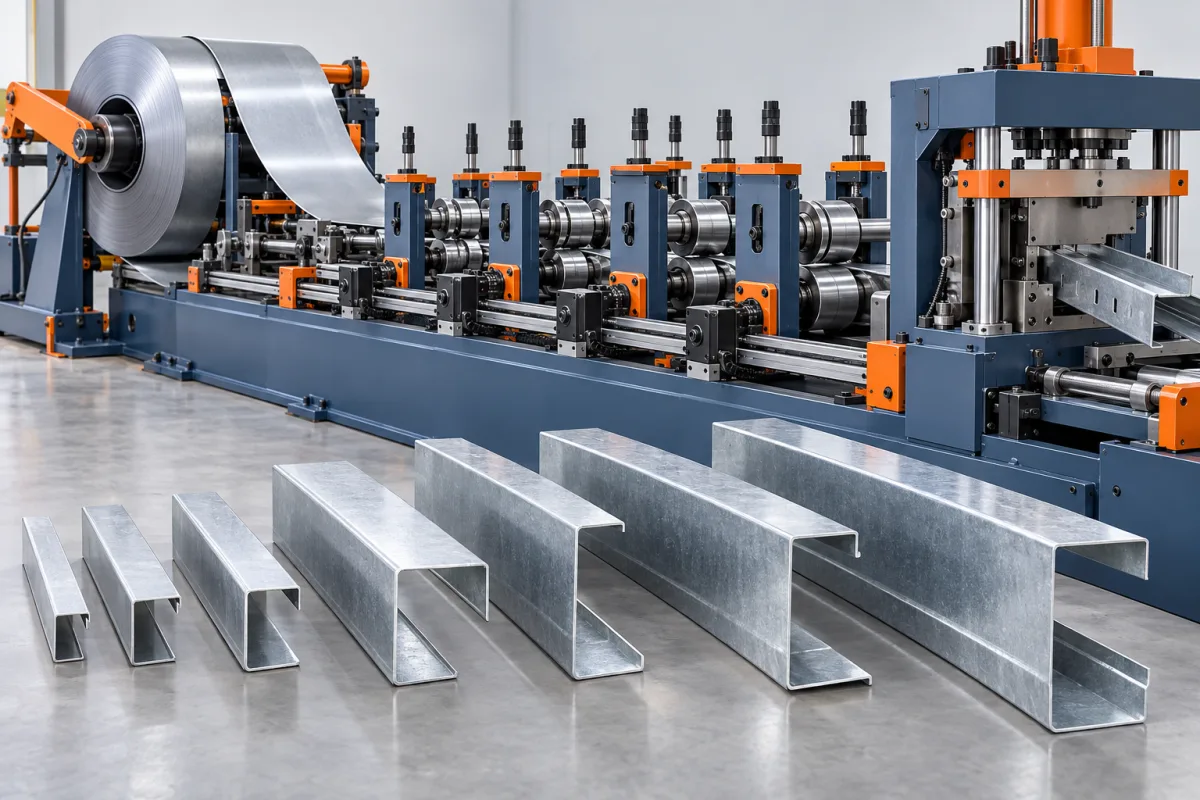
An automatic size change CZ purlin machine is intended to reduce the work involved in moving between approved C and Z section orders. Its value is not the movement of the forming stands alone. The complete change includes section dimensions, feature positions, cutting support, material setup and confirmation that the first new member is acceptable.
For a business with many short purlin orders, that transition can be as important as steady production speed. The buying brief should therefore describe the actual order sequence and define what automatic means for every operation in the proposed route.
Which changes need to be automated?
List web-depth changes, flange or lip changes, C-to-Z conversion and hole-pattern changes separately. A machine may automate some of them while others require manual adjustments or replacement tools. Ask for an explicit operation matrix.
Include tasks outside the main mill: coil width changes, punch-tool exchange, guide setting, cutoff changes and discharge setup. If these remain manual, they still affect the total transition time and should appear in the comparison.
How should a purlin product recipe be defined?
A useful recipe identifies the controlled section, material, hole program and cut schedule. It should refer to an approved drawing revision rather than an informal product nickname. Operators need to know which physical tools and coil correspond to the selected program.
Recipe storage does not replace first-piece inspection. After a size change, verify the section and connection features using the agreed method. A correct program selection cannot compensate for the wrong coil, tooling or material condition.
What does C-to-Z conversion add?
The change affects the relative direction of the flanges and may alter the required lip or flange relationships. Where the Z product has unequal flanges for its intended assembly, that geometry needs its own approved reference.
Confirm how punching datums and member orientation are managed after conversion. The production system should preserve a clear relationship between the drawing, finished part identification and the position of holes or slots.
How can changeover time be measured fairly?
Start at the last accepted member of the old order and stop at the first accepted member of the new order. Include all required physical changes, program selection, trial pieces and inspection. Record any excluded coil change separately rather than letting it disappear from the result.
Use more than one transition. A small web adjustment within one C family may be easy, while a C-to-Z conversion with new punching and different material can be more demanding. The trial should reflect the transitions that occur in normal business.
How should punching follow size changes?
Define hole positions from final member datums and cut ends. The equipment proposal should explain which punch positions adjust, which tools change and how feature programs are selected. Verify the resulting holes in the formed member, not only on a flat setup strip.
Include a connection-fit check where practical. A section can meet web and flange dimensions while holes are displaced relative to the intended cleat or lap. Size-change acceptance should cover both geometry and assembly features.
What role does material variation play?
Pair each recipe with the approved grade, thickness and strip width. Different material behavior can affect the recovered section after an automated movement. The proposal should identify the allowed production envelope and the checks needed when material changes.
Do not ask automation to hide an undefined input specification. Agree coil requirements and retain material identification during trials. This makes it possible to distinguish a recipe issue from a change in incoming strip.
How should mixed orders be discharged and identified?
Frequent automatic changes increase the importance of clear member identification. Define labels or marks, bundle grouping and the point where a new order begins. Finished pieces should remain associated with their drawing and hole program.
Check that discharge supports and stacking arrangements accommodate the next section. A fast mill change is of limited value if the takeoff requires extensive unplanned rearrangement or mixes two similar products in one bundle.
What should the acceptance sequence contain?
- Choose a representative mixed-order schedule.
- Record the tools, coils and recipes required for each order.
- Measure complete transitions to first accepted members.
- Inspect section, holes, cut ends and straightness.
- Verify C/Z orientation and member identification.
- Record startup scrap and manual interventions.
- Calculate accepted output for the whole schedule.
This creates a useful comparison between automation packages. It also reveals whether the proposed savings come from stand movement, feature positioning, better order control or a combination of functions.
Frequently asked questions
Does automatic size change mean no operator work?
No. The scope depends on the equipment. Coil handling, tool exchange and inspection may remain manual even when the main section dimensions move automatically.
Should every saved recipe be accepted without checks?
No. Confirm the correct material and tools, then perform the agreed first-piece checks. A saved setup is a controlled starting point, not proof that every input condition is unchanged.
Can one quoted changeover time cover all transitions?
Only if the included tasks and transition are clearly defined. Compare several representative changes, especially those involving C/Z conversion, punching changes or different material.
Why include startup scrap in the comparison?
A fast mechanical movement can still consume material before acceptable production resumes. Recording both time and rejected starts gives a more complete view of the changeover result.
What should a buyer provide first?
Provide the section matrix and a realistic sequence of orders, including material, holes and lengths. That lets suppliers propose automation around actual transitions rather than a generic size range.
Buy first-good-member recovery, not movement alone
The useful outcome of automatic changeover is a correctly identified, dimensionally acceptable purlin ready for its order. Specify and test that outcome across representative transitions to understand the real value of the system.

Continue your research
- Purlin Roll Forming Machines
- C Purlin Roll Forming Machine
- Z Purlin Roll Forming Machine
- 80-300mm CZ Purlin Roll Forming Machine
- 100-400mm CZ Purlin Roll Forming Machine
- Quick Change C Purlin Roll Forming Machine
- How Purlin roll forming machine Works
- How To Choose a Purlin roll forming machine
- Purlin roll forming machine Price: What Affects the Cost?
Configuration & specification inputs
Match the configuration to your section drawing, material and production requirements.
| Parameter | Requirement / confirmation needed |
|---|---|
| Profile geometry | Approved C/Z recipes linking section dimensions, material, feature program and drawing revision. |
| Material | Recipe-specific steel grade, coating and traceable incoming strip. |
| Thickness & grade | Thickness and strip-width combinations assigned to each approved product recipe. |
| Process route | Controlled order selection, defined automatic and manual changes, feature making, forming and identification. |
| Cutting | Cutoff setup and end-feature registration recovered and verified after each relevant transition. |
| Output | Accepted mixed-order members with full last-good to first-good transitions and startup scrap recorded. |
| Electrical supply | Supply and auxiliaries for automated positioning plus the complete purlin process. |
| Acceptance | Section and holes after changes, C/Z orientation, connection fit, member identity and repeatable recipe recovery. |