
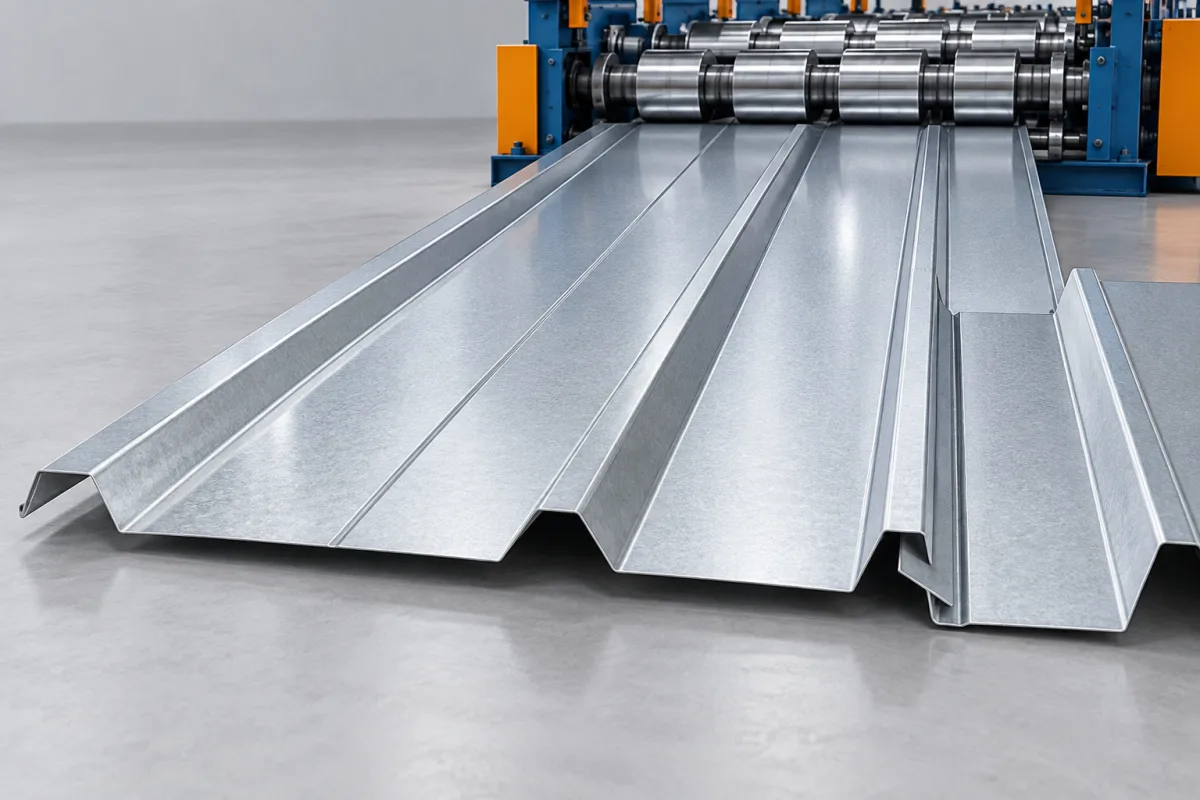
A 1000 trapezoidal roofing sheet machine forms a specified trapezoidal section associated with a 1000 profile designation. The first step is to confirm whether this means 1000 mm effective cover in the intended product drawing. A metre-wide installed contribution is useful for order planning, but it does not define the complete sheet geometry or the required input-coil width.
For a producer considering wider roof coverage, the equipment decision should connect the section to coil supply, forming tools, discharge space and customer orders. Wider coverage is not a substitute for a correct lap or a handling system that preserves the finished ribs.
What does a 1000 profile drawing need to show?
Define the repeating ribs, flat areas and two terminal edges. Record rib height, pitch, crest width, valley width and any smaller stiffening features. Show the assembled overlap and distinguish physical width from effective cover.
Use explicit dimensions rather than a scaled photograph. Different regional products may use the same nominal number with different rib patterns. The approved tooling drawing should identify one specific section and revision.
How does wider coverage affect the production brief?
The input strip, roll tooling and material-handling envelope must suit the actual developed profile. The coil specification should include strip width together with coil mass and diameters. Do not size handling equipment from installed cover alone.
At discharge, the supports must accommodate the panel width and length without local damage to the ribs or laps. Include access for inspection, stack movement and packaging in the layout. The forming mill's footprint is only part of the floor space needed for useful production.
Is a 1000 panel simply a wider 840 panel?
Not necessarily. The rib count, rib spacing and terminal details may all change. Even where the central pitch is shared, the edge arrangement and developed input width still need review. Compare the actual sections before selecting a common production arrangement.
Ask a supplier to separate adjustable dimensions from changes needing replacement rolls or other tools. A profile-change schedule should include cutoff parts and inspection references, not merely the main forming rolls. That schedule reveals the practical cost of serving two product families.
What happens along the manufacturing route?
Coil handling presents the strip to controlled entry guides. Progressive tools develop the longitudinal ribs and complete the side laps. Length control and the chosen cutting system then produce individual sheets, which move onto suitable supports for inspection and stacking.
Review how the line handles startup and the last portion of a coil. Those pieces may need separate identification or inspection. Include the agreed treatment of startup scrap in output discussions instead of reporting every metre fed as saleable roofing.
How should material combinations be specified?
Pair grade or alloy with base-metal thickness, input width and surface requirements. Coated steel and aluminum should not share an assumed production envelope without review. The nominal panel width does not describe the material's bending behavior.
For appearance-sensitive orders, identify the visible face and any protective layer. Agree the inspection lighting and support condition, then check both formed bends and broad flats. Preserve trial material identification so the approved result can be traced to the coil used.
What determines covered-area output?
When the approved effective cover is exactly 1 m, accepted panel length in metres is numerically equal to nominal covered area in square metres. That is a unit relationship, not a machine performance rating. It applies only to the stated cover and does not include roof openings, end laps or installation waste.
To compare equipment, use a representative order with stated lengths and handling requirements. Record accepted area after cutting and stacking. Frequent short pieces, stack removal and coil changes may influence the result more than a higher steady forming speed.
Which lap and accessory checks are essential?
Assemble several sheets without forcing the overlap and measure the resulting cover. Check the terminal edges near cut ends as well as halfway along the sheet. Fit the intended closure shape and any critical trim reference to the same trial pieces.
If customers expect new sheets to extend an existing roof, include an accepted existing-profile sample in the comparison. A new section can be internally consistent yet still fail to mate with the product already in service.
How should quotation scope and acceptance be linked?
List the equipment responsible for coil loading, entry, forming, cutting, discharge and order handling. Specify any film or marking operation separately. If future profiles are planned, include their tools and changeover requirements as distinct scope items.
- Approve drawing, material matrix and inspection methods.
- Demonstrate representative short and long sheets.
- Measure ribs, edges and assembled coverage.
- Inspect finish and end condition after normal handling.
- Check the agreed accessory interfaces.
- Record accepted output and remaining deviations.
This connects the quoted package to a testable result. A vague complete-line description is less useful than a clear account of which equipment delivers each part of the accepted order.
Frequently asked questions
Does 1000 always mean one-metre cover?
Confirm the supplier's drawing and local naming convention. If it denotes another width, record that explicitly. Never use an ambiguous product label as the only tooling requirement.
Can the same tools change rib height?
Only where the proposed tooling is designed for that change. Rib depth alters the section and potentially its developed width. Request an engineering review rather than treating it as a normal width adjustment.
Will wider panels automatically reduce production cost?
The result depends on material use, accepted output, handling and the order mix. Compare complete production costs and scrap records instead of drawing a conclusion from installed width alone.
What is the most useful trial order?
Use the actual material and a realistic combination of lengths, including handling and stack changes. That reveals whether the complete route suits everyday production rather than one ideal demonstration.
Can this machine also produce ridge caps?
Not unless specific accessory tools and operations are included. Ridge and flashing production should be listed separately so the equipment plan covers the entire roofing package.
Specify a complete wide-panel route
The 1000 panel decision joins profile geometry to coil supply and finished-sheet handling. With those inputs defined, equipment proposals can be compared on accepted coverage, changeover needs and usable order output.

Continue your research
- Roofing Sheet Roll Forming Machines
- Corrugated Roof Sheet Roll Forming Machine
- Trapezoidal Roof Sheet Roll Forming Machine
- R Panel Roll Forming Machine
- PBR Panel Roll Forming Machine
- IBR 686 Roofing Sheet Machine
- How Roofing sheet roll forming machine Works
- How To Choose a Roofing sheet roll forming machine
- Roofing sheet roll forming machine Price: What Affects the Cost?
Configuration & specification inputs
Match the configuration to your section drawing, material and production requirements.
| Parameter | Requirement / confirmation needed |
|---|---|
| Profile geometry | 1000-designated trapezoidal roof section with confirmed effective cover and complete edge drawing. |
| Material | Grade or alloy, coating and surface protection paired with the developed input width. |
| Thickness & grade | Reviewed material-thickness combinations for the specified wide-panel geometry. |
| Process route | Coil handling, guided forming, lap completion, cut-list production and supported discharge. |
| Cutting | Approved lengths and end quality across the full panel width. |
| Output | Accepted covered area for the stated order, calculated from actual effective cover. |
| Electrical supply | Electrical and auxiliary requirements matched to the wide-panel forming and handling arrangement. |
| Acceptance | Rib and edge dimensions, multi-panel cover, existing-profile fit, finish and stacked condition. |