
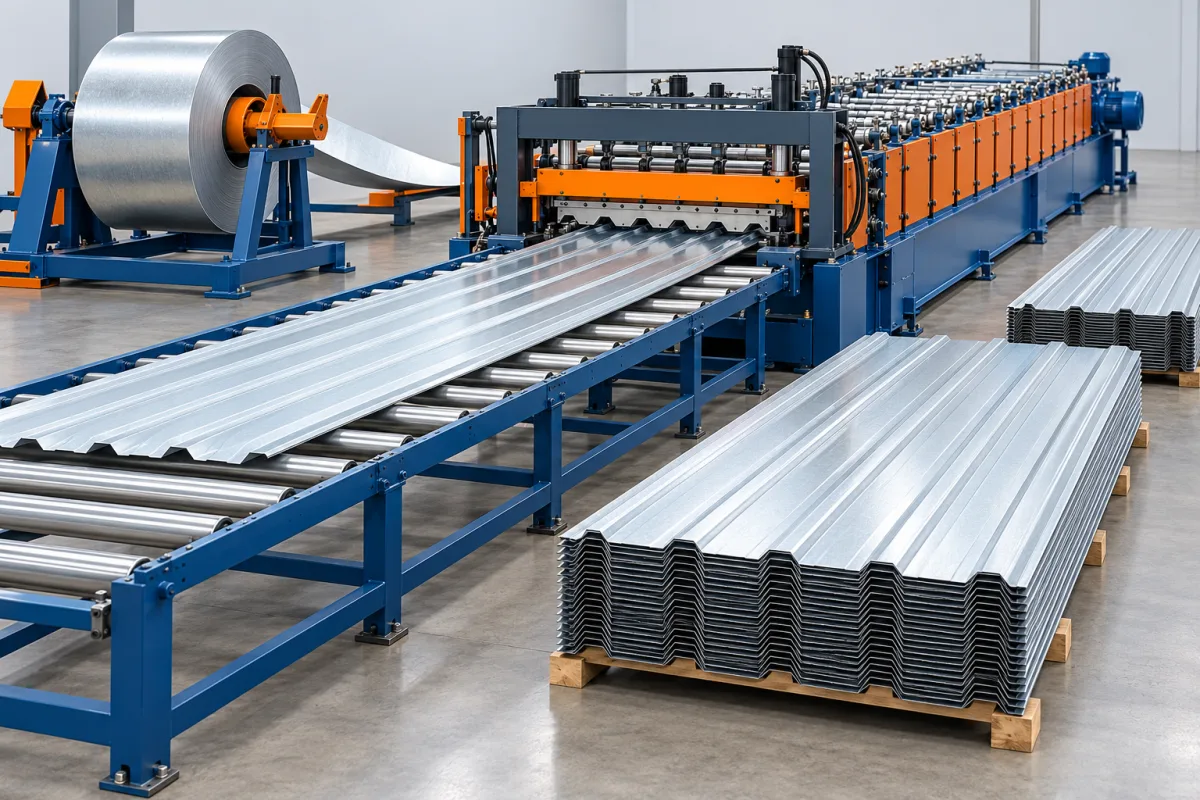
Roofing-sheet production speed should be measured at two levels: how quickly strip moves through the machine, and how many accepted roofing sheets the complete route delivers. The second figure is the one needed for staffing, delivery promises and investment decisions. Cutting, coil changes, profile changes and bundle removal can make two lines with similar forming speeds produce very different daily results.
Choose the output unit before comparing machines
Metres per minute describes linear movement. Sheets per hour depends on sheet length. Square metres of roofing depends on effective cover as well as length. State which unit is being used and keep the conversion visible. Otherwise, a short-sheet demonstration and a long-sheet demonstration can appear comparable when they are not.
Use accepted output, not merely material that passed through the rolls. A sheet rejected for a damaged lap or scratched finish is not available for shipment. Keep gross produced quantity and saleable quantity as separate fields in the production report.
Use a representative roof-order basket
Build a trial order containing the lengths and quantities that resemble your business. Include short pieces if they create frequent cuts, and long sheets if discharge is difficult. If the business changes colors or profiles regularly, those transitions belong in the trial plan or a separate measured changeover study.
A line demonstrated on one convenient length answers only a narrow question. Ask whether the quoted result includes setup, first-off inspection, coil loading and packing. There is no single correct boundary for every study, but the competing proposals must use the same one.
Convert accepted sheets into coverage correctly
Consider an illustrative run of 120 accepted sheets, each 5 metres long and providing 0.85 metre effective cover. Nominal coverage is 120 × 5 × 0.85 = 510 square metres. If the measured production window is 150 minutes, average accepted coverage is 3.4 square metres per minute, or 204 square metres per hour over that window.
These assumed values show the calculation, not a rating. The figure does not represent the net roof area of a particular building, which can involve openings, cuts and installation allowances. It is a production measure based on the profile's installed cover.
Locate where elapsed time is actually spent
Divide the production window into meaningful activities: preparation, forming, cutting interruptions, inspection, coil changes, profile changes, stack removal and unplanned stops. Avoid putting every loss into a single downtime category. Different causes need different improvements.
- Repeated waits at discharge suggest a handling constraint.
- Long first-off approval suggests setup or inspection workflow needs attention.
- Frequent stops for short sheets point toward the actual cutting cycle.
- Coil preparation delays may involve storage and loading rather than forming.
- Rejected starts after every change deserve their own yield investigation.
Cutting frequency changes the relationship with line speed
For the same linear quantity, shorter sheets require more individual cuts. The impact depends on the chosen cutting arrangement and complete operating cycle. Ask for output at your required lengths rather than assuming a quoted strip speed converts directly into finished pieces.
Inspect the resulting ends while studying output. Increasing production at the expense of distorted ribs or damaged laps creates an apparent gain that disappears during quality inspection. A useful demonstration records both the time and the accepted condition of the sheets.
Long panels make discharge part of the process
Long sheets require suitable support and a controlled route into the stack. The layout must accommodate their complete length and the removal of the finished package. If the mill repeatedly waits for takeoff, raising its available speed will not necessarily improve shipped output.
Study the handling sequence without bypassing protective arrangements or increasing manual exposure to moving equipment. Improvements might concern staging, supports, package organization or an appropriately designed handling system. The production objective is repeatable accepted output under the intended safe operating arrangement.
Separate availability, performance and yield
A simple production review can distinguish the time available for work, the rate achieved while running and the share of product accepted. This separation prevents a quality loss from being mistaken for slow equipment or a scheduling gap from being blamed on tooling.
Suppose a planned 400-minute window includes 80 minutes of recorded interruptions, leaving 320 minutes of operation. The time-use ratio is 320 ÷ 400 = 80 percent. That number alone says nothing about speed while operating or accepted yield. Calculate those separately from measured output; do not multiply arbitrary percentages into an impressive capacity claim.
Model an improvement before buying faster equipment
If a study finds 45 minutes per shift waiting for bundles to be removed, first evaluate that constraint. A handling improvement that reliably removes part of the wait may help more than increasing roll speed during periods already running smoothly. Verify the result with a comparable order mix after the change.
Likewise, grouping compatible colors or profiles may reduce setup losses, but only if delivery commitments permit it. Production optimization should not create unwanted inventory simply to make the machine's daily metre count look better.
Create a repeatable acceptance and operating report
Record drawing revision, coil identity, lengths, quantities, effective cover, elapsed time and rejected quantity. Add a short stop log and explain what the clock includes. This makes supplier trials, commissioning and later production studies comparable.
Retain the measurement method when the product mix changes. If one month contains mostly long runs and another contains small mixed orders, their average output should not be compared without that context. The report needs to explain the work performed, not merely show a single number.
Frequently asked output questions
Can I calculate sheets per hour from maximum line speed?
You can calculate a theoretical movement-based figure, but it omits cutting, handling, stops and rejects. Use it only as a clearly labeled theoretical comparison, then measure the complete route on representative lengths.
Why does a wider panel not always improve output?
Greater cover can increase area per sheet, but the profile and handling may differ. Compare accepted coverage over the same time boundary rather than assuming width alone determines productivity.
Should inspection be excluded to show machine performance?
A narrowly defined machine trial can report its own boundary, but production planning must include the inspection needed to release saleable sheets. State both figures if they serve different purposes.
What is the best improvement target for a small shop?
Find the largest measured recurring loss in its actual order mix. It may be coil preparation, first-off approval, short-sheet cutting or packing. Choose the intervention from evidence rather than from a generic preference for faster forming.
Continue your research
- Roofing Sheet Roll Forming Machines
- Corrugated Roof Sheet Roll Forming Machine
- Trapezoidal Roof Sheet Roll Forming Machine
- R Panel Roll Forming Machine
- PBR Panel Roll Forming Machine
- IBR 686 Roofing Sheet Machine
- How Roofing sheet roll forming machine Works
- How To Choose a Roofing sheet roll forming machine
- Roofing sheet roll forming machine Price: What Affects the Cost?