
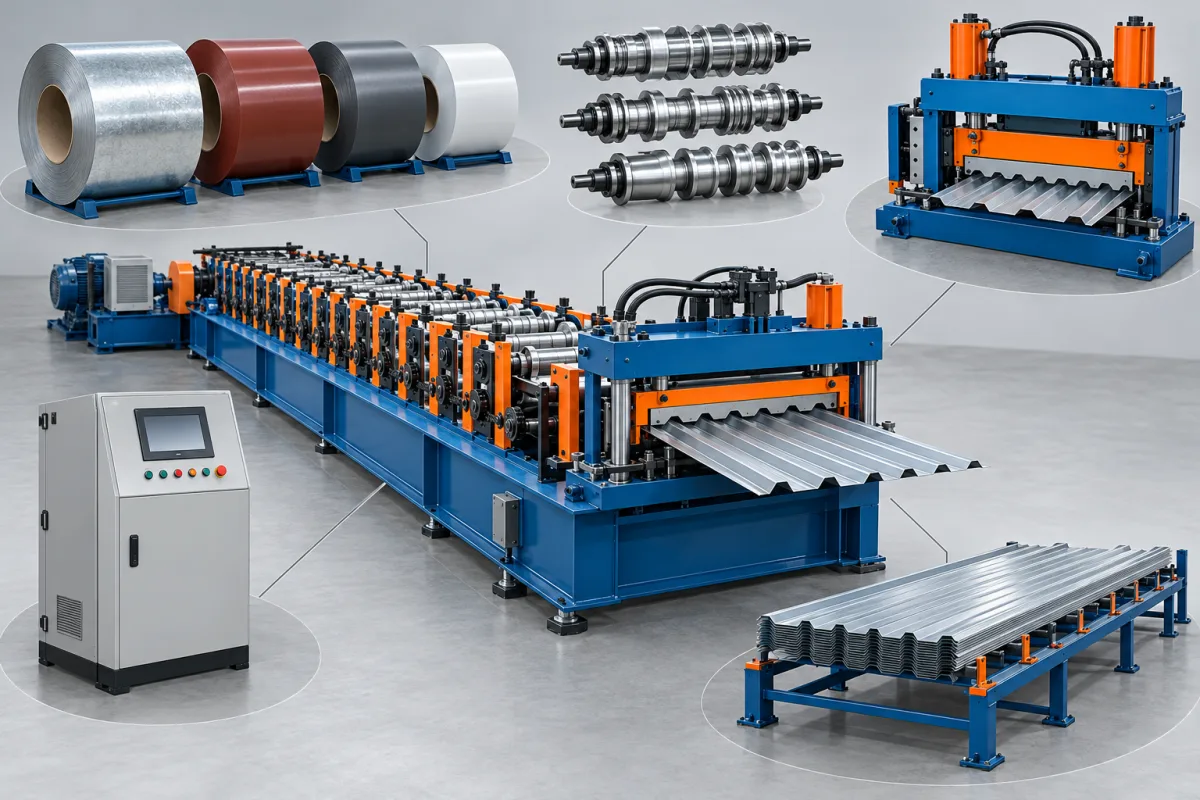
The price of a roofing sheet roll forming machine depends on the roof products and production route included in the quotation. Two offers bearing the same machine name can cover different profiles, coil handling, cutting arrangements and stacking equipment. A useful cost comparison begins by making those boundaries visible rather than trying to identify one universal market price.
Separate purchase price from the installed production project
The former is one asset within a working route. The project can also require coil loading, foundation or floor preparation, utilities, lifting arrangements, discharge supports and commissioning. Allocate responsibility for each item before comparing totals. An omitted item has not become free simply because it is absent from the equipment quotation.
Keep recurring production expenses in a separate model: coil, labor, consumables, energy, maintenance and rejected material. Mixing these into the purchase figure makes it difficult to understand whether a higher initial investment reduces a meaningful operating cost or merely adds capability that the order book will not use.
The approved roof profile determines the tooling scope
List central ribs, terminal laps and the effective cover of each required section. A change to the rib pattern or side lap can affect more than the last forming roll. Ask which tools, guides and cutoff components belong to each product, and which are shared. A profile name alone is not an adequate pricing basis.
Additional profiles introduce both hardware and production planning costs. If a second product represents only a small fraction of orders, compare its incremental margin with the added investment and changeover time. Do not assume that a broad profile catalog automatically produces a better return.
Material capability must be priced as combinations
Present grade, thickness, width and finish together. A proposal for one coated-steel sheet cannot be compared fairly with one covering a wider group of steel and aluminum products. Ask what evidence and trials support the specified combinations, especially where the visible finish is commercially important.
Appearance requirements may introduce protective handling or additional acceptance work. State these requirements explicitly. A low price based on uncoated demonstration stock can be misleading when the business sells exposed painted roofing that must survive forming, cutting and bundling without unacceptable marking.
Cutting and handling can change the economic result
Review cutting configuration with the planned length distribution. Its value depends on the actual order mix and the quality of the cut ends, not just whether it carries a particular automation label. Include the required tools and maintenance responsibilities for each section in the comparison.
Likewise, manual or automated discharge should be evaluated as part of a production route. Long sheets, frequent short orders and finish-sensitive bundles place different demands on takeoff. A faster former is not a profitable upgrade if completed panels wait for removal or suffer damage before packing.
Build a normalized quotation worksheet
Start with one agreed specification and enter every offer against it. Mark items as included, optional, excluded or unresolved. Do not treat an unanswered item as included. Request written clarification before ranking proposals by total price.
- Main profiles, material combinations and representative lengths.
- Coil support, loading equipment and entry accessories.
- Forming tools, change parts and cutoff components.
- Discharge, stacking, protective separation and order identification.
- Transport, installation, trial material, training and acceptance work.
- Utilities, local site work and accessories supplied by the buyer.
Calculate cost per accepted square metre
Use the effective cover of the roof profile, not the flat coil width. An illustrative order of 200 accepted sheets, each 3 metres long with 0.8 metre cover, represents 480 square metres of nominal roofing coverage. If the order consumes 12 labor-hours, the labor requirement is 12 ÷ 480 = 0.025 labor-hour per square metre. These are deliberately assumed planning inputs, not a machine performance claim.
Multiply that requirement by your own loaded labor rate. Add actual material, energy and other measured costs on consistent boundaries. Record rejected sheets and setup material separately; calculating from all strip fed into the machine can conceal a poor saleable yield.
Test an upgrade with a break-even calculation
Suppose an optional handling package costs an additional 30,000 budget units and, using a documented order study, is expected to save 2.5 labor-hours on each of 160 comparable orders annually. At an assumed loaded cost of 20 units per labor-hour, the gross annual labor saving is 8,000 units. A simple payback before maintenance, financing and other effects is 30,000 ÷ 8,000 = 3.75 years.
The arithmetic is reusable; the inputs are not market quotations. Replace every assumption with your own evidence and run a lower-utilization case. Include additional maintenance and any effect on damage or output. Do not count the same saved hour once as labor savings and again as extra production unless the business can actually realize both benefits.
Include changeovers and small orders in the model
A weekly schedule with many colors and short lengths can generate costs that disappear in a long continuous demonstration. Track coil changes, profile changes, first-off approval, rejected starts and packing interruptions. Use time per order as well as time per metre when comparing proposals.
For a second profile, consider whether its orders can be grouped without harming delivery commitments. Scheduling may reduce unnecessary changes more economically than additional hardware. Conversely, persistent simultaneous demand may justify separate equipment even if the purchase price is higher.
Protect the investment with clear acceptance terms
Define the products, trial material, measurement methods and unresolved scope before placing the order. Require the demonstration to include the lengths and configurations that drive the commercial case. A cheap line that cannot produce the approved lap or protect the required finish does not meet the economic brief.
Identify documentation, spare-part references and training as deliverables. Their value is practical: the team needs to recover accepted production and order the right replacement component without depending on undocumented knowledge. Compare these deliverables directly rather than assigning a vague premium to a brand name.
Frequently asked price questions
Why is there no single price for a roof-sheet machine?
The product envelope and included equipment vary substantially. A meaningful quotation needs the section, material and production boundary. An isolated price can describe a different scope from the one your business requires.
Does a lower motor rating mean a cheaper product?
Not by itself. Energy expense depends on actual operation, auxiliary equipment and accepted output. Compare measured consumption on an agreed production trial rather than using one nameplate number as the total operating cost.
Should extra tooling be purchased immediately?
Prioritize confirmed demand and the cost of adding it later. Document what the initial machine supports and what future tooling would require. Buying unused profiles consumes capital; ignoring essential interfaces can make later expansion difficult.
What is the fairest final comparison?
Compare installed scope, accepted product quality, realistic output and lifecycle obligations on the same order mix. Keep the assumptions visible so a different sales volume or staffing cost can be recalculated without rebuilding the entire model.
Continue your research
- Roofing Sheet Roll Forming Machines
- Corrugated Roof Sheet Roll Forming Machine
- Trapezoidal Roof Sheet Roll Forming Machine
- R Panel Roll Forming Machine
- PBR Panel Roll Forming Machine
- IBR 686 Roofing Sheet Machine
- How Roofing sheet roll forming machine Works
- How To Choose a Roofing sheet roll forming machine
- Materials and Thickness for Roofing sheet roll forming machine